Pearson Edexcel · A-Level · English Literature
Course version: 9ET0 · Version from Sept 2015
Poetry – Section B: Specified Poetry Pre- or Post-1900 – Pre-1900 –…
Full specification wording
Component 3: Poetry – Section B: Specified Poetry Pre- or Post-1900 – Pre-1900 – Metaphysical Poetry – John Donne Selected Poems (Penguin Classics, 2006): A Valediction Forbidding Mourning
John Donne’s 'A Valediction Forbidding Mourning' explores the spiritual transcendence of true love over physical separation.
Checked against the Pearson Edexcel 9ET0 specification (opens in a new tab) on .
- Point 16 of 22
- 4 key terms
Study notes
From the checked teaching notes for this specification point.
The idea
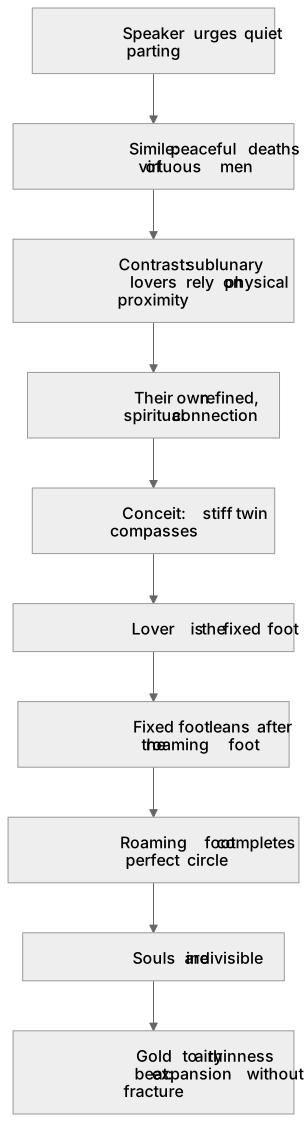
John Donne’s 'A Valediction Forbidding Mourning' explores the spiritual transcendence of true love over physical separation. Written before a journey, the speaker urges his lover to part quietly, comparing their separation to the peaceful deaths of virtuous men. Donne contrasts 'sublunary' lovers, whose affection relies on physical proximity, with their own refined, spiritual connection. The poem culminates in the famous metaphysical conceit of the stiff twin compasses. The lover is the fixed foot, remaining grounded and leaning after the roaming foot, ensuring it completes a perfect circle. This imagery mathematically proves that their souls are indivisible, expanding like 'gold to airy thinness beat' rather than breaking.
What earns the marks
- Analysis of the extended metaphysical conceit of the compass, focusing on interdependence and the perfection of the circle.
- Exploration of the contrast between 'sublunary' (earthly, physical) love and the refined, spiritual love shared by the speaker and his partner.
- Significance of the metallurgical imagery, specifically 'gold to airy thinness beat', representing expansion without fracture.
- Contextual links to Renaissance science, astronomy, and Donne's personal life, particularly his separation from his wife Anne More.
Common mistakes and how to put them right
Claiming the poem is about a literal death.
Put it right: Recognise that death is used as a simile in the opening stanza to describe a peaceful, dignified parting, not an actual demise.
Misinterpreting the compass as a navigational tool.
Put it right: Specify that Donne refers to a mathematical drawing compass, symbolising precision, unity, and the creation of a perfect circle.
Stating the lovers are completely detached from one another.
Put it right: Explain that they are two parts of a single entity, connected spiritually even when physically apart.
Exam tips
- Compare the quiet, dignified tone of this poem with the more dramatic or physical arguments found in Donne's other works.
- Analyse the regular ABAB rhyme scheme and iambic tetrameter as a structural reflection of the lovers' steady, harmonious relationship.
- Use the term 'metaphysical conceit' explicitly when discussing the extended compass metaphor in the final three stanzas.
Try the lesson
The start of the Component 3: Poetry – Section B: Specified Poetry Pre- or Post-1900 – Pre-1900 – Metaphysical Poetry – John Donne Selected Poems (Penguin Classics, 2006): A Valediction Forbidding Mourning lesson, made from checked teaching notes for this specification point.
Have a go first
Which famous metaphysical conceit does John Donne use in "A Valediction Forbidding Mourning" to describe the connection between the two lovers?
Listen
John Donne’s 'A Valediction Forbidding Mourning' explores the spiritual transcendence of true love over physical separation. Written before a journey, the speaker urges his lover to part quietly, comparing their separation to the peaceful deaths of virtuous men. Donne contrasts 'sublunary' lovers, whose affection relies on physical proximity, with their own refined, spiritual connection. The poem culminates in the famous metaphysical conceit of the stiff twin compasses. The lover is the fixed foot, remaining grounded and leaning after the roaming foot, ensuring it completes a perfect circle. This imagery mathematically proves that their souls are indivisible, expanding like 'gold to airy thinness beat' rather than breaking. A strong answer earns marks for these points. Analysis of the extended metaphysical conceit of the compass, focusing on interdependence and the perfection of the circle. Exploration of the contrast between 'sublunary' (earthly, physical) love and the refined, spiritual love shared by the speaker and his partner. Significance of the metallurgical imagery, specifically 'gold to airy thinness beat', representing expansion without fracture. Contextual links to Renaissance science, astronomy, and Donne's personal life, particularly his separation from his wife Anne More. A common slip: Claiming the poem is about a literal death. Instead, Recognise that death is used as a simile in the opening stanza to describe a peaceful, dignified parting, not an actual demise. Exam tip: Compare the quiet, dignified tone of this poem with the more dramatic or physical arguments found in Donne's other works.
See it
Key words
Say what each word means before you turn the card.
Spiritual love
Try answering aloud or in your head before turning the card.
Separation and parting
Try answering aloud or in your head before turning the card.
Metaphysical conceit
Try answering aloud or in your head before turning the card.
Sublunary love
Try answering aloud or in your head before turning the card.
See every definition
- Spiritual love
- A refined connection that transcends physical proximity, contrasted with the affection of sublunary lovers who rely on being physically close.
- Separation and parting
- A journey apart that the speaker urges his lover to endure quietly, compared to the peaceful deaths of virtuous men.
- Metaphysical conceit
- An extended metaphor, such as the stiff twin compasses, used to articulate complex emotional states.
- Sublunary love
- Earthly, physical affection that relies on physical proximity, contrasted with the refined, spiritual love shared by the speaker and his partner.
Label the diagram
Some boxes have lost their names. Pick the right name for each number.
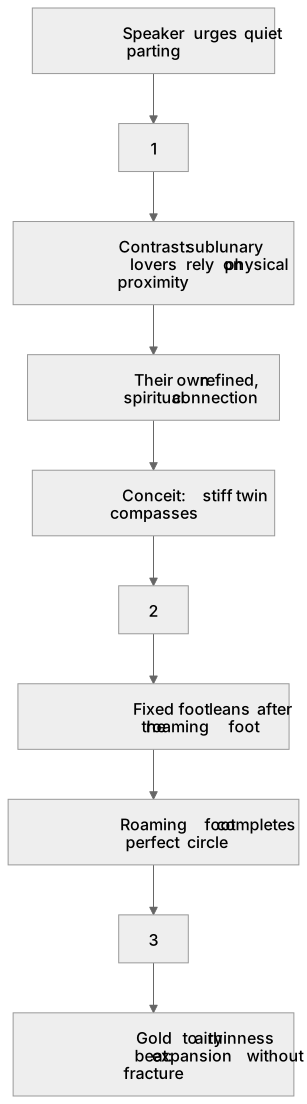
1Box 1
2Box 2
3Box 3
There is more to this lesson
The full lesson goes on to check your understanding and help you earn the marks. Create a free account to carry on, with your progress saved.
A week of Premium from your first lesson · Then the free plan continues · No card, no charge
Test your understanding of Component 3: Poetry – Section B: Specified Poetry Pre- or Post-1900 – Pre-1900 – Metaphysical Poetry – John Donne Selected Poems (Penguin Classics, 2006): A Valediction Forbidding Mourning
Active recall beats re-reading. Take an instant quiz now to test what you’ve learned and lock it into long-term memory.
A week of Premium from your first lesson · Then the free plan continues · No card, no charge