Pearson Edexcel · A-Level · English Literature
Course version: 9ET0 · Version from Sept 2015
Poetry – Section B: Specified Poetry Pre- or Post-1900 – Pre-1900 –…
Full specification wording
Component 3: Poetry – Section B: Specified Poetry Pre- or Post-1900 – Pre-1900 – Metaphysical Poetry – John Donne Selected Poems (Penguin Classics, 2006): The Good Morrow John Donne
In 'The Good Morrow', John Donne presents a dramatic monologue celebrating the profound awakening of spiritual and physical love.
Checked against the Pearson Edexcel 9ET0 specification (opens in a new tab) on .
- Point 1 of 22
- 4 key terms
Study notes
From the checked teaching notes for this specification point.
The idea
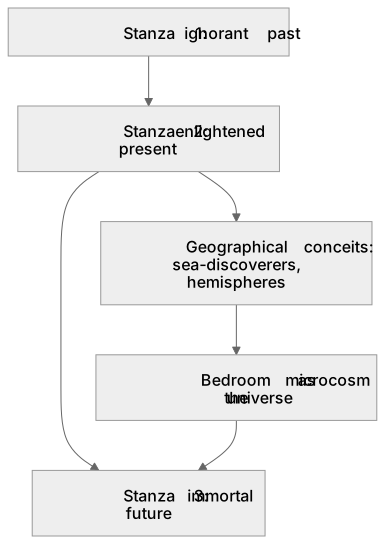
In 'The Good Morrow', John Donne presents a dramatic monologue celebrating the profound awakening of spiritual and physical love. The poem exemplifies metaphysical poetry through its striking conceits, particularly the geographical imagery where the lovers' bedroom becomes a microcosm of the universe. By comparing the lovers to 'two better hemispheres', Donne argues that their perfectly balanced union defies mortality. Analysis should focus on the colloquial opening, the integration of Renaissance cartography, and the complex rhyme scheme that reinforces the poem's logical argument for eternal love.
What earns the marks
- Analyse the dramatic, colloquial opening and its contrast with the elevated spiritual language in later stanzas.
- Evaluate the use of geographical and exploratory conceits, such as the 'sea-discoverers' and 'hemispheres'.
- Examine the tripartite structure of the poem and how it reflects the progression of the speaker's logical argument.
- Connect the poem's themes of microcosm and macrocosm to Renaissance contextual beliefs about love and the universe.
Common mistakes and how to put them right
Misinterpreting the 'Seven Sleepers den' reference as merely about sleep.
Put it right: Recognise it as a specific theological allusion to spiritual awakening.
Focusing only on the romantic elements without analysing the intellectual and logical structure of Donne's argument.
Confusing the 'hemispheres' conceit.
Put it right: Ensure you explain that the lovers form a perfect, complete world without the 'sharp North' or 'declining West'.
Exam tips
- Use the transition between stanzas to structure your essay paragraphs, tracing the shift from physical past to spiritual eternity.
- Highlight the repetition of 'let' in the second stanza to demonstrate Donne's dismissive attitude towards the external world.
- Connect the poem's ending, which relies on the Galenic medical theory of balanced humours, to Donne's argument for immortal love.
Try the lesson
The start of the Component 3: Poetry – Section B: Specified Poetry Pre- or Post-1900 – Pre-1900 – Metaphysical Poetry – John Donne Selected Poems (Penguin Classics, 2006): The Good Morrow John Donne lesson, made from checked teaching notes for this specification point.
Have a go first
In the opening stanza of 'The Good Morrow', how does the speaker characterise the lovers' lives before they fell in love?
Listen
In 'The Good Morrow', John Donne presents a dramatic monologue celebrating the profound awakening of spiritual and physical love. The poem exemplifies metaphysical poetry through its striking conceits, particularly the geographical imagery where the lovers' bedroom becomes a microcosm of the universe. By comparing the lovers to 'two better hemispheres', Donne argues that their perfectly balanced union defies mortality. Analysis should focus on the colloquial opening, the integration of Renaissance cartography, and the complex rhyme scheme that reinforces the poem's logical argument for eternal love. A strong answer earns marks for these points. Analyse the dramatic, colloquial opening and its contrast with the elevated spiritual language in later stanzas. Evaluate the use of geographical and exploratory conceits, such as the 'sea-discoverers' and 'hemispheres'. Examine the tripartite structure of the poem and how it reflects the progression of the speaker's logical argument. Connect the poem's themes of microcosm and macrocosm to Renaissance contextual beliefs about love and the universe. Exam tip: Use the transition between stanzas to structure your essay paragraphs, tracing the shift from physical past to spiritual eternity.
See it
Key words
Say what each word means before you turn the card.
The microcosm versus the macrocosm
Try answering aloud or in your head before turning the card.
Spiritual awakening
Try answering aloud or in your head before turning the card.
Renaissance exploration and cartography
Try answering aloud or in your head before turning the card.
The immortality of perfectly balanced love
Try answering aloud or in your head before turning the card.
See every definition
- The microcosm versus the macrocosm
- The idea that the lovers' bedroom becomes a small world compared with the universe, connecting the poem to Renaissance beliefs about love and the universe.
- Spiritual awakening
- The profound awakening of spiritual and physical love that the dramatic monologue celebrates, linked to the theological allusion of the 'Seven Sleepers den'.
- Renaissance exploration and cartography
- The geographical and exploratory imagery, such as the 'sea-discoverers' and 'hemispheres', drawn from Renaissance cartography and integrated into the poem's conceits.
- The immortality of perfectly balanced love
- The argument that the lovers' perfectly balanced union defies mortality, supported by the Galenic medical theory of balanced humours at the poem's ending.
Label the diagram
Some boxes have lost their names. Pick the right name for each number.
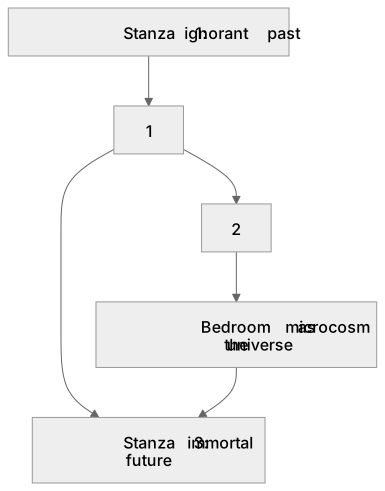
1Box 1
2Box 2
There is more to this lesson
The full lesson goes on to check your understanding and help you earn the marks. Create a free account to carry on, with your progress saved.
A week of Premium from your first lesson · Then the free plan continues · No card, no charge
Test your understanding of Component 3: Poetry – Section B: Specified Poetry Pre- or Post-1900 – Pre-1900 – Metaphysical Poetry – John Donne Selected Poems (Penguin Classics, 2006): The Good Morrow John Donne
Active recall beats re-reading. Take an instant quiz now to test what you’ve learned and lock it into long-term memory.
A week of Premium from your first lesson · Then the free plan continues · No card, no charge