Pearson Edexcel · A-Level · English Literature
Course version: 9ET0 · Version from Sept 2015
Poetry – Section B: Specified Poetry Pre- or Post-1900 – Pre-1900 –…
Full specification wording
Component 3: Poetry – Section B: Specified Poetry Pre- or Post-1900 – Pre-1900 – Metaphysical Poetry – John Donne Selected Poems (Penguin Classics, 2006): Song (‘Go and catch a falling star’)
John Donne’s ‘Song’ is a cynical, satirical metaphysical poem exploring the impossibility of finding a woman who is both beautiful and faithful.
Checked against the Pearson Edexcel 9ET0 specification (opens in a new tab) on .
- Point 2 of 22
- 4 key terms
Study notes
From the checked teaching notes for this specification point.
The idea
John Donne’s ‘Song’ is a cynical, satirical metaphysical poem exploring the impossibility of finding a woman who is both beautiful and faithful. The speaker issues a series of impossible imperatives, such as catching a falling star or hearing mermaids singing, to argue that finding a true woman is equally miraculous and unattainable. Donne employs a mocking, conversational tone, structured in three stanzas with a lively trochaic metre. The final stanza shifts to a bitter conclusion: even if such a woman were found, she would inevitably become unfaithful by the time the speaker meets her.
What earns the marks
- Analyse the use of impossible imperatives (adynata) in the first stanza to establish the poem's cynical premise.
- Evaluate how the trochaic metre and regular rhyme scheme create a light, mocking tone that contrasts with the bitter subject matter.
- Explore the subversion of traditional Petrarchan love poetry, focusing on the speaker's misogynistic view of female infidelity.
- Discuss the structural shift in the final stanza, where the hypothetical journey concludes with the inevitability of betrayal.
Common mistakes and how to put them right
Assuming the poem is a genuine romantic lyric.
Put it right: Identify the poem as a satirical and cynical critique of female constancy, subverting traditional romantic tropes.
Ignoring the specific metrical choices.
Put it right: Analyse how the trochaic metre creates a lively, almost nursery-rhyme rhythm that heightens the mocking tone.
Treating the speaker and the poet as identical.
Put it right: Refer to the 'speaker' or 'persona' rather than Donne himself, acknowledging the performative nature of metaphysical poetry.
Exam tips
- Compare the cynical tone of 'Song' with Donne's more sincere explorations of love, such as 'The Good-Morrow', to demonstrate range.
- Focus on the specific imagery of the impossible tasks (adynata) and explain how they logically build the speaker's argument.
- Use the term 'Petrarchan subversion' to describe how the poem dismantles idealised Renaissance views of women.
Try the lesson
The start of the Component 3: Poetry – Section B: Specified Poetry Pre- or Post-1900 – Pre-1900 – Metaphysical Poetry – John Donne Selected Poems (Penguin Classics, 2006): Song (‘Go and catch a falling star’) lesson, made from checked teaching notes for this specification point.
Have a go first
Which of the following is one of the impossible tasks the speaker commands the listener to perform in the first stanza of 'Song ('Go and catch a falling star')'?
Listen
John Donne’s ‘Song’ is a cynical, satirical metaphysical poem exploring the impossibility of finding a woman who is both beautiful and faithful. The speaker issues a series of impossible imperatives, such as catching a falling star or hearing mermaids singing, to argue that finding a true woman is equally miraculous and unattainable. Donne employs a mocking, conversational tone, structured in three stanzas with a lively trochaic metre. The final stanza shifts to a bitter conclusion: even if such a woman were found, she would inevitably become unfaithful by the time the speaker meets her. A strong answer earns marks for these points. Analyse the use of impossible imperatives (adynata) in the first stanza to establish the poem's cynical premise. Evaluate how the trochaic metre and regular rhyme scheme create a light, mocking tone that contrasts with the bitter subject matter. Explore the subversion of traditional Petrarchan love poetry, focusing on the speaker's misogynistic view of female infidelity. Discuss the structural shift in the final stanza, where the hypothetical journey concludes with the inevitability of betrayal. A common slip: Assuming the poem is a genuine romantic lyric. Instead, Identify the poem as a satirical and cynical critique of female constancy, subverting traditional romantic tropes. Exam tip: Compare the cynical tone of 'Song' with Donne's more sincere explorations of love, such as 'The Good-Morrow', to demonstrate range.
See it
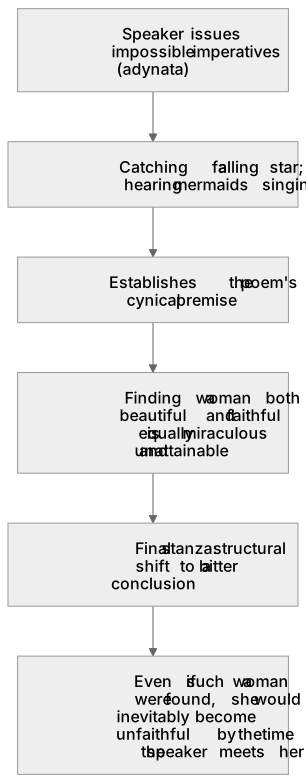
Put it in order
Put these steps in the order they happen.
- 1. Establishes the poem's cynical premise
- 2. Catching a falling star; hearing mermaids singing
- 3. Speaker issues impossible imperatives (adynata)
- 4. Even if such a woman were found, she would inevitably become unfaithful by the time the speaker meets her
- 5. Final stanza: structural shift to a bitter conclusion
- 6. Finding a woman both beautiful and faithful is equally miraculous and unattainable
Key words
Say what each word means before you turn the card.
Cynicism and Misogyny
Try answering aloud or in your head before turning the card.
The Impossibility of Constancy
Try answering aloud or in your head before turning the card.
Satire and Mockery
Try answering aloud or in your head before turning the card.
Subversion of Courtly Love
Try answering aloud or in your head before turning the card.
See every definition
- Cynicism and Misogyny
- The poem's satirical critique of female constancy, presenting a bitter and mocking view of women as inevitably unfaithful.
- The Impossibility of Constancy
- The argument that finding a woman who is both beautiful and faithful is as miraculous and unattainable as the impossible tasks the speaker sets.
- Satire and Mockery
- A mocking, conversational tone, created through a lively trochaic metre and regular rhyme scheme, that contrasts with the bitter subject matter.
- Subversion of Courtly Love
- The dismantling of traditional Petrarchan ideals of female perfection, focusing on the speaker's misogynistic view of female infidelity.
Label the diagram
Some boxes have lost their names. Pick the right name for each number.
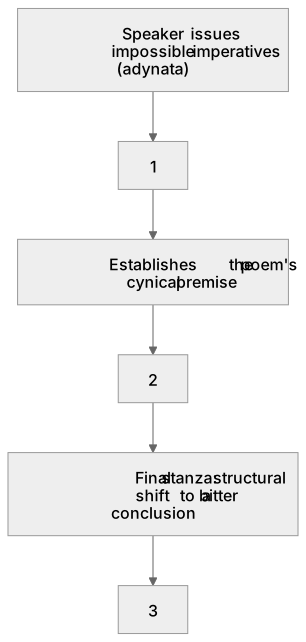
1Box 1
2Box 2
3Box 3
There is more to this lesson
The full lesson goes on to check your understanding and help you earn the marks. Create a free account to carry on, with your progress saved.
A week of Premium from your first lesson · Then the free plan continues · No card, no charge
Test your understanding of Component 3: Poetry – Section B: Specified Poetry Pre- or Post-1900 – Pre-1900 – Metaphysical Poetry – John Donne Selected Poems (Penguin Classics, 2006): Song (‘Go and catch a falling star’)
Active recall beats re-reading. Take an instant quiz now to test what you’ve learned and lock it into long-term memory.
A week of Premium from your first lesson · Then the free plan continues · No card, no charge