Pearson Edexcel · A-Level · English Literature
Course version: 9ET0 · Version from Sept 2015
Poetry – Section B: Specified Poetry Pre- or Post-1900 – Pre-1900 –…
Full specification wording
Component 3: Poetry – Section B: Specified Poetry Pre- or Post-1900 – Pre-1900 – Metaphysical Poetry – Metaphysical Poetry, editor Colin Burrow (Penguin, 2006): A Song (‘Ask me no more where Jove bestows’)
Thomas Carew’s lyric poem employs a series of rhetorical commands to praise a mistress's beauty, arguing that all transient natural wonders find their eternal resting place within her.
Checked against the Pearson Edexcel 9ET0 specification (opens in a new tab) on .
- Point 17 of 23
- 3 key terms
Study notes
From the checked teaching notes for this specification point.
The idea
Thomas Carew’s lyric poem employs a series of rhetorical commands to praise a mistress's beauty, arguing that all transient natural wonders find their eternal resting place within her. Blending metaphysical conceit with classical allusion, Carew asserts that fading roses, golden atoms of sunlight, the nightingale's song, and falling stars do not disappear but are absorbed into her physical form. The poem exemplifies Caroline court poetry through its elegant AABB rhyme scheme and logical progression across five stanzas.
What earns the marks
- Analyse the opening allusion to Jove and the final phoenix image, explaining how myth enlarges the poem’s praise without inventing figures absent from the text.
- Evaluate the structural progression of the five stanzas, noting how the AABB rhyme scheme creates a sense of logical, inevitable conclusion.
- Explore the metaphysical conceit of the microcosm, where the mistress embodies all the transient beauties of the natural world.
- Discuss the tone of certainty and authority established by the repeated imperative 'Ask me no more' at the beginning of each stanza.
Common mistakes and how to put them right
Treating the poem solely as a romantic lyric without acknowledging its philosophical argument.
Put it right: Analyse the poem as a logical argument about permanence and decay, typical of metaphysical poetry.
Misidentifying the tone as purely emotional.
Put it right: Recognise the authoritative, almost legalistic tone created by the repeated imperatives and structured stanzas.
Ignoring the significance of the specific natural elements chosen.
Put it right: Connect each natural element, such as roses or stars, to specific physical attributes of the mistress, like her cheeks or eyes.
Exam tips
- Compare Carew's use of the blazon tradition with other metaphysical poets like Donne or Marvell to highlight his unique focus on permanence.
- Focus on the transition in the final stanza where the imagery shifts from natural phenomena to the mythological phoenix to cement the theme of immortality.
- Use the repeated imperative 'Ask me no more' as a structural pivot point in your essay to discuss how Carew builds his rhetorical argument.
Try the lesson
The start of the Component 3: Poetry – Section B: Specified Poetry Pre- or Post-1900 – Pre-1900 – Metaphysical Poetry – Metaphysical Poetry, editor Colin Burrow (Penguin, 2006): A Song (‘Ask me no more where Jove bestows’) lesson, made from checked teaching notes for this specification point.
Have a go first
In "A Song (‘Ask me no more where Jove bestows’)", what is the central conceit used to praise the addressee?
Listen
Thomas Carew’s lyric poem employs a series of rhetorical commands to praise a mistress's beauty, arguing that all transient natural wonders find their eternal resting place within her. Blending metaphysical conceit with classical allusion, Carew asserts that fading roses, golden atoms of sunlight, the nightingale's song, and falling stars do not disappear but are absorbed into her physical form. The poem exemplifies Caroline court poetry through its elegant AABB rhyme scheme and logical progression across five stanzas. A strong answer earns marks for these points. Analyse the opening allusion to Jove and the final phoenix image, explaining how myth enlarges the poem’s praise without inventing figures absent from the text. Evaluate the structural progression of the five stanzas, noting how the AABB rhyme scheme creates a sense of logical, inevitable conclusion. Explore the metaphysical conceit of the microcosm, where the mistress embodies all the transient beauties of the natural world. Discuss the tone of certainty and authority established by the repeated imperative 'Ask me no more' at the beginning of each stanza. A common slip: Treating the poem solely as a romantic lyric without acknowledging its philosophical argument. Instead, Analyse the poem as a logical argument about permanence and decay, typical of metaphysical poetry. Exam tip: Compare Carew's use of the blazon tradition with other metaphysical poets like Donne or Marvell to highlight his unique focus on permanence.
See it
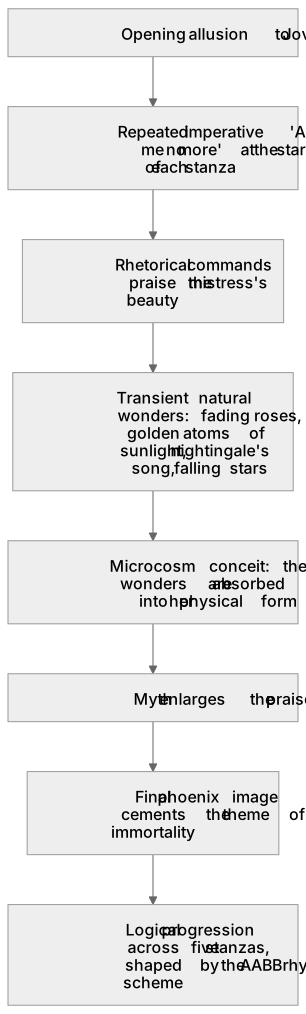
Put it in order
Put these steps in the order they happen.
- 1. Microcosm conceit: these wonders are absorbed into her physical form
- 2. Logical progression across five stanzas, shaped by the AABB rhyme scheme
- 3. Myth enlarges the praise
- 4. Opening allusion to Jove
- 5. Repeated imperative 'Ask me no more' at the start of each stanza
- 6. Final phoenix image cements the theme of immortality
- 7. Rhetorical commands praise the mistress's beauty
- 8. Transient natural wonders: fading roses, golden atoms of sunlight, nightingale's song, falling stars
Key words
Say what each word means before you turn the card.
Transience and permanence
Try answering aloud or in your head before turning the card.
The microcosm
Try answering aloud or in your head before turning the card.
Divine beauty
Try answering aloud or in your head before turning the card.
See every definition
- Transience and permanence
- The philosophical argument of the poem, in which transient natural wonders find their eternal resting place within the mistress's beauty.
- The microcosm
- A metaphysical conceit in which the mistress embodies all the transient beauties of the natural world, elevating her to a divine status.
- Divine beauty
- The elevated status given to the woman through the microcosm conceit, transforming a conventional catalogue of beauties into a philosophical argument.
Label the diagram
Some boxes have lost their names. Pick the right name for each number.
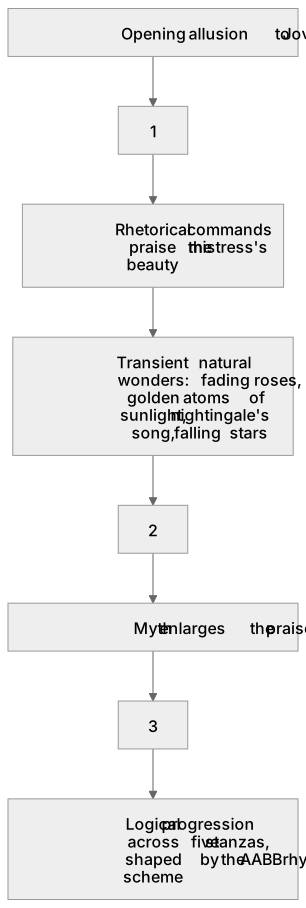
1Box 1
2Box 2
3Box 3
There is more to this lesson
The full lesson goes on to check your understanding and help you earn the marks. Create a free account to carry on, with your progress saved.
A week of Premium from your first lesson · Then the free plan continues · No card, no charge
Test your understanding of Component 3: Poetry – Section B: Specified Poetry Pre- or Post-1900 – Pre-1900 – Metaphysical Poetry – Metaphysical Poetry, editor Colin Burrow (Penguin, 2006): A Song (‘Ask me no more where Jove bestows’)
Active recall beats re-reading. Take an instant quiz now to test what you’ve learned and lock it into long-term memory.
A week of Premium from your first lesson · Then the free plan continues · No card, no charge