Pearson Edexcel · A-Level · English Literature
Course version: 9ET0 · Version from Sept 2015
Poetry – Section B: Specified Poetry Pre- or Post-1900 – Pre-1900 –…
Full specification wording
Component 3: Poetry – Section B: Specified Poetry Pre- or Post-1900 – Pre-1900 – Metaphysical Poetry – Metaphysical Poetry, editor Colin Burrow (Penguin, 2006): Love III
George Herbert's 'Love III' concludes his collection 'The Temple', presenting an allegorical dialogue between the speaker (a human soul) and Love (personifying God).
Checked against the Pearson Edexcel 9ET0 specification (opens in a new tab) on .
- Point 16 of 23
- 4 key terms
Study notes
From the checked teaching notes for this specification point.
The idea
George Herbert's 'Love III' concludes his collection 'The Temple', presenting an allegorical dialogue between the speaker (a human soul) and Love (personifying God). The poem explores the tension between human unworthiness and unconditional divine grace. The speaker feels 'guilty of dust and sin' and hesitates to accept Love's invitation to a feast, representing the Eucharist or heavenly banquet. Through gentle, interrogative dialogue, Love systematically dismantles the speaker's insecurities, culminating in the speaker's submission: 'So I did sit and eat'.
What earns the marks
- Analyse the personification of 'Love' as a gentle, welcoming host representing God or Christ.
- Evaluate the speaker's feelings of inadequacy and sinfulness ('guilty of dust and sin') against the concept of divine grace.
- Examine the significance of the feast as a metaphor for the Eucharist and spiritual communion.
- Discuss the structural use of dialogue and alternating line lengths to mirror the psychological hesitation and ultimate surrender of the speaker.
Common mistakes and how to put them right
Reading the poem as a secular romantic encounter.
Put it right: Identify 'Love' as a theological allegory for God or Christ.
Overlooking the significance of the final line.
Put it right: Analyse 'So I did sit and eat' as the crucial moment of spiritual submission and acceptance of grace.
Misinterpreting the tone of Love as aggressive or commanding.
Put it right: Recognise Love's tone as consistently gentle, patient, and accommodating.
Exam tips
- Contrast the gentle, welcoming God of 'Love III' with the more demanding or punitive depictions of God in other metaphysical works.
- Analyse the sensory language of the feast to discuss how Herbert grounds abstract theological concepts in domestic, relatable imagery.
- Pay close attention to the pronouns and dialogue tags to trace the shifting power dynamic between the hesitant speaker and the reassuring host.
Try the lesson
The start of the Component 3: Poetry – Section B: Specified Poetry Pre- or Post-1900 – Pre-1900 – Metaphysical Poetry – Metaphysical Poetry, editor Colin Burrow (Penguin, 2006): Love III lesson, made from checked teaching notes for this specification point.
Have a go first
What is the central allegorical conceit used by George Herbert in 'Love III'?
Listen
George Herbert's 'Love III' concludes his collection 'The Temple', presenting an allegorical dialogue between the speaker (a human soul) and Love (personifying God). The poem explores the tension between human unworthiness and unconditional divine grace. The speaker feels 'guilty of dust and sin' and hesitates to accept Love's invitation to a feast, representing the Eucharist or heavenly banquet. Through gentle, interrogative dialogue, Love systematically dismantles the speaker's insecurities, culminating in the speaker's submission: 'So I did sit and eat'. A strong answer earns marks for these points. Analyse the personification of 'Love' as a gentle, welcoming host representing God or Christ. Evaluate the speaker's feelings of inadequacy and sinfulness ('guilty of dust and sin') against the concept of divine grace. Examine the significance of the feast as a metaphor for the Eucharist and spiritual communion. Discuss the structural use of dialogue and alternating line lengths to mirror the psychological hesitation and ultimate surrender of the speaker. A common slip: Reading the poem as a secular romantic encounter. Instead, identify 'Love' as a theological allegory for God or Christ. Exam tip: Contrast the gentle, welcoming God of 'Love III' with the more demanding or punitive depictions of God in other metaphysical works.
See it
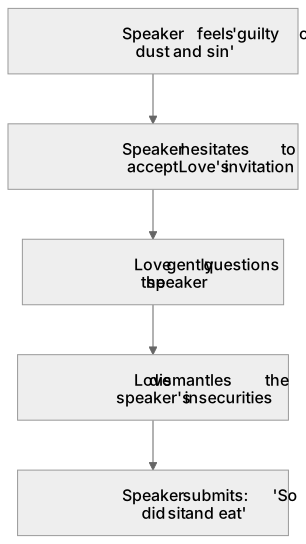
Put it in order
Put these steps in the order they happen.
- 1. Speaker hesitates to accept Love's invitation
- 2. Love gently questions the speaker
- 3. Speaker feels 'guilty of dust and sin'
- 4. Speaker submits: 'So I did sit and eat'
- 5. Love dismantles the speaker's insecurities
Key words
Say what each word means before you turn the card.
Divine grace and forgiveness
Try answering aloud or in your head before turning the card.
Human unworthiness and sin
Try answering aloud or in your head before turning the card.
The Eucharist and spiritual communion
Try answering aloud or in your head before turning the card.
The intimacy of the divine-human relationship
Try answering aloud or in your head before turning the card.
See every definition
- Divine grace and forgiveness
- Unconditional divine grace is set against the speaker's feeling of being 'guilty of dust and sin', as Love dismantles the speaker's insecurities.
- Human unworthiness and sin
- The speaker feels 'guilty of dust and sin' and hesitates to accept Love's invitation to a feast.
- The Eucharist and spiritual communion
- The feast to which Love invites the speaker represents the Eucharist or heavenly banquet, and the final line marks spiritual submission and acceptance of grace.
- The intimacy of the divine-human relationship
- An intimate tone and gentle, interrogative dialogue between the speaker and Love personifying God convey the relationship.
Label the diagram
Some boxes have lost their names. Pick the right name for each number.
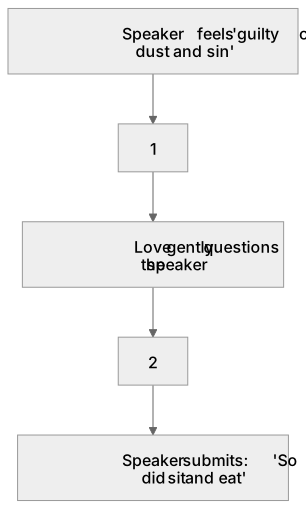
1Box 1
2Box 2
There is more to this lesson
The full lesson goes on to check your understanding and help you earn the marks. Create a free account to carry on, with your progress saved.
A week of Premium from your first lesson · Then the free plan continues · No card, no charge
Test your understanding of Component 3: Poetry – Section B: Specified Poetry Pre- or Post-1900 – Pre-1900 – Metaphysical Poetry – Metaphysical Poetry, editor Colin Burrow (Penguin, 2006): Love III
Active recall beats re-reading. Take an instant quiz now to test what you’ve learned and lock it into long-term memory.
A week of Premium from your first lesson · Then the free plan continues · No card, no charge