Pearson Edexcel · A-Level · English Literature
Course version: 9ET0 · Version from Sept 2015
Poetry – Section B: Specified Poetry Pre- or Post-1900 – Pre-1900 –…
Full specification wording
Component 3: Poetry – Section B: Specified Poetry Pre- or Post-1900 – Pre-1900 – Metaphysical Poetry – Metaphysical Poetry, editor Colin Burrow (Penguin, 2006): ‘Death be not Proud’
In Holy Sonnet X, ‘Death be not Proud’, John Donne personifies Death to strip it of its terrifying power, constructing a theological argument that diminishes mortality.
Checked against the Pearson Edexcel 9ET0 specification (opens in a new tab) on .
- Point 11 of 23
- 4 key terms
Study notes
From the checked teaching notes for this specification point.
The idea
In Holy Sonnet X, ‘Death be not Proud’, John Donne personifies Death to strip it of its terrifying power, constructing a theological argument that diminishes mortality. The speaker mocks Death, comparing it to 'rest and sleep' and asserting that it is merely a slave to 'fate, chance, kings, and desperate men'. The poem culminates in the Christian paradox that through death, humanity achieves eternal life, rendering Death itself obsolete ('Death, thou shalt die').
What earns the marks
- Analyse the personification of Death as an arrogant but ultimately powerless tyrant.
- Evaluate the use of paradox in the final couplet ('Death, thou shalt die') as an expression of Christian eschatology.
- Examine the rhetorical strategies and confrontational tone used by the speaker to belittle Death.
- Discuss the contextual influence of Renaissance Christian theology, specifically the belief in the resurrection of the soul.
Common mistakes and how to put them right
Treating the poem as evidence that Donne had no fear of death.
Put it right: Acknowledge that the aggressive rhetoric often masks a deep-seated anxiety about mortality.
Failing to analyse the specific agents Death is enslaved to; correction: explicitly discuss how 'fate, chance, kings, and desperate men' strip Death of its autonomy.
Misinterpreting the final line as a literal physical event.
Put it right: Explain it as a theological paradox referring to the eternal life of the soul after the apocalypse.
Exam tips
- Focus on the poem's use of apostrophe, noting how directly addressing Death diminishes its abstract terror.
- Compare the confident tone of this sonnet with the fearful pleading in other Holy Sonnets to show a nuanced understanding of Donne's work.
- Analyse the rhythmic disruptions in the final line to demonstrate how metre reinforces the poem's thematic climax.
Try the lesson
The start of the Component 3: Poetry – Section B: Specified Poetry Pre- or Post-1900 – Pre-1900 – Metaphysical Poetry – Metaphysical Poetry, editor Colin Burrow (Penguin, 2006): ‘Death be not Proud’ lesson, made from checked teaching notes for this specification point.
Have a go first
In John Donne's 'Death be not Proud', what is the central argument the speaker makes against the personified figure of Death?
Listen
In Holy Sonnet X, ‘Death be not Proud’, John Donne personifies Death to strip it of its terrifying power, constructing a theological argument that diminishes mortality. The speaker mocks Death, comparing it to 'rest and sleep' and asserting that it is merely a slave to 'fate, chance, kings, and desperate men'. The poem culminates in the Christian paradox that through death, humanity achieves eternal life, rendering Death itself obsolete ('Death, thou shalt die'). A strong answer earns marks for these points. Analyse the personification of Death as an arrogant but ultimately powerless tyrant. Evaluate the use of paradox in the final couplet ('Death, thou shalt die') as an expression of Christian eschatology. Examine the rhetorical strategies and confrontational tone used by the speaker to belittle Death. Discuss the contextual influence of Renaissance Christian theology, specifically the belief in the resurrection of the soul. A common slip: Treating the poem as evidence that Donne had no fear of death. Instead, acknowledge that the aggressive rhetoric often masks a deep-seated anxiety about mortality. Exam tip: Focus on the poem's use of apostrophe, noting how directly addressing Death diminishes its abstract terror.
See it
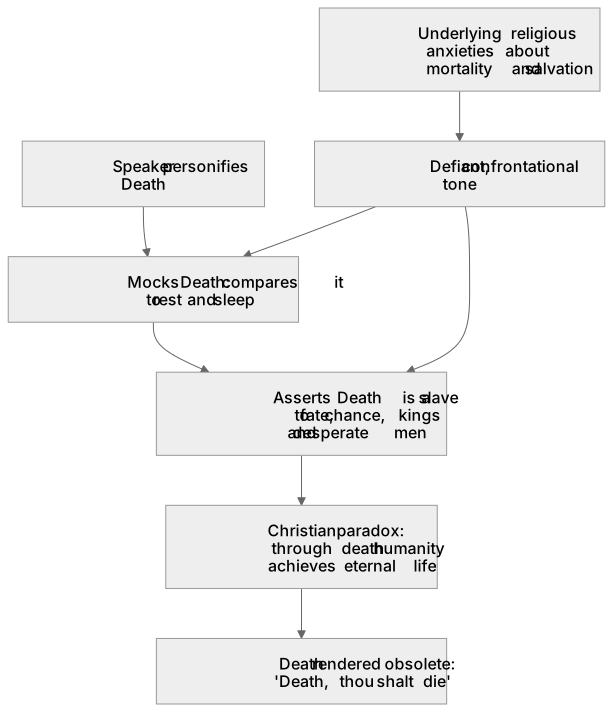
Key words
Say what each word means before you turn the card.
Mortality and the afterlife
Try answering aloud or in your head before turning the card.
Power and powerlessness
Try answering aloud or in your head before turning the card.
Christian faith and resurrection
Try answering aloud or in your head before turning the card.
Rhetoric and argument
Try answering aloud or in your head before turning the card.
See every definition
- Mortality and the afterlife
- The poem's treatment of mortality within 17th-century Christian beliefs about the afterlife, which students must contextualise.
- Power and powerlessness
- The personification of Death as an arrogant but ultimately powerless tyrant, enslaved to 'fate, chance, kings, and desperate men'.
- Christian faith and resurrection
- The belief in the resurrection of the soul, expressed through the paradox that through death humanity achieves eternal life.
- Rhetoric and argument
- The rhetorical structure and strategies, including apostrophe and a confrontational tone, used to belittle Death and construct a logical conceit.
Label the diagram
Some boxes have lost their names. Pick the right name for each number.
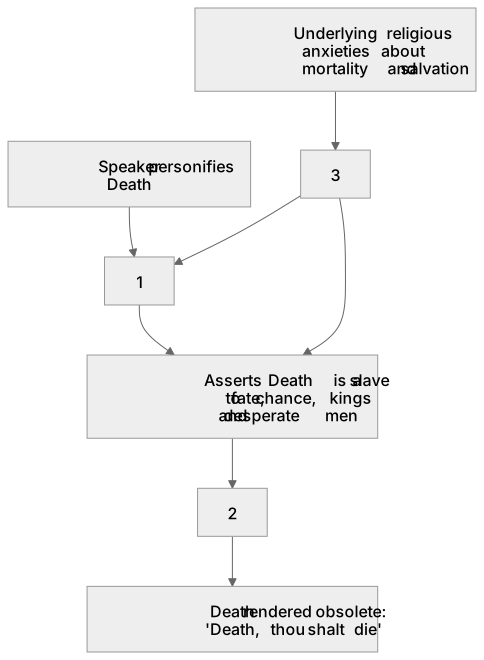
1Box 1
2Box 2
3Box 3
There is more to this lesson
The full lesson goes on to check your understanding and help you earn the marks. Create a free account to carry on, with your progress saved.
A week of Premium from your first lesson · Then the free plan continues · No card, no charge
Test your understanding of Component 3: Poetry – Section B: Specified Poetry Pre- or Post-1900 – Pre-1900 – Metaphysical Poetry – Metaphysical Poetry, editor Colin Burrow (Penguin, 2006): ‘Death be not Proud’
Active recall beats re-reading. Take an instant quiz now to test what you’ve learned and lock it into long-term memory.
A week of Premium from your first lesson · Then the free plan continues · No card, no charge