Pearson Edexcel · A-Level · English Literature
Course version: 9ET0 · Version from Sept 2015
Poetry – Section B: Specified Poetry Pre- or Post-1900 – Pre-1900 –…
Full specification wording
Component 3: Poetry – Section B: Specified Poetry Pre- or Post-1900 – Pre-1900 – Metaphysical Poetry – Metaphysical Poetry, editor Colin Burrow (Penguin, 2006): ‘Batter My Heart’
John Donne’s Holy Sonnet XIV, ‘Batter my heart, three-person’d God’, exemplifies metaphysical poetry through its startling use of violent and erotic conceits to explore spiritual crisis.
Checked against the Pearson Edexcel 9ET0 specification (opens in a new tab) on .
- Point 12 of 23
- 4 key terms
Study notes
From the checked teaching notes for this specification point.
The idea
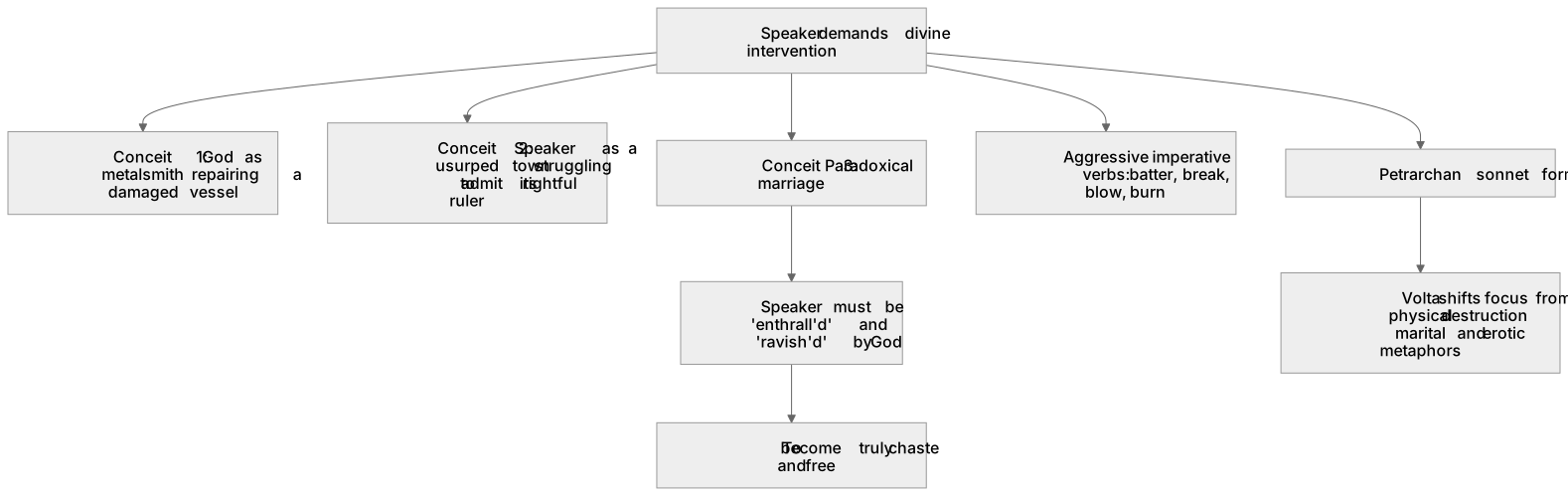
John Donne’s Holy Sonnet XIV, ‘Batter my heart, three-person’d God’, exemplifies metaphysical poetry through its startling use of violent and erotic conceits to explore spiritual crisis. The speaker demands divine intervention to achieve salvation, arguing that gentle persuasion is insufficient. Donne structures the poem around three central metaphors: God as a metalsmith repairing a damaged vessel, the speaker as a usurped town struggling to admit its rightful ruler, and a paradoxical marriage where the speaker must be 'enthrall'd' and 'ravish'd' by God to become truly chaste and free.
What earns the marks
- Analyse the use of aggressive imperative verbs (e.g., 'batter', 'break', 'burn') to convey the speaker's desperation for divine intervention.
- Evaluate the effectiveness of the 'usurpt town' conceit in representing the speaker's soul captured by sin or reason.
- Explore the paradoxical ending where spiritual purity is achieved through violent, erotic subjugation ('ravish').
- Discuss the significance of the Petrarchan sonnet form, noting how the volta shifts the focus from physical destruction to marital and erotic metaphors.
Common mistakes and how to put them right
Reading the poem purely as a literal description of physical violence.
Put it right: Interpret the violence metaphorically as the necessary force required for spiritual purification and salvation.
Ignoring the specific reference to the 'three-person'd God'.
Put it right: Acknowledge the Trinitarian reference and how it aligns with the tripartite verbs (knock, breathe, shine / break, blow, burn).
Confusing the sonnet form as purely Shakespearean.
Put it right: Identify the structure as predominantly Petrarchan (octave and sestet) but note the concluding rhyming couplet typical of English sonnets.
Exam tips
- Link the violent imagery of the poem to the broader metaphysical characteristic of using shocking, unconventional conceits.
- Compare the speaker's relationship with God in this poem to the more negotiated, argumentative tone found in other Donne poems.
- Analyse the rhythmic disruptions and enjambment to demonstrate how the meter reflects the speaker's internal turmoil and desperation.
Try the lesson
The start of the Component 3: Poetry – Section B: Specified Poetry Pre- or Post-1900 – Pre-1900 – Metaphysical Poetry – Metaphysical Poetry, editor Colin Burrow (Penguin, 2006): ‘Batter My Heart’ lesson, made from checked teaching notes for this specification point.
Have a go first
In Donne's 'Batter My Heart', what central metaphor does the speaker use in the first quatrain to describe his relationship with God?
Listen
John Donne’s Holy Sonnet XIV, ‘Batter my heart, three-person’d God’, exemplifies metaphysical poetry through its startling use of violent and erotic conceits to explore spiritual crisis. The speaker demands divine intervention to achieve salvation, arguing that gentle persuasion is insufficient. Donne structures the poem around three central metaphors: God as a metalsmith repairing a damaged vessel, the speaker as a usurped town struggling to admit its rightful ruler, and a paradoxical marriage where the speaker must be 'enthrall'd' and 'ravish'd' by God to become truly chaste and free. A strong answer earns marks for these points. Analyse the use of aggressive imperative verbs (e.g., 'batter', 'break', 'burn') to convey the speaker's desperation for divine intervention. Evaluate the effectiveness of the 'usurpt town' conceit in representing the speaker's soul captured by sin or reason. Explore the paradoxical ending where spiritual purity is achieved through violent, erotic subjugation ('ravish'). Discuss the significance of the Petrarchan sonnet form, noting how the volta shifts the focus from physical destruction to marital and erotic metaphors. A common slip: Reading the poem purely as a literal description of physical violence. Instead, Interpret the violence metaphorically as the necessary force required for spiritual purification and salvation. Exam tip: Link the violent imagery of the poem to the broader metaphysical characteristic of using shocking, unconventional conceits.
See it
Key words
Say what each word means before you turn the card.
Spiritual crisis
Try answering aloud or in your head before turning the card.
Divine love vs. earthly sin
Try answering aloud or in your head before turning the card.
Paradox and contradiction
Try answering aloud or in your head before turning the card.
Submission and dominance
Try answering aloud or in your head before turning the card.
See every definition
- Spiritual crisis
- The intense, deeply personal theological struggle that the speaker undergoes, explored through startling violent and erotic conceits.
- Divine love vs. earthly sin
- The contrast between the speaker's demand for divine intervention to achieve salvation and the soul's capture by sin or reason.
- Paradox and contradiction
- The paradoxical marriage in which the speaker must be 'enthrall'd' and 'ravish'd' by God to become truly chaste and free.
- Submission and dominance
- Spiritual purity achieved through violent, erotic subjugation, as in the ending where the speaker is 'ravish'd' by God.
Label the diagram
Some boxes have lost their names. Pick the right name for each number.
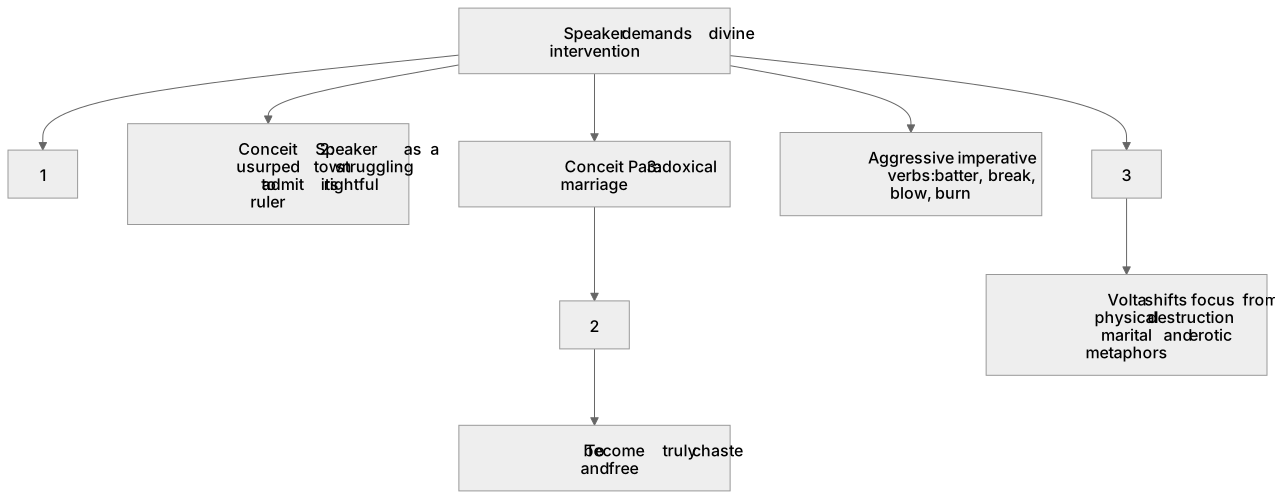
1Box 1
2Box 2
3Box 3
There is more to this lesson
The full lesson goes on to check your understanding and help you earn the marks. Create a free account to carry on, with your progress saved.
A week of Premium from your first lesson · Then the free plan continues · No card, no charge
Test your understanding of Component 3: Poetry – Section B: Specified Poetry Pre- or Post-1900 – Pre-1900 – Metaphysical Poetry – Metaphysical Poetry, editor Colin Burrow (Penguin, 2006): ‘Batter My Heart’
Active recall beats re-reading. Take an instant quiz now to test what you’ve learned and lock it into long-term memory.
A week of Premium from your first lesson · Then the free plan continues · No card, no charge