Pearson Edexcel · A-Level · English Literature
Course version: 9ET0 · Version from Sept 2015
Poetry – Section B: Specified Poetry Pre- or Post-1900 – Pre-1900 –…
Full specification wording
Component 3: Poetry – Section B: Specified Poetry Pre- or Post-1900 – Pre-1900 – Metaphysical Poetry – Metaphysical Poetry, editor Colin Burrow (Penguin, 2006): Orinda to Lucasia
Katherine Philips’s ‘Orinda to Lucasia’ adapts traditional metaphysical conceits to elevate female friendship to a spiritual, Platonic ideal.
Checked against the Pearson Edexcel 9ET0 specification (opens in a new tab) on .
- Point 23 of 23
- 4 key terms
Study notes
From the checked teaching notes for this specification point.
The idea
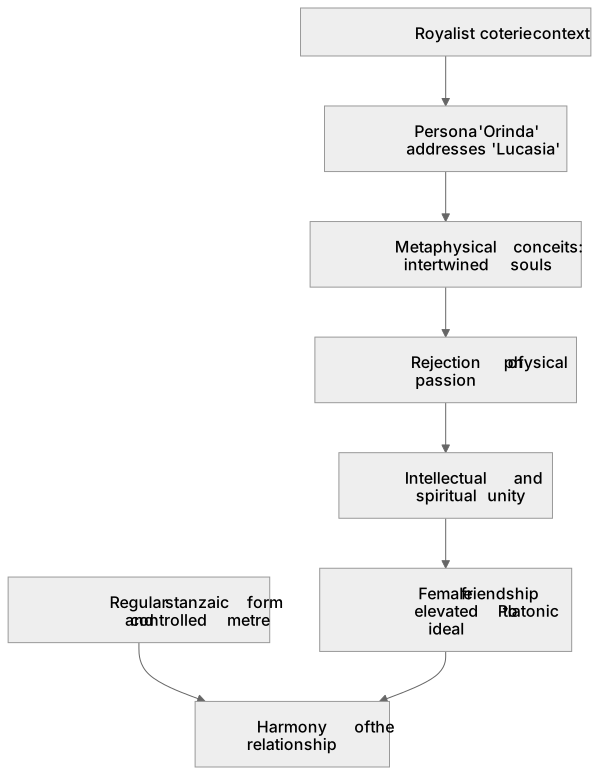
Katherine Philips’s ‘Orinda to Lucasia’ adapts traditional metaphysical conceits to elevate female friendship to a spiritual, Platonic ideal. Writing within a royalist coterie, Philips adopts the persona ‘Orinda’ addressing her close friend Anne Owen (‘Lucasia’). The poem explores the merging of two souls, rejecting physical passion in favour of intellectual and spiritual unity. By examining the poem’s regular stanzaic form and controlled metre, learners can evaluate how Philips constructs a rational argument for the supremacy of their bond over worldly distractions.
What earns the marks
- Identification and analysis of metaphysical conceits used to describe and elevate female friendship.
- Evaluation of the poem's structure, rhyme, and metre, and how these reflect the harmony of the relationship.
- Exploration of the historical and literary context of the royalist coterie and Platonic love during the seventeenth century.
- Comparison of Philips's approach to spiritual union and the private sphere with male metaphysical poets in the anthology.
Common mistakes and how to put them right
Reading the poem purely as a modern romantic or sexual love poem.
Put it right: Contextualise the relationship within seventeenth-century Platonic friendship and coterie conventions.
Ignoring the metaphysical elements because the author is female.
Put it right: Actively identify and analyse the metaphysical conceits, such as the merging of souls, that align Philips with the broader movement.
Treating 'Orinda' and 'Lucasia' as literal, everyday names.
Put it right: Recognise these as pastoral, coterie pseudonyms used to elevate the subjects to classical ideals.
Exam tips
- Compare Philips's use of the 'two souls as one' conceit with Donne's to highlight her unique focus on female friendship.
- Analyse the regular rhyme scheme as a structural reflection of the harmony and equality between Orinda and Lucasia.
- Integrate contextual knowledge of the Interregnum and royalist retreat to explain the poem's focus on private, internal worlds.
Try the lesson
The start of the Component 3: Poetry – Section B: Specified Poetry Pre- or Post-1900 – Pre-1900 – Metaphysical Poetry – Metaphysical Poetry, editor Colin Burrow (Penguin, 2006): Orinda to Lucasia lesson, made from checked teaching notes for this specification point.
Have a go first
What is the primary subject matter explored by Katherine Philips in her poem 'Orinda to Lucasia'?
Listen
Katherine Philips’s ‘Orinda to Lucasia’ adapts traditional metaphysical conceits to elevate female friendship to a spiritual, Platonic ideal. Writing within a royalist coterie, Philips adopts the persona ‘Orinda’ addressing her close friend Anne Owen (‘Lucasia’). The poem explores the merging of two souls, rejecting physical passion in favour of intellectual and spiritual unity. By examining the poem’s regular stanzaic form and controlled metre, learners can evaluate how Philips constructs a rational argument for the supremacy of their bond over worldly distractions. A strong answer earns marks for these points. Identification and analysis of metaphysical conceits used to describe and elevate female friendship. Evaluation of the poem's structure, rhyme, and metre, and how these reflect the harmony of the relationship. Exploration of the historical and literary context of the royalist coterie and Platonic love during the seventeenth century. Comparison of Philips's approach to spiritual union and the private sphere with male metaphysical poets in the anthology. A common slip: Reading the poem purely as a modern romantic or sexual love poem. Instead, Contextualise the relationship within seventeenth-century Platonic friendship and coterie conventions. Exam tip: Compare Philips's use of the 'two souls as one' conceit with Donne's to highlight her unique focus on female friendship.
See it
Key words
Say what each word means before you turn the card.
Platonic love
Try answering aloud or in your head before turning the card.
Female friendship
Try answering aloud or in your head before turning the card.
Spiritual union
Try answering aloud or in your head before turning the card.
The private versus public sphere
Try answering aloud or in your head before turning the card.
See every definition
- Platonic love
- A seventeenth-century ideal within which the relationship between Orinda and Lucasia is contextualised, rejecting physical passion in favour of intellectual and spiritual unity.
- Female friendship
- The bond that Philips elevates to a spiritual, Platonic ideal through metaphysical conceits such as intertwined souls and religious devotion.
- Spiritual union
- The merging of two souls that the poem explores, repurposing metaphysical tropes to validate female intimacy.
- The private versus public sphere
- The poem's focus on private, internal worlds, explained through contextual knowledge of the Interregnum and royalist retreat.
Label the diagram
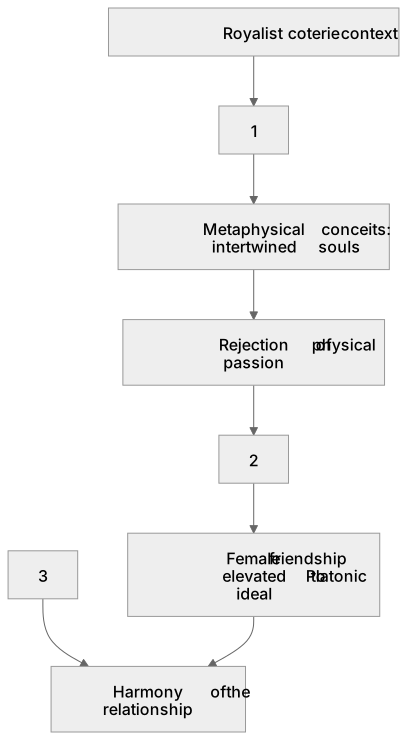
Some boxes have lost their names. Pick the right name for each number.
1Box 1
2Box 2
3Box 3
There is more to this lesson
The full lesson goes on to check your understanding and help you earn the marks. Create a free account to carry on, with your progress saved.
A week of Premium from your first lesson · Then the free plan continues · No card, no charge
Test your understanding of Component 3: Poetry – Section B: Specified Poetry Pre- or Post-1900 – Pre-1900 – Metaphysical Poetry – Metaphysical Poetry, editor Colin Burrow (Penguin, 2006): Orinda to Lucasia
Active recall beats re-reading. Take an instant quiz now to test what you’ve learned and lock it into long-term memory.
A week of Premium from your first lesson · Then the free plan continues · No card, no charge