Pearson Edexcel · A-Level · English Literature
Course version: 9ET0 · Version from Sept 2015
Poetry – Section B: Specified Poetry Pre- or Post-1900 – Pre-1900 –…
Full specification wording
Component 3: Poetry – Section B: Specified Poetry Pre- or Post-1900 – Pre-1900 – Metaphysical Poetry – Metaphysical Poetry, editor Colin Burrow (Penguin, 2006): A Dialogue of Friendship Multiplied
In 'A Dialogue of Friendship Multiplied', Katherine Philips explores the complexities of expanding a platonic bond to include a third person.
Checked against the Pearson Edexcel 9ET0 specification (opens in a new tab) on .
- Point 22 of 23
- 4 key terms
Study notes
From the checked teaching notes for this specification point.
The idea
In 'A Dialogue of Friendship Multiplied', Katherine Philips explores the complexities of expanding a platonic bond to include a third person. Written as a dialogue between Orinda (Philips) and Musidorus, the poem debates whether true friendship, often conceptualised as an exclusive union of two souls, can be 'multiplied' without diluting its intensity. The use of alternating voices allows Philips to examine the paradox of infinite love within finite human capacity, ultimately arguing that spiritual friendship, unlike material wealth, grows when shared.
What earns the marks
- Analyse the dialogue form as a metaphysical tool for logical debate and the exploration of philosophical paradoxes.
- Evaluate the arguments presented by Orinda and Musidorus regarding the exclusivity versus the expansiveness of true friendship.
- Examine the use of economic and spatial metaphors to contrast material limitations with the infinite nature of the soul.
- Discuss how the poem contributes to Philips's broader coterie poetics, where friendship is elevated to a supreme spiritual virtue.
Common mistakes and how to put them right
Treating the dialogue as a literal argument between enemies.
Put it right: Recognise it as a philosophical debate between intellectual equals exploring a concept.
Overlooking the metaphysical paradox at the poem's core.
Put it right: Explicitly discuss the paradox that giving friendship away actually increases its total amount.
Failing to identify the speakers.
Put it right: Attribute the specific arguments to Orinda and Musidorus to trace the development of the poem's logic.
Exam tips
- Focus on the structural shifts in the dialogue to demonstrate how the argument progresses towards a resolution.
- Contrast the poem's treatment of 'multiplied' love with other metaphysical poets who often insist on the strict exclusivity of the romantic couple.
- Use the poem to discuss the concept of the 'Society of Friendship' and how Philips used poetry to build a network of platonic bonds.
Try the lesson
The start of the Component 3: Poetry – Section B: Specified Poetry Pre- or Post-1900 – Pre-1900 – Metaphysical Poetry – Metaphysical Poetry, editor Colin Burrow (Penguin, 2006): A Dialogue of Friendship Multiplied lesson, made from checked teaching notes for this specification point.
Have a go first
How does the central conceit in 'A Dialogue of Friendship Multiplied' characterise the effect of sharing affection among multiple people?
Listen
In 'A Dialogue of Friendship Multiplied', Katherine Philips explores the complexities of expanding a platonic bond to include a third person. Written as a dialogue between Orinda (Philips) and Musidorus, the poem debates whether true friendship, often conceptualised as an exclusive union of two souls, can be 'multiplied' without diluting its intensity. The use of alternating voices allows Philips to examine the paradox of infinite love within finite human capacity, ultimately arguing that spiritual friendship, unlike material wealth, grows when shared. A strong answer earns marks for these points. Analyse the dialogue form as a metaphysical tool for logical debate and the exploration of philosophical paradoxes. Evaluate the arguments presented by Orinda and Musidorus regarding the exclusivity versus the expansiveness of true friendship. Examine the use of economic and spatial metaphors to contrast material limitations with the infinite nature of the soul. Discuss how the poem contributes to Philips's broader coterie poetics, where friendship is elevated to a supreme spiritual virtue. A common slip: Treating the dialogue as a literal argument between enemies. Instead, recognise it as a philosophical debate between intellectual equals exploring a concept. Exam tip: Focus on the structural shifts in the dialogue to demonstrate how the argument progresses towards a resolution.
See it
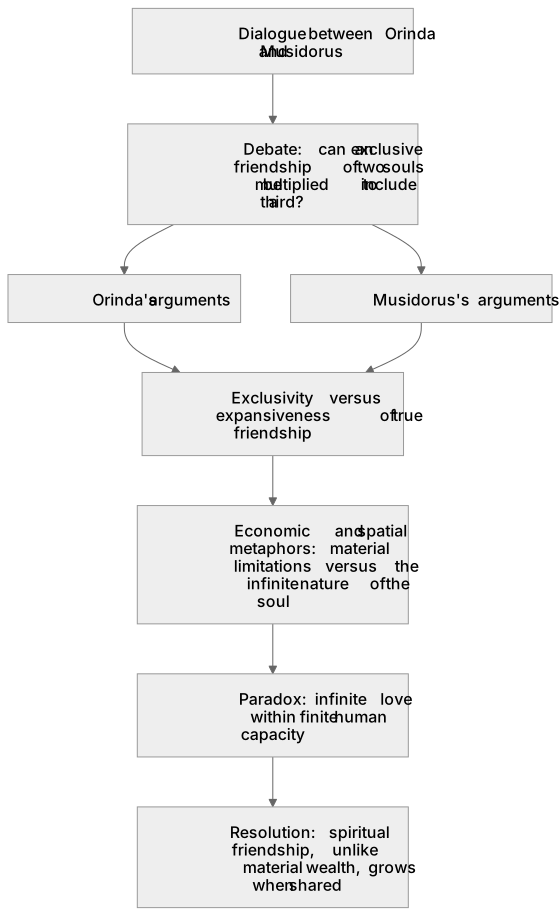
Key words
Say what each word means before you turn the card.
Philosophical debate
Try answering aloud or in your head before turning the card.
Infinity versus limitation
Try answering aloud or in your head before turning the card.
Coterie and community
Try answering aloud or in your head before turning the card.
The nature of friendship
Try answering aloud or in your head before turning the card.
See every definition
- Philosophical debate
- A dialogue between intellectual equals exploring a concept, rather than a literal argument between enemies.
- Infinity versus limitation
- The paradox of infinite love within finite human capacity, contrasted through economic and spatial metaphors.
- Coterie and community
- The 17th-century culture of literary coteries and platonic friendship in which Philips's poetry built a network of bonds.
- The nature of friendship
- Whether true friendship, often conceptualised as an exclusive union of two souls, can be multiplied without diluting its intensity.
Label the diagram
Some boxes have lost their names. Pick the right name for each number.
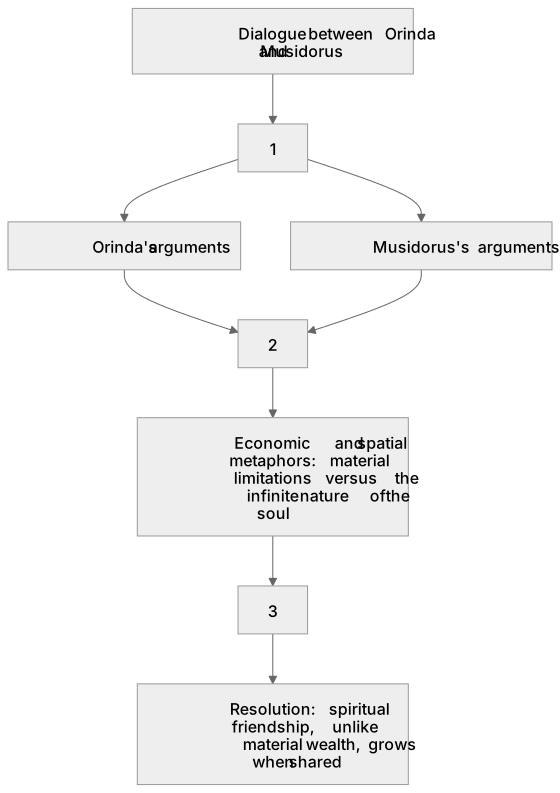
1Box 1
2Box 2
3Box 3
There is more to this lesson
The full lesson goes on to check your understanding and help you earn the marks. Create a free account to carry on, with your progress saved.
A week of Premium from your first lesson · Then the free plan continues · No card, no charge
Test your understanding of Component 3: Poetry – Section B: Specified Poetry Pre- or Post-1900 – Pre-1900 – Metaphysical Poetry – Metaphysical Poetry, editor Colin Burrow (Penguin, 2006): A Dialogue of Friendship Multiplied
Active recall beats re-reading. Take an instant quiz now to test what you’ve learned and lock it into long-term memory.
A week of Premium from your first lesson · Then the free plan continues · No card, no charge