Pearson Edexcel · A-Level · English Literature
Course version: 9ET0 · Version from Sept 2015
Poetry – Section B: Specified Poetry Pre- or Post-1900 – Pre-1900 –…
Full specification wording
Component 3: Poetry – Section B: Specified Poetry Pre- or Post-1900 – Pre-1900 – Metaphysical Poetry – Metaphysical Poetry, editor Colin Burrow (Penguin, 2006): Song: To Lucasta, Going to the Wars Richard Lovelace
Richard Lovelace’s Cavalier lyric explores the tension between romantic love and masculine duty during the English Civil War.
Checked against the Pearson Edexcel 9ET0 specification (opens in a new tab) on .
- Point 19 of 23
- 4 key terms
Study notes
From the checked teaching notes for this specification point.
The idea
Richard Lovelace’s Cavalier lyric explores the tension between romantic love and masculine duty during the English Civil War. The speaker addresses his lover, justifying his departure to fight by elevating military honour above romantic devotion. The poem employs a regular alternating rhyme scheme and iambic metre to reflect the speaker’s rational, measured argument. Key imagery includes the personification of war as a new mistress, highlighting the era's chivalric codes and the metaphysical conceit of transferring romantic fidelity to martial obligation.
What earns the marks
- Analyse the personification of war as a 'new mistress' and its effect on the poem's tone.
- Evaluate the use of paradox in the final stanza regarding the relationship between love and honour.
- Discuss the impact of the regular lyric form and alternating rhyme scheme on the speaker's persuasive argument.
- Connect the poem to its Cavalier context and the chivalric ideals prevalent during the English Civil War.
Common mistakes and how to put them right
Categorising Lovelace strictly as a Metaphysical poet without acknowledging his Cavalier traits.
Put it right: Identify Lovelace as a Cavalier poet whose work is included in the Metaphysical anthology due to shared contextual and stylistic elements like paradox.
Misinterpreting the speaker's departure as a rejection of Lucasta.
Put it right: Explain that the speaker views his military duty as an extension of his capacity to love, not a rejection of it.
Ignoring the poem's formal structure.
Put it right: Link the controlled, song-like structure to the speaker's attempt to present a logical, soothing argument to his lover.
Exam tips
- Compare Lovelace's treatment of duty and honour with other poets in the anthology, such as Marvell or Donne.
- Focus on the specific lexical choices in the second stanza that conflate military weaponry with romantic pursuit.
- Use the term 'Cavalier poetry' to contextualise the speaker's allegiance to King Charles I and chivalric codes.
Try the lesson
The start of the Component 3: Poetry – Section B: Specified Poetry Pre- or Post-1900 – Pre-1900 – Metaphysical Poetry – Metaphysical Poetry, editor Colin Burrow (Penguin, 2006): Song: To Lucasta, Going to the Wars Richard Lovelace lesson, made from checked teaching notes for this specification point.
Have a go first
In Richard Lovelace's 'Song: To Lucasta, Going to the Wars', what is the speaker's primary justification for leaving his beloved to go to war?
Listen
Richard Lovelace’s Cavalier lyric explores the tension between romantic love and masculine duty during the English Civil War. The speaker addresses his lover, justifying his departure to fight by elevating military honour above romantic devotion. The poem employs a regular alternating rhyme scheme and iambic metre to reflect the speaker’s rational, measured argument. Key imagery includes the personification of war as a new mistress, highlighting the era's chivalric codes and the metaphysical conceit of transferring romantic fidelity to martial obligation. A strong answer earns marks for these points. Analyse the personification of war as a 'new mistress' and its effect on the poem's tone. Evaluate the use of paradox in the final stanza regarding the relationship between love and honour. Discuss the impact of the regular lyric form and alternating rhyme scheme on the speaker's persuasive argument. Connect the poem to its Cavalier context and the chivalric ideals prevalent during the English Civil War. A common slip: Categorising Lovelace strictly as a Metaphysical poet without acknowledging his Cavalier traits. Instead, Identify Lovelace as a Cavalier poet whose work is included in the Metaphysical anthology due to shared contextual and stylistic elements like paradox. Exam tip: Compare Lovelace's treatment of duty and honour with other poets in the anthology, such as Marvell or Donne.
See it
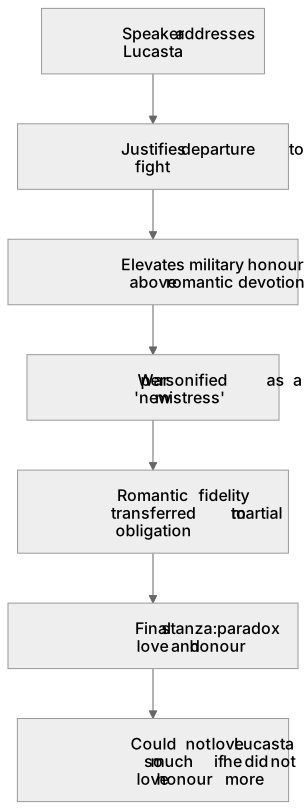
Put it in order
Put these steps in the order they happen.
- 1. Could not love Lucasta so much if he did not love honour more
- 2. Final stanza: paradox of love and honour
- 3. Elevates military honour above romantic devotion
- 4. Romantic fidelity transferred to martial obligation
- 5. Speaker addresses Lucasta
- 6. Justifies departure to fight
- 7. War personified as a 'new mistress'
Key words
Say what each word means before you turn the card.
Love and Duty
Try answering aloud or in your head before turning the card.
Honour and Chivalry
Try answering aloud or in your head before turning the card.
Masculinity
Try answering aloud or in your head before turning the card.
War and Conflict
Try answering aloud or in your head before turning the card.
See every definition
- Love and Duty
- The tension between romantic love and masculine duty during the English Civil War, which the speaker addresses by justifying his departure to fight.
- Honour and Chivalry
- The chivalric codes of the era, which the speaker draws on by elevating military honour above romantic devotion and transferring romantic fidelity to martial obligation.
- Masculinity
- The masculine duty the speaker sets against romantic love, presented through the personification of war as a new mistress.
- War and Conflict
- The English Civil War, during which the speaker leaves his lover to fight, with war personified as a new mistress.
Label the diagram
Some boxes have lost their names. Pick the right name for each number.
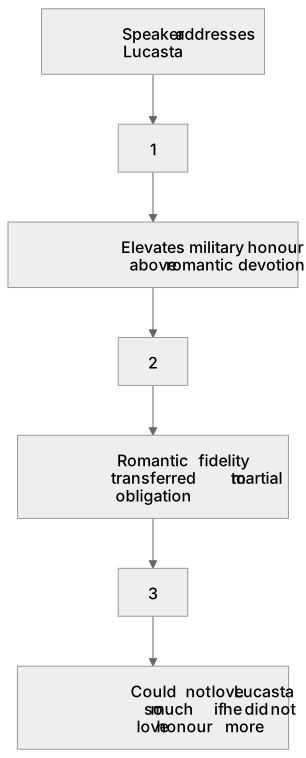
1Box 1
2Box 2
3Box 3
There is more to this lesson
The full lesson goes on to check your understanding and help you earn the marks. Create a free account to carry on, with your progress saved.
A week of Premium from your first lesson · Then the free plan continues · No card, no charge
Test your understanding of Component 3: Poetry – Section B: Specified Poetry Pre- or Post-1900 – Pre-1900 – Metaphysical Poetry – Metaphysical Poetry, editor Colin Burrow (Penguin, 2006): Song: To Lucasta, Going to the Wars Richard Lovelace
Active recall beats re-reading. Take an instant quiz now to test what you’ve learned and lock it into long-term memory.
A week of Premium from your first lesson · Then the free plan continues · No card, no charge