Pearson Edexcel · A-Level · English Literature
Course version: 9ET0 · Version from Sept 2015
Poetry – Section B: Specified Poetry Pre- or Post-1900 – Pre-1900 –…
Full specification wording
Component 3: Poetry – Section B: Specified Poetry Pre- or Post-1900 – Pre-1900 – Metaphysical Poetry – Metaphysical Poetry, editor Colin Burrow (Penguin, 2006): The Nymph Complaining for the Death of her Fawn Andrew Marvell
Andrew Marvell’s pastoral elegy uses the death of a pet fawn to explore profound themes of grief, lost innocence, and betrayal.
Checked against the Pearson Edexcel 9ET0 specification (opens in a new tab) on .
- Point 20 of 23
- 4 key terms
Study notes
From the checked teaching notes for this specification point.
The idea
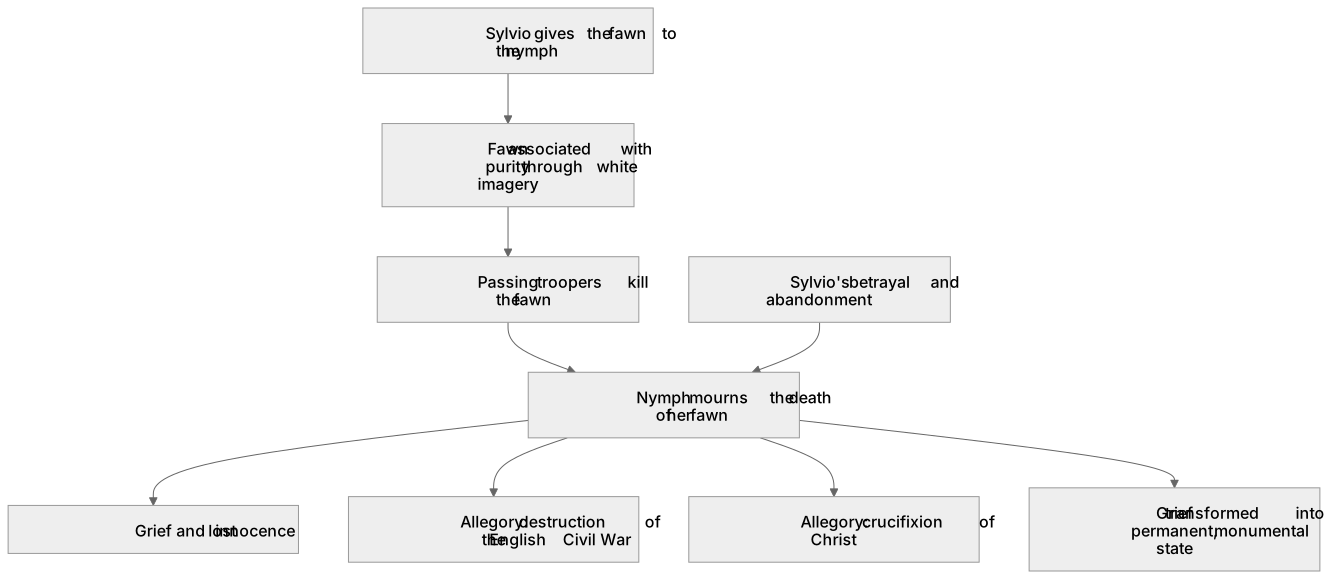
Andrew Marvell’s pastoral elegy uses the death of a pet fawn to explore profound themes of grief, lost innocence, and betrayal. The speaker, a young nymph, mourns the creature killed by passing troopers, which critics often interpret as an allegory for the destruction of the English Civil War or the crucifixion of Christ. Key areas for analysis include the fawn's association with purity through white imagery, the betrayal by the nymph's former lover Sylvio, and the transformation of the nymph's grief into a permanent, monumental state.
What earns the marks
- Analyse the use of white imagery and its connotations of purity, innocence, and religious sacrifice.
- Evaluate the allegorical interpretations of the troopers and the fawn in the context of the English Civil War.
- Discuss the significance of Sylvio's betrayal and how it parallels the violence of the outside world.
- Examine the effect of the iambic tetrameter couplets in creating a tension between naive tone and complex subject matter.
Common mistakes and how to put them right
Reading the poem purely as a literal story about a pet without acknowledging allegorical layers.
Put it right: Explore the political and religious allegories, such as the fawn representing Christ or the victims of the Civil War.
Confusing the nymph's voice with Marvell's own perspective.
Put it right: Treat the nymph as a distinct dramatic persona whose naive perspective is deliberately constructed by Marvell.
Overlooking the role of Sylvio in the poem's tragedy.
Put it right: Analyse how Sylvio's initial gift of the fawn and subsequent abandonment initiates the nymph's experience of betrayal and loss.
Exam tips
- Link the pastoral setting of the poem to Marvell's broader use of nature as a space for philosophical reflection.
- Contrast the violence of the 'wanton troopers' with the gentle, spiritualised descriptions of the fawn.
- Consider how the final image of the weeping statue connects to Renaissance traditions of monumental poetry and Ovidian metamorphosis.
Try the lesson
The start of the Component 3: Poetry – Section B: Specified Poetry Pre- or Post-1900 – Pre-1900 – Metaphysical Poetry – Metaphysical Poetry, editor Colin Burrow (Penguin, 2006): The Nymph Complaining for the Death of her Fawn Andrew Marvell lesson, made from checked teaching notes for this specification point.
Have a go first
In Andrew Marvell's poem 'The Nymph Complaining for the Death of her Fawn', who originally gives the fawn to the speaker?
Listen
Andrew Marvell’s pastoral elegy uses the death of a pet fawn to explore profound themes of grief, lost innocence, and betrayal. The speaker, a young nymph, mourns the creature killed by passing troopers, which critics often interpret as an allegory for the destruction of the English Civil War or the crucifixion of Christ. Key areas for analysis include the fawn's association with purity through white imagery, the betrayal by the nymph's former lover Sylvio, and the transformation of the nymph's grief into a permanent, monumental state. A strong answer earns marks for these points. Analyse the use of white imagery and its connotations of purity, innocence, and religious sacrifice. Evaluate the allegorical interpretations of the troopers and the fawn in the context of the English Civil War. Discuss the significance of Sylvio's betrayal and how it parallels the violence of the outside world. Examine the effect of the iambic tetrameter couplets in creating a tension between naive tone and complex subject matter. A common slip: Reading the poem purely as a literal story about a pet without acknowledging allegorical layers. Instead, Explore the political and religious allegories, such as the fawn representing Christ or the victims of the Civil War. Exam tip: Link the pastoral setting of the poem to Marvell's broader use of nature as a space for philosophical reflection.
See it
Key words
Say what each word means before you turn the card.
Innocence and Experience
Try answering aloud or in your head before turning the card.
Grief and Loss
Try answering aloud or in your head before turning the card.
Religion and Allegory
Try answering aloud or in your head before turning the card.
Nature vs Violence
Try answering aloud or in your head before turning the card.
See every definition
- Innocence and Experience
- The poem explores lost innocence through the death of a pet fawn, with the nymph mourning the creature and the purity associated with it.
- Grief and Loss
- The speaker, a young nymph, mourns the fawn killed by passing troopers, and her grief is transformed into a permanent, monumental state.
- Religion and Allegory
- Critics often interpret the fawn's death as an allegory for the crucifixion of Christ, with white imagery carrying connotations of religious sacrifice.
- Nature vs Violence
- The pastoral setting links nature to philosophical reflection, contrasting the violence of the 'wanton troopers' with the gentle, spiritualised descriptions of the fawn.
Label the diagram
Some boxes have lost their names. Pick the right name for each number.
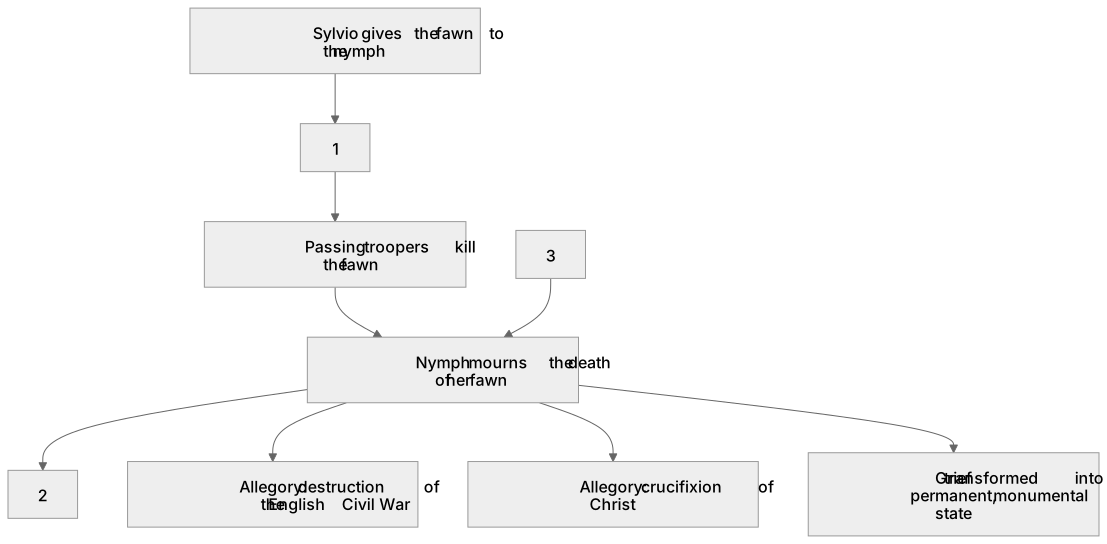
1Box 1
2Box 2
3Box 3
There is more to this lesson
The full lesson goes on to check your understanding and help you earn the marks. Create a free account to carry on, with your progress saved.
A week of Premium from your first lesson · Then the free plan continues · No card, no charge
Test your understanding of Component 3: Poetry – Section B: Specified Poetry Pre- or Post-1900 – Pre-1900 – Metaphysical Poetry – Metaphysical Poetry, editor Colin Burrow (Penguin, 2006): The Nymph Complaining for the Death of her Fawn Andrew Marvell
Active recall beats re-reading. Take an instant quiz now to test what you’ve learned and lock it into long-term memory.
A week of Premium from your first lesson · Then the free plan continues · No card, no charge