Pearson Edexcel · A-Level · English Literature
Course version: 9ET0 · Version from Sept 2015
Poetry – Section B: Specified Poetry Pre- or Post-1900 – Pre-1900 –…
Full specification wording
Component 3: Poetry – Section B: Specified Poetry Pre- or Post-1900 – Pre-1900 – Metaphysical Poetry – Metaphysical Poetry, editor Colin Burrow (Penguin, 2006): The Flea John Donne
John Donne’s 'The Flea' is a quintessential metaphysical poem that employs a startling conceit to construct a seductive argument.
Checked against the Pearson Edexcel 9ET0 specification (opens in a new tab) on .
- Point 1 of 23
- 4 key terms
Study notes
From the checked teaching notes for this specification point.
The idea
John Donne’s 'The Flea' is a quintessential metaphysical poem that employs a startling conceit to construct a seductive argument. The speaker uses the image of a flea, which has bitten both him and his beloved, to argue that their blood is already mingled, thus trivialising her concerns about premarital sex. The poem exemplifies the metaphysical blending of the intellectual and the erotic, requiring students to evaluate how Donne manipulates logic, rhythm, and dramatic monologue to persuade the silent female addressee and challenge 17th-century moral conventions.
What earns the marks
- Analyse the central conceit of the flea as a microcosm for sexual union and marriage.
- Evaluate the use of religious and sacrilegious imagery, such as 'cloister' and 'marriage temple', in advancing the speaker's argument.
- Examine the structural progression of the poem's three stanzas, noting how the speaker adapts his argument in response to the woman's actions.
- Discuss the poem in the context of 17th-century attitudes towards honour, virginity, and courtship.
Common mistakes and how to put them right
Reading the poem as a straightforward romantic lyric.
Put it right: Analyse the poem as a witty, intellectual exercise in persuasion and rhetorical manipulation.
Ignoring the implied presence and actions of the female addressee.
Put it right: Track how the woman's silent actions, such as crushing the flea, force the speaker to pivot his logical argument in the final stanza.
Misinterpreting the mingling of blood as a literal medical belief of the time.
Put it right: Understand the mingling of blood as a metaphorical conceit representing sexual intercourse and the physical union of marriage.
Exam tips
- Trace the shifting tone of the speaker, from playful persuasion to mock-indignation, to demonstrate a nuanced understanding of the dramatic monologue.
- Analyse the rhyme scheme (AABBCCDDD) and how the final triplet in each stanza reinforces the speaker's concluding logical point.
- Connect the poem's blending of the sacred and the profane to broader trends in Donne's early poetry.
Try the lesson
The start of the Component 3: Poetry – Section B: Specified Poetry Pre- or Post-1900 – Pre-1900 – Metaphysical Poetry – Metaphysical Poetry, editor Colin Burrow (Penguin, 2006): The Flea John Donne lesson, made from checked teaching notes for this specification point.
Have a go first
In John Donne's poem 'The Flea', what does the speaker primarily use the image of the flea to represent?
Listen
John Donne’s 'The Flea' is a quintessential metaphysical poem that employs a startling conceit to construct a seductive argument. The speaker uses the image of a flea, which has bitten both him and his beloved, to argue that their blood is already mingled, thus trivialising her concerns about premarital sex. The poem exemplifies the metaphysical blending of the intellectual and the erotic, requiring students to evaluate how Donne manipulates logic, rhythm, and dramatic monologue to persuade the silent female addressee and challenge 17th-century moral conventions. A strong answer earns marks for these points. Analyse the central conceit of the flea as a microcosm for sexual union and marriage. Evaluate the use of religious and sacrilegious imagery, such as 'cloister' and 'marriage temple', in advancing the speaker's argument. Examine the structural progression of the poem's three stanzas, noting how the speaker adapts his argument in response to the woman's actions. Discuss the poem in the context of 17th-century attitudes towards honour, virginity, and courtship. A common slip: Reading the poem as a straightforward romantic lyric. Instead, Analyse the poem as a witty, intellectual exercise in persuasion and rhetorical manipulation. Exam tip: Trace the shifting tone of the speaker, from playful persuasion to mock-indignation, to demonstrate a nuanced understanding of the dramatic monologue.
See it
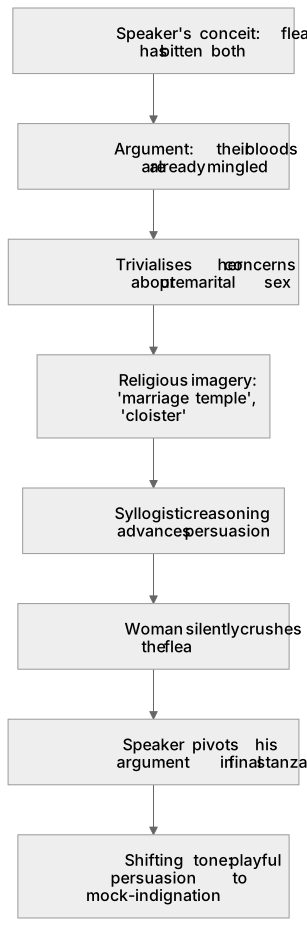
Put it in order
Put these steps in the order they happen.
- 1. Syllogistic reasoning advances persuasion
- 2. Shifting tone: playful persuasion to mock-indignation
- 3. Woman silently crushes the flea
- 4. Speaker's conceit: flea has bitten both
- 5. Argument: their bloods are already mingled
- 6. Speaker pivots his argument in final stanza
- 7. Trivialises her concerns about premarital sex
- 8. Religious imagery: 'marriage temple', 'cloister'
Key words
Say what each word means before you turn the card.
Conceit
Try answering aloud or in your head before turning the card.
Syllogistic reasoning
Try answering aloud or in your head before turning the card.
Dramatic monologue
Try answering aloud or in your head before turning the card.
The sacred and the profane
Try answering aloud or in your head before turning the card.
See every definition
- Conceit
- A startling image, such as the flea, used to construct a seductive argument in a metaphysical poem.
- Syllogistic reasoning
- A form of logic the speaker uses to build his persuasive argument across the poem.
- Dramatic monologue
- A form in which the speaker manipulates logic, rhythm and tone to persuade a silent female addressee.
- The sacred and the profane
- The blending of religious imagery, such as the 'marriage temple', with erotic argument in the poem.
Label the diagram
Some boxes have lost their names. Pick the right name for each number.
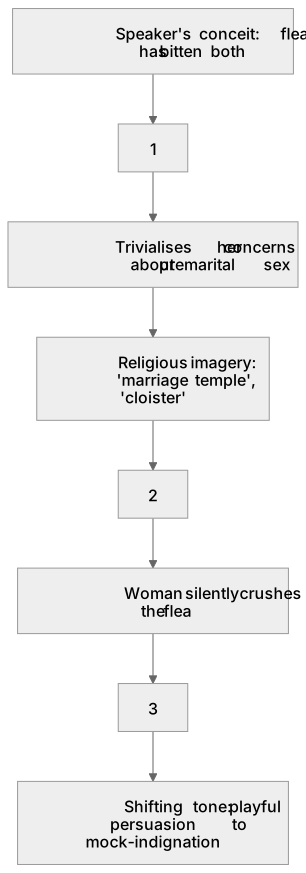
1Box 1
2Box 2
3Box 3
There is more to this lesson
The full lesson goes on to check your understanding and help you earn the marks. Create a free account to carry on, with your progress saved.
A week of Premium from your first lesson · Then the free plan continues · No card, no charge
Test your understanding of Component 3: Poetry – Section B: Specified Poetry Pre- or Post-1900 – Pre-1900 – Metaphysical Poetry – Metaphysical Poetry, editor Colin Burrow (Penguin, 2006): The Flea John Donne
Active recall beats re-reading. Take an instant quiz now to test what you’ve learned and lock it into long-term memory.
A week of Premium from your first lesson · Then the free plan continues · No card, no charge