Pearson Edexcel · A-Level · English Literature
Course version: 9ET0 · Version from Sept 2015
Poetry – Section B: Specified Poetry Pre- or Post-1900 – Pre-1900 –…
Full specification wording
Component 3: Poetry – Section B: Specified Poetry Pre- or Post-1900 – Pre-1900 – Metaphysical Poetry – Metaphysical Poetry, editor Colin Burrow (Penguin, 2006): The Good Morrow
John Donne's 'The Good Morrow' is a quintessential metaphysical poem celebrating the spiritual and physical awakening of true love.
Checked against the Pearson Edexcel 9ET0 specification (opens in a new tab) on .
- Point 2 of 23
- 4 key terms
Study notes
From the checked teaching notes for this specification point.
The idea
John Donne's 'The Good Morrow' is a quintessential metaphysical poem celebrating the spiritual and physical awakening of true love. The speaker dismisses their past lives as mere childish slumber, contrasting this with the enlightened present where their souls awaken to one another. Donne employs complex conceits, notably comparing the lovers' microcosm to the macrocosm of the newly discovered world, asserting that their love forms a perfect, immortal sphere ('without sharp north, without declining west').
What earns the marks
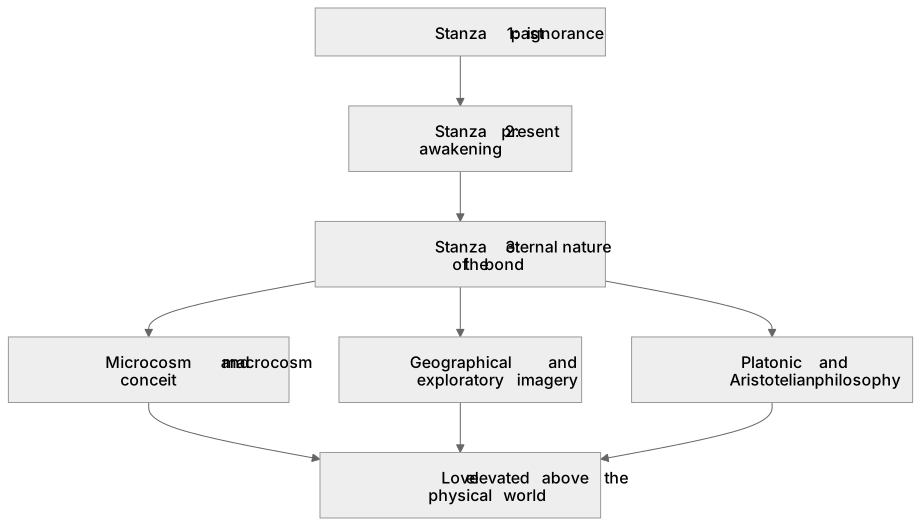
- Analyse Donne's use of the microcosm and macrocosm conceit to elevate the lovers' relationship above the physical world.
- Evaluate the structural progression across the three stanzas: past ignorance, present awakening, and future eternity.
- Explore the significance of geographical and exploratory imagery in the context of Renaissance expansion and cartography.
- Discuss the application of Platonic and Aristotelian philosophy regarding perfect mixtures and immortality in the final stanza.
Common mistakes and how to put them right
Assuming the poem is solely about physical lust.
Put it right: Emphasise that while physical love is present, the poem ultimately celebrates a spiritual union that transcends the physical.
Misinterpreting 'seven sleepers' den' as a random religious reference.
Put it right: Explain it as a specific allusion to Catholic legend, used hyperbolically to emphasise the depth of their past ignorance.
Ignoring the historical context of exploration.
Put it right: Connect the 'new worlds' imagery directly to the Age of Discovery and Renaissance mapmaking.
Exam tips
- Compare the confident, reciprocal love in 'The Good Morrow' with the unrequited or cynical love found in other metaphysical poems.
- Focus closely on the shift in pronouns from 'I' and 'thou' to 'we', illustrating the unification of the lovers' souls.
- Use the phrase 'metaphysical conceit' explicitly when analysing the comparison between the lovers' eyes and hemispheres.
Try the lesson
The start of the Component 3: Poetry – Section B: Specified Poetry Pre- or Post-1900 – Pre-1900 – Metaphysical Poetry – Metaphysical Poetry, editor Colin Burrow (Penguin, 2006): The Good Morrow lesson, made from checked teaching notes for this specification point.
Have a go first
In John Donne's 'The Good Morrow', how does the speaker characterise the lovers' lives before they found each other?
Listen
John Donne's 'The Good Morrow' is a quintessential metaphysical poem celebrating the spiritual and physical awakening of true love. The speaker dismisses their past lives as mere childish slumber, contrasting this with the enlightened present where their souls awaken to one another. Donne employs complex conceits, notably comparing the lovers' microcosm to the macrocosm of the newly discovered world, asserting that their love forms a perfect, immortal sphere ('without sharp north, without declining west'). A strong answer earns marks for these points. Analyse Donne's use of the microcosm and macrocosm conceit to elevate the lovers' relationship above the physical world. Evaluate the structural progression across the three stanzas: past ignorance, present awakening, and future eternity. Explore the significance of geographical and exploratory imagery in the context of Renaissance expansion and cartography. Discuss the application of Platonic and Aristotelian philosophy regarding perfect mixtures and immortality in the final stanza. A common slip: Assuming the poem is solely about physical lust. Instead, Emphasise that while physical love is present, the poem ultimately celebrates a spiritual union that transcends the physical. Exam tip: Compare the confident, reciprocal love in 'The Good Morrow' with the unrequited or cynical love found in other metaphysical poems.
See it
Key words
Say what each word means before you turn the card.
Spiritual vs Physical Love
Try answering aloud or in your head before turning the card.
Awakening and Enlightenment
Try answering aloud or in your head before turning the card.
Microcosm and Macrocosm
Try answering aloud or in your head before turning the card.
Time and Eternity
Try answering aloud or in your head before turning the card.
See every definition
- Spiritual vs Physical Love
- The poem celebrates a union that is spiritual as well as physical, transcending the physical rather than being solely about physical lust.
- Awakening and Enlightenment
- The enlightened present in which the lovers' souls awaken to one another, contrasted with past lives dismissed as mere childish slumber.
- Microcosm and Macrocosm
- A conceit comparing the lovers' microcosm to the macrocosm of the newly discovered world, elevating their relationship above the physical world.
- Time and Eternity
- The structural progression across the three stanzas, from past ignorance to present revelation and finally to the eternal nature of the lovers' bond.
Label the diagram
Some boxes have lost their names. Pick the right name for each number.
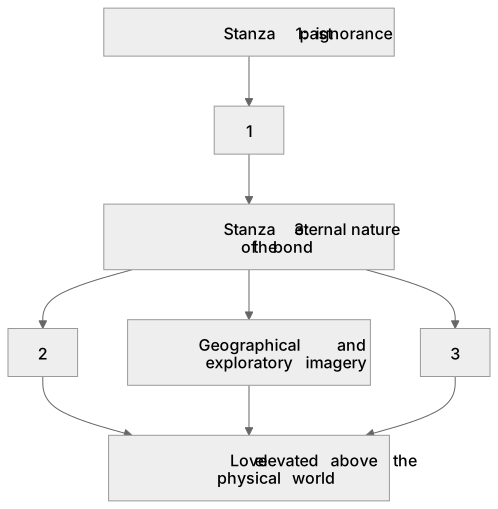
1Box 1
2Box 2
3Box 3
There is more to this lesson
The full lesson goes on to check your understanding and help you earn the marks. Create a free account to carry on, with your progress saved.
A week of Premium from your first lesson · Then the free plan continues · No card, no charge
Test your understanding of Component 3: Poetry – Section B: Specified Poetry Pre- or Post-1900 – Pre-1900 – Metaphysical Poetry – Metaphysical Poetry, editor Colin Burrow (Penguin, 2006): The Good Morrow
Active recall beats re-reading. Take an instant quiz now to test what you’ve learned and lock it into long-term memory.
A week of Premium from your first lesson · Then the free plan continues · No card, no charge