Pearson Edexcel · A-Level · English Literature
Course version: 9ET0 · Version from Sept 2015
Poetry – Section B: Specified Poetry Pre- or Post-1900 – Pre-1900 –…
Full specification wording
Component 3: Poetry – Section B: Specified Poetry Pre- or Post-1900 – Pre-1900 – Metaphysical Poetry – Metaphysical Poetry, editor Colin Burrow (Penguin, 2006): The Sun Rising
John Donne’s ‘The Sun Rising’ is a metaphysical aubade in which the speaker arrogantly chides the morning sun for interrupting his time with his lover.
Checked against the Pearson Edexcel 9ET0 specification (opens in a new tab) on .
- Point 5 of 23
- 3 key terms
Study notes
From the checked teaching notes for this specification point.
The idea
John Donne’s ‘The Sun Rising’ is a metaphysical aubade in which the speaker arrogantly chides the morning sun for interrupting his time with his lover. The poem explores the theme of microcosmic love, where the lovers’ bedroom is elevated to become the entire universe, rendering the external world irrelevant. Donne employs striking hyperbole and metaphysical conceits, famously declaring ‘She's all states, and all princes, I’. The tone shifts from colloquial irritation in the opening stanza to a triumphant, philosophical assertion of love's supremacy. Ultimately, the speaker uses twisted logic to argue that since the sun's duty is to warm the world, and their bed is the world, the sun need only shine on them to fulfil its cosmic role.
What earns the marks
- Analyse the personification of the sun as a 'Busy old fool' and 'unruly' intruder to establish the speaker's arrogant, colloquial tone.
- Evaluate the use of the microcosm conceit, where the lovers' bedroom replaces the macrocosm of the external world.
- Explore the use of hyperbole and political imagery, such as 'all states' and 'all princes', to elevate the status of the romantic relationship.
- Examine the logical progression of the speaker's argument across the three stanzas, culminating in the paradox that the sun revolves around their bed.
Common mistakes and how to put them right
Misinterpreting the speaker's arrogance as genuine anger.
Put it right: Recognise the playful, hyperbolic nature of the speaker's chiding of the sun.
Overlooking the aubade tradition.
Put it right: Explicitly identify the poem as an aubade and discuss how Donne subverts the traditional morning lament.
Failing to connect the political imagery to the era of exploration.
Put it right: Link references to 'the Indias of spice and mine' to seventeenth-century colonial expansion and wealth.
Exam tips
- Use the term 'microcosm' to describe how the lovers' private world is presented as a miniature version of the universe.
- Compare the confident, transcendent love in this poem with the cynical, fleeting love depicted in 'Woman's Constancy'.
- Analyse the changing tone across the three stanzas, from irritation to confident superiority, to show structural awareness.
Try the lesson
The start of the Component 3: Poetry – Section B: Specified Poetry Pre- or Post-1900 – Pre-1900 – Metaphysical Poetry – Metaphysical Poetry, editor Colin Burrow (Penguin, 2006): The Sun Rising lesson, made from checked teaching notes for this specification point.
Have a go first
In the opening lines of John Donne's "The Sun Rising", how does the speaker initially address the sun?
Listen
John Donne’s ‘The Sun Rising’ is a metaphysical aubade in which the speaker arrogantly chides the morning sun for interrupting his time with his lover. The poem explores the theme of microcosmic love, where the lovers’ bedroom is elevated to become the entire universe, rendering the external world irrelevant. Donne employs striking hyperbole and metaphysical conceits, famously declaring ‘She's all states, and all princes, I’. The tone shifts from colloquial irritation in the opening stanza to a triumphant, philosophical assertion of love's supremacy. Ultimately, the speaker uses twisted logic to argue that since the sun's duty is to warm the world, and their bed is the world, the sun need only shine on them to fulfil its cosmic role. A strong answer earns marks for these points. Analyse the personification of the sun as a 'Busy old fool' and 'unruly' intruder to establish the speaker's arrogant, colloquial tone. Evaluate the use of the microcosm conceit, where the lovers' bedroom replaces the macrocosm of the external world. Explore the use of hyperbole and political imagery, such as 'all states' and 'all princes', to elevate the status of the romantic relationship. Examine the logical progression of the speaker's argument across the three stanzas, culminating in the paradox that the sun revolves around their bed. A common slip: Misinterpreting the speaker's arrogance as genuine anger. Instead, recognise the playful, hyperbolic nature of the speaker's chiding of the sun. Exam tip: Use the term 'microcosm' to describe how the lovers' private world is presented as a miniature version of the universe.
See it
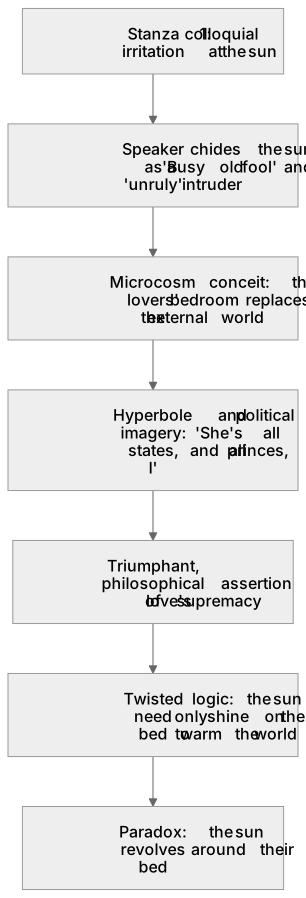
Put it in order
Put these steps in the order they happen.
- 1. Paradox: the sun revolves around their bed
- 2. Twisted logic: the sun need only shine on their bed to warm the world
- 3. Microcosm conceit: the lovers' bedroom replaces the external world
- 4. Triumphant, philosophical assertion of love's supremacy
- 5. Stanza 1: colloquial irritation at the sun
- 6. Speaker chides the sun as a 'Busy old fool' and 'unruly' intruder
- 7. Hyperbole and political imagery: 'She's all states, and all princes, I'
Key words
Say what each word means before you turn the card.
Microcosm
Try answering aloud or in your head before turning the card.
Hyperbole
Try answering aloud or in your head before turning the card.
Metaphysical conceit
Try answering aloud or in your head before turning the card.
See every definition
- Microcosm
- The conceit in which the lovers' bedroom is elevated to become the entire universe, rendering the external world irrelevant.
- Hyperbole
- Striking exaggeration employed by Donne to elevate the status of the romantic relationship.
- Metaphysical conceit
- A striking conceit through which the lovers' private world is presented as a miniature version of the universe.
Label the diagram
Some boxes have lost their names. Pick the right name for each number.
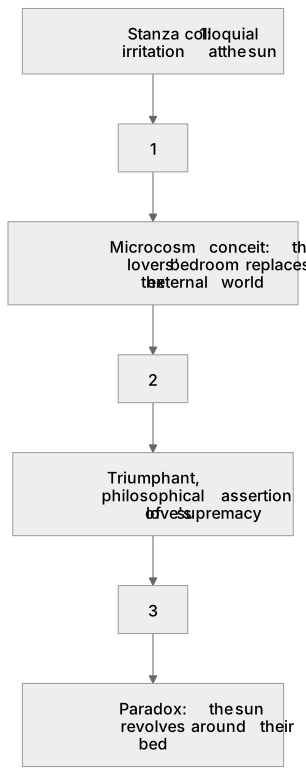
1Box 1
2Box 2
3Box 3
There is more to this lesson
The full lesson goes on to check your understanding and help you earn the marks. Create a free account to carry on, with your progress saved.
A week of Premium from your first lesson · Then the free plan continues · No card, no charge
Test your understanding of Component 3: Poetry – Section B: Specified Poetry Pre- or Post-1900 – Pre-1900 – Metaphysical Poetry – Metaphysical Poetry, editor Colin Burrow (Penguin, 2006): The Sun Rising
Active recall beats re-reading. Take an instant quiz now to test what you’ve learned and lock it into long-term memory.
A week of Premium from your first lesson · Then the free plan continues · No card, no charge