Pearson Edexcel · A-Level · English Literature
Course version: 9ET0 · Version from Sept 2015
Poetry – Section B: Specified Poetry Pre- or Post-1900 – Pre-1900 –…
Full specification wording
Component 3: Poetry – Section B: Specified Poetry Pre- or Post-1900 – Pre-1900 – Metaphysical Poetry – Metaphysical Poetry, editor Colin Burrow (Penguin, 2006): Woman’s Constancy
John Donne’s ‘Woman’s Constancy’ is a cynical metaphysical poem that satirises traditional courtly love by exploring the fleeting nature of romantic fidelity.
Checked against the Pearson Edexcel 9ET0 specification (opens in a new tab) on .
- Point 4 of 23
- 4 key terms
Study notes
From the checked teaching notes for this specification point.
The idea
John Donne’s ‘Woman’s Constancy’ is a cynical metaphysical poem that satirises traditional courtly love by exploring the fleeting nature of romantic fidelity. The speaker anticipates his lover’s excuses for abandoning him after a single night, mocking her potential arguments through complex legalistic and philosophical conceits. For example, he imagines her claiming that time changes them, meaning they are no longer the same people bound by yesterday's oaths. The poem's dramatic monologue structure relies heavily on rhetorical questions to build a mock-logical argument. The final twist reveals the speaker’s own fickleness, as he admits he might feel exactly the same way tomorrow, subverting the reader's expectations of a betrayed lover.
What earns the marks
- Analyse the use of rhetorical questions to create a dramatic, argumentative tone typical of metaphysical poetry.
- Evaluate the speaker's use of legal and philosophical terminology, such as 'contracts' and 'oaths', to satirise romantic promises.
- Explore the structural shift in the final lines where the speaker reveals his own inconstancy, subverting the initial accusatory tone.
- Compare the poem's cynical attitude towards love and fidelity with other metaphysical poems in the anthology.
Common mistakes and how to put them right
Assuming the speaker is genuinely heartbroken.
Put it right: Recognise the cynical, playful tone and the final twist where the speaker admits his own fickleness.
Ignoring the legalistic language.
Put it right: Explicitly analyse terms like 'contracts' and 'bind' to show how Donne uses logic to deconstruct romance.
Treating the poem as a straightforward narrative.
Put it right: Identify it as a dramatic monologue featuring an imagined, one-sided dialogue with a silent lover.
Exam tips
- Link the poem's argumentative structure to the metaphysical conceit of using logic to explain emotional states.
- Contrast the cynical tone of this poem with Donne's more sincere explorations of love, such as 'The Good-Morrow'.
- Focus on the abrupt volta at the end of the poem to demonstrate an understanding of Donne's structural subversions.
Try the lesson
The start of the Component 3: Poetry – Section B: Specified Poetry Pre- or Post-1900 – Pre-1900 – Metaphysical Poetry – Metaphysical Poetry, editor Colin Burrow (Penguin, 2006): Woman’s Constancy lesson, made from checked teaching notes for this specification point.
Have a go first
In John Donne's 'Woman's Constancy', what situation does the speaker anticipate occurring by the following day?
Listen
John Donne’s ‘Woman’s Constancy’ is a cynical metaphysical poem that satirises traditional courtly love by exploring the fleeting nature of romantic fidelity. The speaker anticipates his lover’s excuses for abandoning him after a single night, mocking her potential arguments through complex legalistic and philosophical conceits. For example, he imagines her claiming that time changes them, meaning they are no longer the same people bound by yesterday's oaths. The poem's dramatic monologue structure relies heavily on rhetorical questions to build a mock-logical argument. The final twist reveals the speaker’s own fickleness, as he admits he might feel exactly the same way tomorrow, subverting the reader's expectations of a betrayed lover. A strong answer earns marks for these points. Analyse the use of rhetorical questions to create a dramatic, argumentative tone typical of metaphysical poetry. Evaluate the speaker's use of legal and philosophical terminology, such as 'contracts' and 'oaths', to satirise romantic promises. Explore the structural shift in the final lines where the speaker reveals his own inconstancy, subverting the initial accusatory tone. Compare the poem's cynical attitude towards love and fidelity with other metaphysical poems in the anthology. A common slip: Assuming the speaker is genuinely heartbroken. Instead, recognise the cynical, playful tone and the final twist where the speaker admits his own fickleness. Exam tip: Link the poem's argumentative structure to the metaphysical conceit of using logic to explain emotional states.
See it
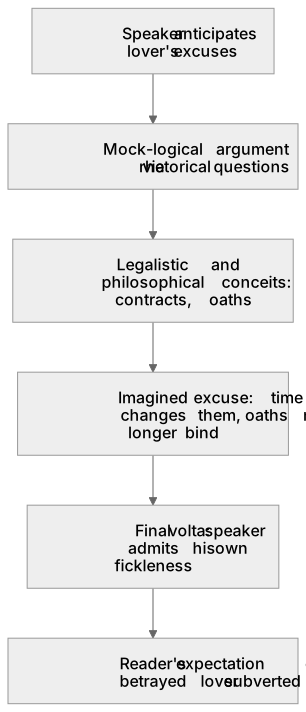
Put it in order
Put these steps in the order they happen.
- 1. Legalistic and philosophical conceits: contracts, oaths
- 2. Mock-logical argument via rhetorical questions
- 3. Speaker anticipates lover's excuses
- 4. Reader's expectation of betrayed lover subverted
- 5. Final volta: speaker admits his own fickleness
- 6. Imagined excuse: time changes them, oaths no longer bind
Key words
Say what each word means before you turn the card.
Inconstancy and fidelity
Try answering aloud or in your head before turning the card.
Satire of courtly love
Try answering aloud or in your head before turning the card.
The passage of time
Try answering aloud or in your head before turning the card.
Logic versus emotion
Try answering aloud or in your head before turning the card.
See every definition
- Inconstancy and fidelity
- The poem explores the fleeting nature of romantic fidelity, as the speaker anticipates his lover's excuses for abandoning him after a single night.
- Satire of courtly love
- A cynical metaphysical poem that mocks traditional courtly love by exposing the fleeting nature of romantic promises.
- The passage of time
- The speaker imagines his lover claiming that time changes them, so they are no longer the same people bound by yesterday's oaths.
- Logic versus emotion
- The poem builds a mock-logical argument through rhetorical questions and legalistic and philosophical conceits to explain emotional states.
Label the diagram
Some boxes have lost their names. Pick the right name for each number.
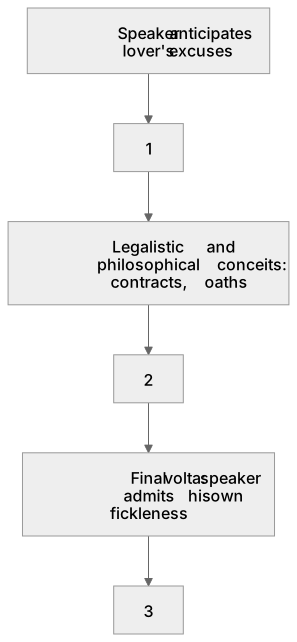
1Box 1
2Box 2
3Box 3
There is more to this lesson
The full lesson goes on to check your understanding and help you earn the marks. Create a free account to carry on, with your progress saved.
A week of Premium from your first lesson · Then the free plan continues · No card, no charge
Test your understanding of Component 3: Poetry – Section B: Specified Poetry Pre- or Post-1900 – Pre-1900 – Metaphysical Poetry – Metaphysical Poetry, editor Colin Burrow (Penguin, 2006): Woman’s Constancy
Active recall beats re-reading. Take an instant quiz now to test what you’ve learned and lock it into long-term memory.
A week of Premium from your first lesson · Then the free plan continues · No card, no charge