Pearson Edexcel · A-Level · English Literature
Course version: 9ET0 · Version from Sept 2015
Poetry – Section B: Specified Poetry Pre- or Post-1900 – Pre-1900 – The…
Full specification wording
Component 3: Poetry – Section B: Specified Poetry Pre- or Post-1900 – Pre-1900 – The Medieval Period – Everyman and Medieval Miracle Plays, editor A C Cawley (Everyman, 1993): Noah’s Flood (Chester) Anon
'Noah’s Flood' from the Chester Mystery Cycle is an anonymous medieval miracle play dramatising the biblical deluge.
Checked against the Pearson Edexcel 9ET0 specification (opens in a new tab) on .
- Point 1 of 3
- 4 key terms
Study notes
From the checked teaching notes for this specification point.
The idea
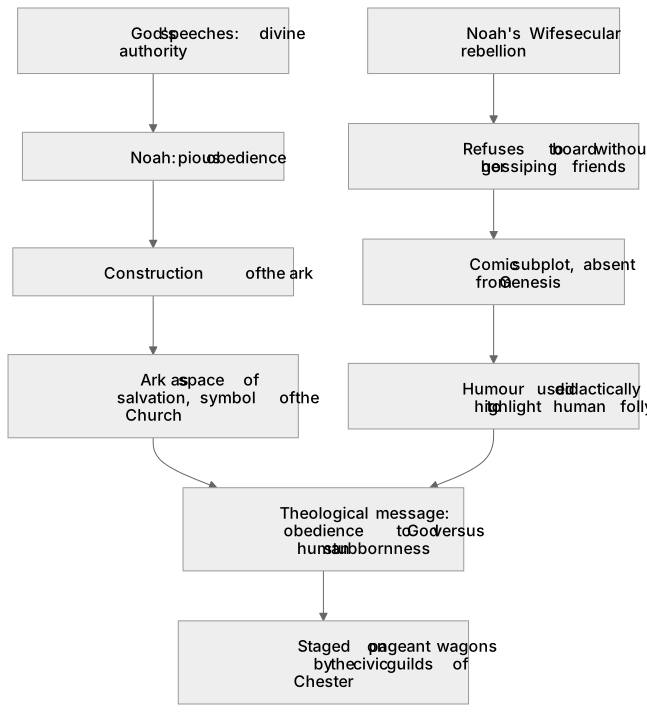
'Noah’s Flood' from the Chester Mystery Cycle is an anonymous medieval miracle play dramatising the biblical deluge. It is celebrated for its dynamic blend of solemn religious instruction and lively secular comedy, particularly through the characterisation of Noah’s Wife as a recalcitrant figure who refuses to board the ark without her gossiping friends. This comic interpolation engaged the medieval civic audience while reinforcing the theological message of obedience to God versus human stubbornness.
What earns the marks
- Analyse the dramatic function of comedy and domestic conflict in conveying theological messages.
- Explore the characterisation of Noah as a figure of pious obedience contrasted with his wife's secular rebellion.
- Evaluate the use of staging, props, and spatial dynamics, such as the construction of the ark, in medieval civic theatre.
- Examine the typological significance of the flood narrative, linking the Old Testament event to New Testament salvation.
Common mistakes and how to put them right
Treating the play purely as a biblical transcription.
Put it right: Analyse the original dramatic additions, such as the comic subplot of Noah's Wife, which are absent from the Genesis account.
Viewing the comedy as disrespectful to the religious subject matter.
Put it right: Understand that medieval drama frequently used humour didactically to engage audiences and highlight human folly.
Ignoring the original performance context.
Put it right: Discuss the play in relation to its staging on pageant wagons by the civic guilds of Chester.
Exam tips
- Focus on the dramatic contrast between the divine authority of God's speeches and the colloquial, earthly dialogue of the human characters.
- Analyse the symbolic importance of the ark as a space of salvation and how physical movement on and off it reflects spiritual obedience.
- Use specific examples of the play's rhyme scheme and metre to show how the anonymous playwright controls pace and tone during moments of conflict.
Try the lesson
The start of the Component 3: Poetry – Section B: Specified Poetry Pre- or Post-1900 – Pre-1900 – The Medieval Period – Everyman and Medieval Miracle Plays, editor A C Cawley (Everyman, 1993): Noah’s Flood (Chester) Anon lesson, made from checked teaching notes for this specification point.
Have a go first
In the Chester mystery play *Noah's Flood*, what is the primary source of comic conflict before the floodwaters rise?
Listen
Noah’s Flood' from the Chester Mystery Cycle is an anonymous medieval miracle play dramatising the biblical deluge. It is celebrated for its dynamic blend of solemn religious instruction and lively secular comedy, particularly through the characterisation of Noah’s Wife as a recalcitrant figure who refuses to board the ark without her gossiping friends. This comic interpolation engaged the medieval civic audience while reinforcing the theological message of obedience to God versus human stubbornness. A strong answer earns marks for these points. Analyse the dramatic function of comedy and domestic conflict in conveying theological messages. Explore the characterisation of Noah as a figure of pious obedience contrasted with his wife's secular rebellion. Evaluate the use of staging, props, and spatial dynamics, such as the construction of the ark, in medieval civic theatre. Examine the typological significance of the flood narrative, linking the Old Testament event to New Testament salvation. A common slip: Treating the play purely as a biblical transcription. Instead, Analyse the original dramatic additions, such as the comic subplot of Noah's Wife, which are absent from the Genesis account. Exam tip: Focus on the dramatic contrast between the divine authority of God's speeches and the colloquial, earthly dialogue of the human characters.
See it
Key words
Say what each word means before you turn the card.
Obedience and rebellion
Try answering aloud or in your head before turning the card.
Divine judgement and salvation
Try answering aloud or in your head before turning the card.
Gender and domestic hierarchy
Try answering aloud or in your head before turning the card.
Civic and religious identity
Try answering aloud or in your head before turning the card.
See every definition
- Obedience and rebellion
- The theological message of obedience to God versus human stubbornness, conveyed through Noah as a figure of pious obedience contrasted with his wife's secular rebellion.
- Divine judgement and salvation
- The typological significance of the flood narrative, linking the Old Testament event to New Testament salvation, with the ark representing the Church.
- Gender and domestic hierarchy
- The domestic conflict between Noah and his wife, whose refusal to board the ark without her gossiping friends forms a comic subplot absent from the Genesis account.
- Civic and religious identity
- The play's staging on pageant wagons by the civic guilds of Chester, engaging the medieval civic audience while reinforcing its didactic purpose.
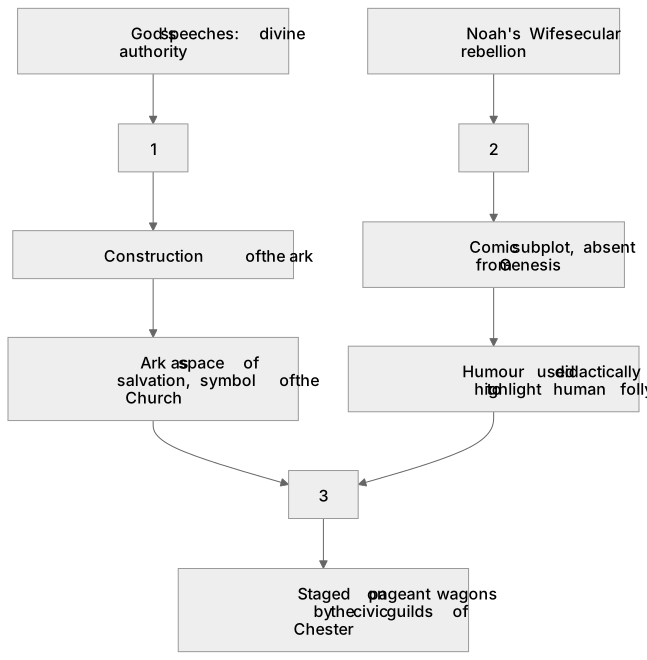
Label the diagram
Some boxes have lost their names. Pick the right name for each number.
1Box 1
2Box 2
3Box 3
There is more to this lesson
The full lesson goes on to check your understanding and help you earn the marks. Create a free account to carry on, with your progress saved.
A week of Premium from your first lesson · Then the free plan continues · No card, no charge
Test your understanding of Component 3: Poetry – Section B: Specified Poetry Pre- or Post-1900 – Pre-1900 – The Medieval Period – Everyman and Medieval Miracle Plays, editor A C Cawley (Everyman, 1993): Noah’s Flood (Chester) Anon
Active recall beats re-reading. Take an instant quiz now to test what you’ve learned and lock it into long-term memory.
A week of Premium from your first lesson · Then the free plan continues · No card, no charge