Pearson Edexcel · A-Level · English Literature
Course version: 9ET0 · Version from Sept 2015
Poetry – Section B: Specified Poetry Pre- or Post-1900 – Pre-1900 – The…
Full specification wording
Component 3: Poetry – Section B: Specified Poetry Pre- or Post-1900 – Pre-1900 – The Medieval Period – Everyman and Medieval Miracle Plays, editor A C Cawley (Everyman, 1993): The Second Shepherds' Pageant (Wakefield)
The Second Shepherds' Pageant, attributed to the Wakefield Master, is a masterpiece of medieval drama that brilliantly juxtaposes secular farce with sacred mystery.
Checked against the Pearson Edexcel 9ET0 specification (opens in a new tab) on .
- Point 2 of 3
- 4 key terms
Study notes
From the checked teaching notes for this specification point.
The idea
The Second Shepherds' Pageant, attributed to the Wakefield Master, is a masterpiece of medieval drama that brilliantly juxtaposes secular farce with sacred mystery. The play opens with stark social commentary as the shepherds lament their poverty, oppressive lords, and harsh weather, grounding the religious narrative in contemporary medieval reality. The transition from the farcical punishment of Mak—being tossed in a canvas—to the angelic annunciation highlights the thematic shift from earthly suffering to divine redemption. The shepherds' humble gifts to the Christ child, including a tennis ball and a bird, emphasise the accessibility of grace for ordinary people.
What earns the marks
- Analyse the Wakefield Master's distinctive nine-line stanza form and its effect on pacing and comic timing.
- Evaluate the use of parody and parallelism between the stolen sheep (a false 'Lamb') and the Christ child (the true Lamb of God).
- Discuss the social realism in the opening soliloquies, focusing on complaints about feudal oppression, marriage, and weather.
- Explore the blending of the comic and the sacred, demonstrating how the farce enhances rather than diminishes the religious message.
Common mistakes and how to put them right
Treating the play solely as a comedy.
Put it right: Ensure analysis balances the comic subplot with the serious theological message of the Nativity.
Ignoring the historical context of mystery plays.
Put it right: Explicitly connect the play's staging and themes to its original purpose of educating and entertaining a medieval lay audience.
Overlooking the specific poetic form.
Put it right: Analyse the complex rhyme scheme and rhythm of the Wakefield stanza rather than treating the text as prose.
Exam tips
- Compare the shepherds' earthly complaints in the opening with their spiritual joy at the end to demonstrate structural understanding.
- Use the specific gifts (cherries, bird, tennis ball) as evidence of the play's anachronistic blending of biblical times with medieval Yorkshire.
- When discussing Mak and Gill, focus on how their deceitful marriage contrasts with the Holy Family.
Try the lesson
The start of the Component 3: Poetry – Section B: Specified Poetry Pre- or Post-1900 – Pre-1900 – The Medieval Period – Everyman and Medieval Miracle Plays, editor A C Cawley (Everyman, 1993): The Second Shepherds' Pageant (Wakefield) lesson, made from checked teaching notes for this specification point.
Have a go first
In *The Second Shepherds' Pageant*, what object does Mak attempt to pass off as a newborn baby to hide his theft?
Listen
The Second Shepherds' Pageant, attributed to the Wakefield Master, is a masterpiece of medieval drama that brilliantly juxtaposes secular farce with sacred mystery. The play opens with stark social commentary as the shepherds lament their poverty, oppressive lords, and harsh weather, grounding the religious narrative in contemporary medieval reality. The transition from the farcical punishment of Mak—being tossed in a canvas—to the angelic annunciation highlights the thematic shift from earthly suffering to divine redemption. The shepherds' humble gifts to the Christ child, including a tennis ball and a bird, emphasise the accessibility of grace for ordinary people. A strong answer earns marks for these points. Analyse the Wakefield Master's distinctive nine-line stanza form and its effect on pacing and comic timing. Evaluate the use of parody and parallelism between the stolen sheep (a false 'Lamb') and the Christ child (the true Lamb of God). Discuss the social realism in the opening soliloquies, focusing on complaints about feudal oppression, marriage, and weather. Explore the blending of the comic and the sacred, demonstrating how the farce enhances rather than diminishes the religious message. A common slip: Treating the play solely as a comedy. Instead, ensure analysis balances the comic subplot with the serious theological message of the Nativity. Exam tip: Compare the shepherds' earthly complaints in the opening with their spiritual joy at the end to demonstrate structural understanding.
See it
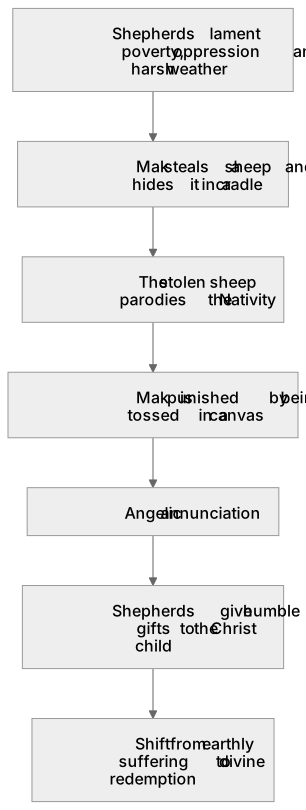
Put it in order
Put these steps in the order they happen.
- 1. Shift from earthly suffering to divine redemption
- 2. Shepherds give humble gifts to the Christ child
- 3. The stolen sheep parodies the Nativity
- 4. Angelic annunciation
- 5. Shepherds lament poverty, oppression and harsh weather
- 6. Mak steals a sheep and hides it in a cradle
- 7. Mak is punished by being tossed in a canvas
Key words
Say what each word means before you turn the card.
Social injustice and poverty
Try answering aloud or in your head before turning the card.
The blending of the sacred and profane
Try answering aloud or in your head before turning the card.
Deception and truth
Try answering aloud or in your head before turning the card.
Redemption and grace
Try answering aloud or in your head before turning the card.
See every definition
- Social injustice and poverty
- The shepherds lament their poverty, oppressive lords and harsh weather, grounding the religious narrative in contemporary medieval reality.
- The blending of the sacred and profane
- Secular farce is juxtaposed with sacred mystery, and the farce enhances rather than diminishes the religious message.
- Deception and truth
- Mak steals a sheep and hides it in a cradle, a deceitful parody of the biblical Nativity.
- Redemption and grace
- The thematic shift from earthly suffering to divine redemption is highlighted, with grace made accessible for ordinary people.
Label the diagram
Some boxes have lost their names. Pick the right name for each number.
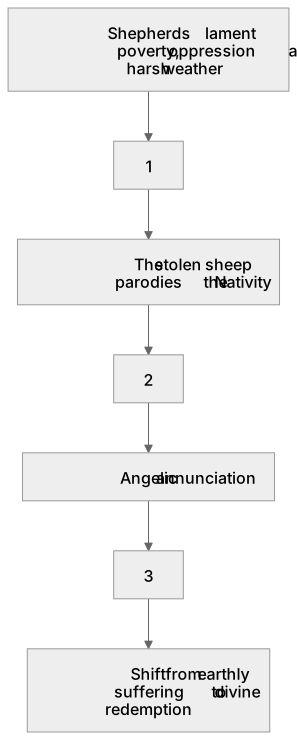
1Box 1
2Box 2
3Box 3
There is more to this lesson
The full lesson goes on to check your understanding and help you earn the marks. Create a free account to carry on, with your progress saved.
A week of Premium from your first lesson · Then the free plan continues · No card, no charge
Test your understanding of Component 3: Poetry – Section B: Specified Poetry Pre- or Post-1900 – Pre-1900 – The Medieval Period – Everyman and Medieval Miracle Plays, editor A C Cawley (Everyman, 1993): The Second Shepherds' Pageant (Wakefield)
Active recall beats re-reading. Take an instant quiz now to test what you’ve learned and lock it into long-term memory.
A week of Premium from your first lesson · Then the free plan continues · No card, no charge