Pearson Edexcel · A-Level · English Literature
Course version: 9ET0 · Version from Sept 2015
Poetry – Section B: Specified Poetry Pre- or Post-1900 – Pre-1900 – The…
Full specification wording
Component 3: Poetry – Section B: Specified Poetry Pre- or Post-1900 – Pre-1900 – The Medieval Period – Everyman and Medieval Miracle Plays, editor A C Cawley (Everyman, 1993): The Crucifixion (York)
The York Crucifixion is renowned for its stark realism, attributed to the anonymous York Realist.
Checked against the Pearson Edexcel 9ET0 specification (opens in a new tab) on .
- Point 3 of 3
- 4 key terms
Study notes
From the checked teaching notes for this specification point.
The idea
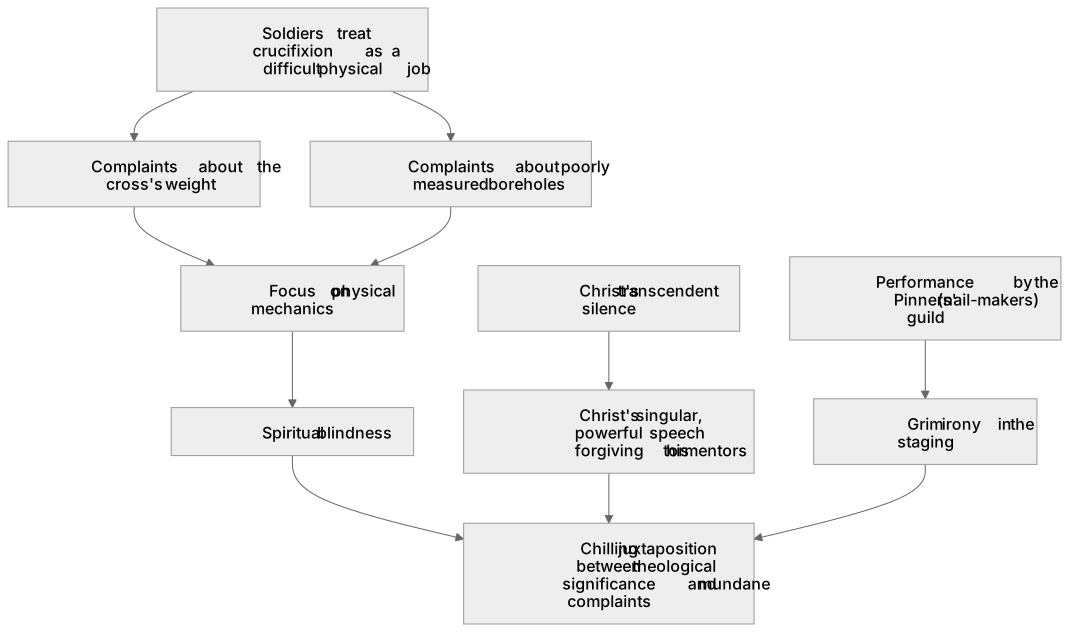
The York Crucifixion is renowned for its stark realism, attributed to the anonymous York Realist. The soldiers treat the crucifixion merely as a difficult physical job, complaining about the cross's weight and poorly measured boreholes, highlighting their spiritual blindness. This focus on physical mechanics contrasts sharply with Christ's transcendent silence and his singular, powerful speech forgiving his tormentors. Analysis should also consider the play's original performance by the Pinners' (nail-makers) guild, adding a layer of grim irony to the staging.
What earns the marks
- Analyse the dramatic effect of the soldiers' colloquial language and focus on the physical mechanics of the crucifixion.
- Evaluate the contrast between the soldiers' continuous, chaotic dialogue and Christ's dignified, sparse utterances.
- Discuss the use of dramatic irony, particularly how the soldiers' ignorance of Christ's divinity emphasises the theme of spiritual blindness.
- Explore the significance of the play's staging by the Pinners' guild and how this context informs the detailed focus on nails and craftsmanship.
Common mistakes and how to put them right
Focusing solely on the religious narrative without analysing the dramatic techniques.
Put it right: Ensure detailed analysis of the soldiers' dialogue, staging, and the York Realist's poetic style.
Misinterpreting the soldiers as purely evil.
Put it right: Analyse them as ordinary workmen blinded by their task, which deepens the tragedy and highlights the theme of human ignorance.
Ignoring the visual elements of the play.
Put it right: Discuss the grotesque, brutally practical stage action of stretching Christ to fit the cross and the soldiers' workmanlike detachment as central to the play's impact.
Exam tips
- Contrast the horizontal action (stretching and nailing Christ) with the vertical action (raising the cross) to discuss the play's dramatic pacing.
- Use short quotations of the soldiers' complaints (e.g., about their aching backs) to demonstrate the York Realist's use of mundane detail.
- Connect Christ's plea for forgiveness directly to the soldiers' preceding actions to highlight the central theological message of grace.
Try the lesson
The start of the Component 3: Poetry – Section B: Specified Poetry Pre- or Post-1900 – Pre-1900 – The Medieval Period – Everyman and Medieval Miracle Plays, editor A C Cawley (Everyman, 1993): The Crucifixion (York) lesson, made from checked teaching notes for this specification point.
Have a go first
Which characters are primarily responsible for the dialogue and action in the York *Crucifixion* play?
Listen
The York Crucifixion is renowned for its stark realism, attributed to the anonymous York Realist. The soldiers treat the crucifixion merely as a difficult physical job, complaining about the cross's weight and poorly measured boreholes, highlighting their spiritual blindness. This focus on physical mechanics contrasts sharply with Christ's transcendent silence and his singular, powerful speech forgiving his tormentors. Analysis should also consider the play's original performance by the Pinners' (nail-makers) guild, adding a layer of grim irony to the staging. A strong answer earns marks for these points. Analyse the dramatic effect of the soldiers' colloquial language and focus on the physical mechanics of the crucifixion. Evaluate the contrast between the soldiers' continuous, chaotic dialogue and Christ's dignified, sparse utterances. Discuss the use of dramatic irony, particularly how the soldiers' ignorance of Christ's divinity emphasises the theme of spiritual blindness. Explore the significance of the play's staging by the Pinners' guild and how this context informs the detailed focus on nails and craftsmanship. A common slip: Focusing solely on the religious narrative without analysing the dramatic techniques. Instead, ensure detailed analysis of the soldiers' dialogue, staging, and the York Realist's poetic style. Exam tip: Contrast the horizontal action (stretching and nailing Christ) with the vertical action (raising the cross) to discuss the play's dramatic pacing.
See it
Key words
Say what each word means before you turn the card.
Spiritual blindness versus divine truth
Try answering aloud or in your head before turning the card.
The banality of evil
Try answering aloud or in your head before turning the card.
Physical suffering and spiritual transcendence
Try answering aloud or in your head before turning the card.
Duty and complicity
Try answering aloud or in your head before turning the card.
See every definition
- Spiritual blindness versus divine truth
- The soldiers' ignorance of Christ's divinity, shown through their focus on the crucifixion as a difficult physical job, contrasted with Christ's transcendent silence and powerful speech.
- The banality of evil
- The soldiers treat the crucifixion merely as a difficult physical job, complaining about the cross's weight and poorly measured boreholes rather than recognising its theological significance.
- Physical suffering and spiritual transcendence
- The stark realism of the physical mechanics of the crucifixion is contrasted with Christ's transcendent silence and his singular, powerful speech forgiving his tormentors.
- Duty and complicity
- The four soldiers tasked with Christ's execution carry out their work as ordinary workmen, blinded by their task rather than acting as purely evil figures.
Label the diagram
Some boxes have lost their names. Pick the right name for each number.
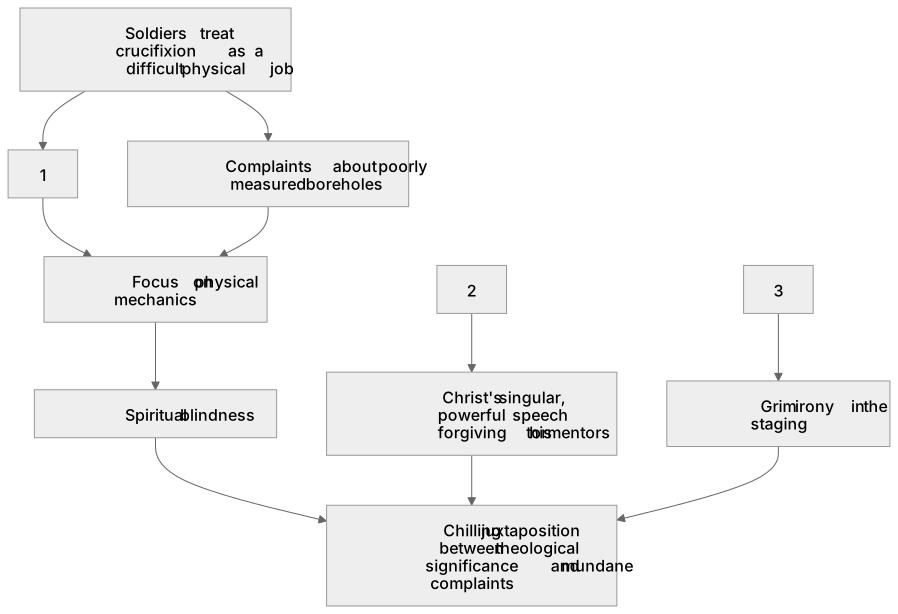
1Box 1
2Box 2
3Box 3
There is more to this lesson
The full lesson goes on to check your understanding and help you earn the marks. Create a free account to carry on, with your progress saved.
A week of Premium from your first lesson · Then the free plan continues · No card, no charge
Test your understanding of Component 3: Poetry – Section B: Specified Poetry Pre- or Post-1900 – Pre-1900 – The Medieval Period – Everyman and Medieval Miracle Plays, editor A C Cawley (Everyman, 1993): The Crucifixion (York)
Active recall beats re-reading. Take an instant quiz now to test what you’ve learned and lock it into long-term memory.
A week of Premium from your first lesson · Then the free plan continues · No card, no charge