Pearson Edexcel · A-Level · English Literature
Course version: 9ET0 · Version from Sept 2015
Poetry – Section B: Specified Poetry Pre- or Post-1900 – Pre-1900 – The…
Full specification wording
Component 3: Poetry – Section B: Specified Poetry Pre- or Post-1900 – Pre-1900 – The Medieval Period – The Wife of Bath’s Prologue and Tale, editor James Winny (Cambridge, 1994): The Wife of Bath’s Prologue Geoffrey Chaucer
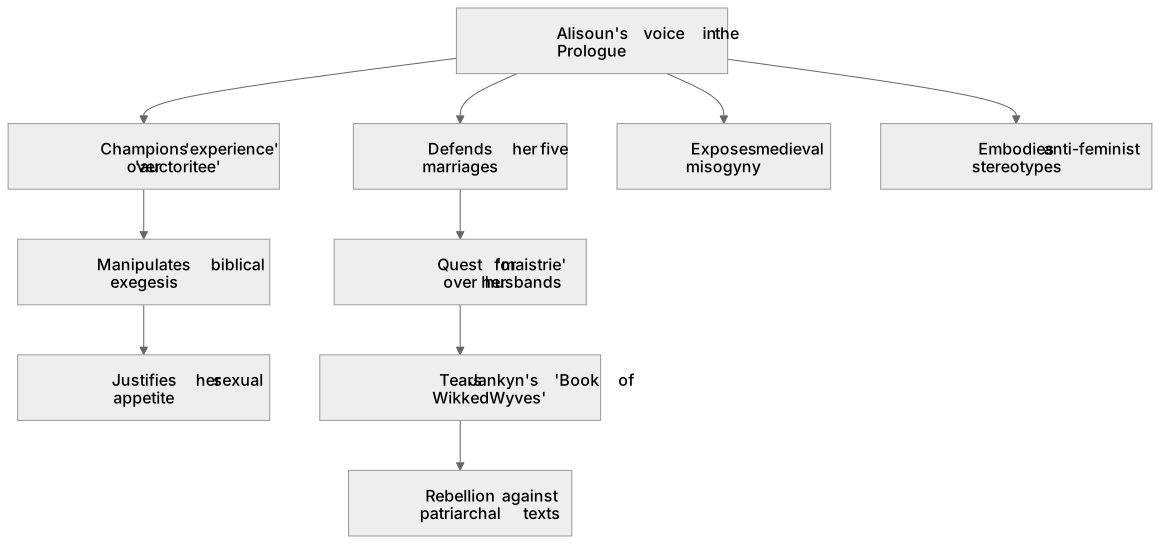
Geoffrey Chaucer’s The Wife of Bath’s Prologue functions as a lengthy, spirited apologia where Alisoun defends her five marriages and champions 'experience' over written 'auctoritee'.
Checked against the Pearson Edexcel 9ET0 specification (opens in a new tab) on .
- Point 1 of 2
- 3 key terms
Study notes
From the checked teaching notes for this specification point.
The idea
Geoffrey Chaucer’s The Wife of Bath’s Prologue functions as a lengthy, spirited apologia where Alisoun defends her five marriages and champions 'experience' over written 'auctoritee'. Key areas of focus include her manipulation of biblical exegesis to justify her sexual appetite and her quest for 'maistrie' (sovereignty) over her husbands.
For example: Her tearing of Jankyn’s 'Book of Wikked Wyves' physically enacts her rebellion against patriarchal texts, making the Prologue a complex study of gender, power, and textual authority in the medieval period.
What earns the marks
- Analyse Chaucer's use of the dramatic monologue and the confessional form to construct Alisoun's voice.
- Evaluate the tension between 'experience' and 'auctoritee' in the Wife's arguments.
- Explore the contextual significance of anti-feminist literature, such as Jankyn's book, and Alisoun's response to it.
- Assess the use of rhetorical devices, irony, and biblical misquotation in her defence of marriage and female sovereignty.
Common mistakes and how to put them right
Treating Alisoun as a modern feminist icon.
Put it right: Analyse her as a complex medieval construct who often reinforces the very anti-feminist stereotypes she attacks.
Ignoring the framing narrative.
Put it right: Alisoun is a pilgrim speaking to an audience, and Chaucer the author is constructing her voice for satirical effect.
Misunderstanding 'maistrie'; correction: define 'maistrie' specifically as sovereignty or mastery within marriage, rather than general female empowerment.
Exam tips
- Always link your analysis of Alisoun's character back to Chaucer's authorial methods and the poetic form.
- Use specific Middle English quotations, such as 'experience, though noon auctoritee', to demonstrate close textual engagement.
- Contextualise your argument by referencing the medieval Church's teachings on virginity, widowhood, and marriage.
Try the lesson
The start of the Component 3: Poetry – Section B: Specified Poetry Pre- or Post-1900 – Pre-1900 – The Medieval Period – The Wife of Bath’s Prologue and Tale, editor James Winny (Cambridge, 1994): The Wife of Bath’s Prologue Geoffrey Chaucer lesson, made from checked teaching notes for this specification point.
Have a go first
In *The Wife of Bath's Prologue*, how does the Wife categorise her five husbands?
Listen
Geoffrey Chaucer’s The Wife of Bath’s Prologue functions as a lengthy, spirited apologia where Alisoun defends her five marriages and champions 'experience' over written 'auctoritee'. Key areas of focus include her manipulation of biblical exegesis to justify her sexual appetite and her quest for 'maistrie' (sovereignty) over her husbands. For example, her tearing of Jankyn’s 'Book of Wikked Wyves' physically enacts her rebellion against patriarchal texts, making the Prologue a complex study of gender, power, and textual authority in the medieval period. A strong answer earns marks for these points. Analyse Chaucer's use of the dramatic monologue and the confessional form to construct Alisoun's voice. Evaluate the tension between 'experience' and 'auctoritee' in the Wife's arguments. Explore the contextual significance of anti-feminist literature, such as Jankyn's book, and Alisoun's response to it. Assess the use of rhetorical devices, irony, and biblical misquotation in her defence of marriage and female sovereignty. A common slip: Treating Alisoun as a modern feminist icon. Instead, analyse her as a complex medieval construct who often reinforces the very anti-feminist stereotypes she attacks. Exam tip: Always link your analysis of Alisoun's character back to Chaucer's authorial methods and the poetic form.
See it
Key words
Say what each word means before you turn the card.
Experience versus Authority
Try answering aloud or in your head before turning the card.
Marriage and Sovereignty
Try answering aloud or in your head before turning the card.
Anti-feminism and Misogyny
Try answering aloud or in your head before turning the card.
See every definition
- Experience versus Authority
- The tension between 'experience' and written 'auctoritee' in the Wife's arguments, which students must evaluate.
- Marriage and Sovereignty
- Her defence of marriage and her quest for 'maistrie', meaning sovereignty or mastery within marriage.
- Anti-feminism and Misogyny
- Medieval misogyny exposed through the dramatic monologue, with Alisoun embodying anti-feminist stereotypes and responding to anti-feminist literature such as Jankyn's book.
Label the diagram
Some boxes have lost their names. Pick the right name for each number.
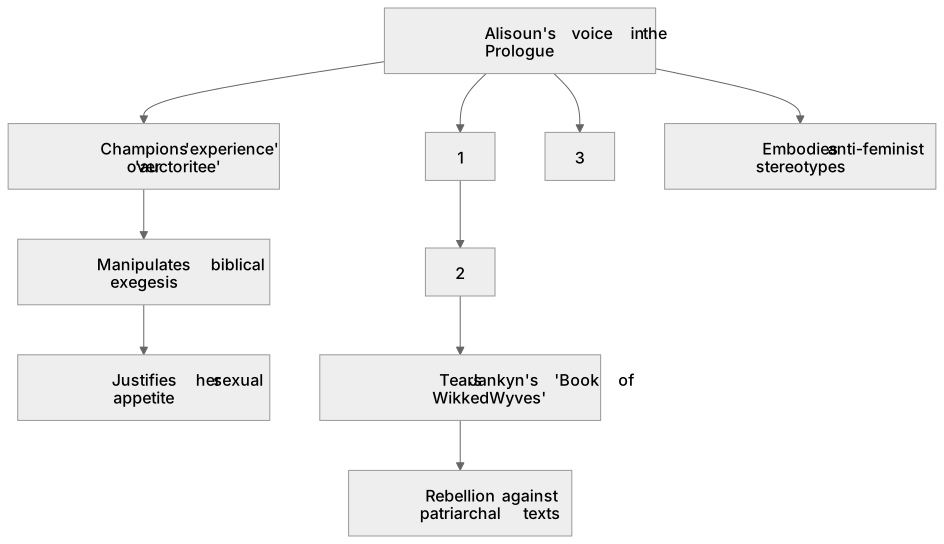
1Box 1
2Box 2
3Box 3
There is more to this lesson
The full lesson goes on to check your understanding and help you earn the marks. Create a free account to carry on, with your progress saved.
A week of Premium from your first lesson · Then the free plan continues · No card, no charge
Test your understanding of Component 3: Poetry – Section B: Specified Poetry Pre- or Post-1900 – Pre-1900 – The Medieval Period – The Wife of Bath’s Prologue and Tale, editor James Winny (Cambridge, 1994): The Wife of Bath’s Prologue Geoffrey Chaucer
Active recall beats re-reading. Take an instant quiz now to test what you’ve learned and lock it into long-term memory.
A week of Premium from your first lesson · Then the free plan continues · No card, no charge