Pearson Edexcel · A-Level · English Literature
Course version: 9ET0 · Version from Sept 2015
Poetry – Section B: Specified Poetry Pre- or Post-1900 – Pre-1900 – The…
Full specification wording
Component 3: Poetry – Section B: Specified Poetry Pre- or Post-1900 – Pre-1900 – The Medieval Period – The Wife of Bath’s Prologue and Tale, editor James Winny (Cambridge, 1994): The Wife of Bath’s Tale
The Wife of Bath’s Tale is an Arthurian romance that serves as a narrative extension of Alisoun’s arguments in her Prologue.
Checked against the Pearson Edexcel 9ET0 specification (opens in a new tab) on .
- Point 2 of 2
- 4 key terms
Study notes
From the checked teaching notes for this specification point.
The idea
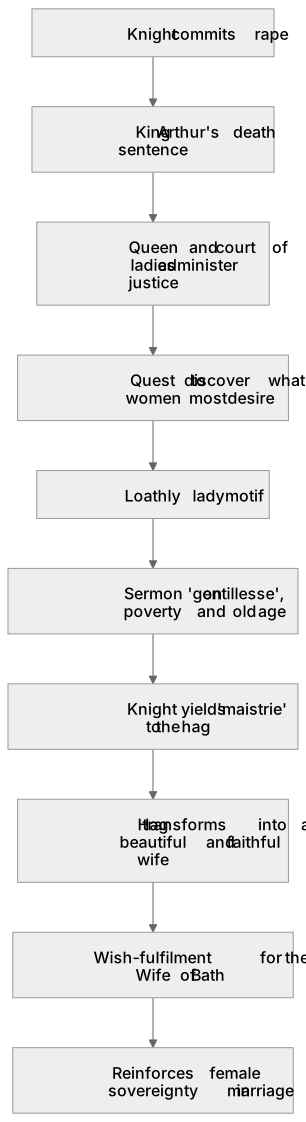
The Wife of Bath’s Tale is an Arthurian romance that serves as a narrative extension of Alisoun’s arguments in her Prologue. The tale follows his quest to discover what women most desire, culminating in the 'loathly lady' motif and a pivotal sermon on 'gentillesse' (true nobility derived from character, not birth). By having the knight yield 'maistrie' to the hag, who then transforms into a beautiful and faithful wife, the tale acts as a wish-fulfilment fantasy for the Wife of Bath, reinforcing her central thesis on female sovereignty in marriage.
What earns the marks
- Analyse the subversion of the Arthurian romance genre and chivalric codes.
- Evaluate the thematic connections between the Tale and the Wife's Prologue, particularly regarding 'maistrie'.
- Examine the significance of the loathly lady's sermon on 'gentillesse', poverty, and old age.
- Assess how the resolution of the tale functions as a form of wish-fulfilment for the narrator.
Common mistakes and how to put them right
Analysing the Tale in isolation.
Put it right: Connect the events and themes of the Tale back to the Wife of Bath's character and her Prologue.
Assuming 'gentillesse' just means being polite.
Put it right: Define 'gentillesse' as a complex medieval concept of true nobility stemming from virtue and divine grace, not aristocratic birth.
Overlooking the initial crime.
Put it right: Address the knight's act of rape as a deliberate subversion of chivalry that sets up the tale's exploration of male violence and female justice.
Exam tips
- Compare the narrative voice of the Tale with the Prologue to show how Alisoun projects her own desires onto the loathly lady.
- Discuss the role of the Queen and her court of ladies in administering justice, contrasting it with King Arthur's initial death sentence.
- Use the concept of 'gentillesse' to explore Chaucer's broader social commentary on class and morality.
Try the lesson
The start of the Component 3: Poetry – Section B: Specified Poetry Pre- or Post-1900 – Pre-1900 – The Medieval Period – The Wife of Bath’s Prologue and Tale, editor James Winny (Cambridge, 1994): The Wife of Bath’s Tale lesson, made from checked teaching notes for this specification point.
Have a go first
In Geoffrey Chaucer's *The Wife of Bath's Tale*, what crime does the knight commit that sets the narrative in motion?
Listen
The Wife of Bath’s Tale is an Arthurian romance that serves as a narrative extension of Alisoun’s arguments in her Prologue. The tale follows his quest to discover what women most desire, culminating in the 'loathly lady' motif and a pivotal sermon on 'gentillesse' (true nobility derived from character, not birth). By having the knight yield 'maistrie' to the hag, who then transforms into a beautiful and faithful wife, the tale acts as a wish-fulfilment fantasy for the Wife of Bath, reinforcing her central thesis on female sovereignty in marriage. A strong answer earns marks for these points. Analyse the subversion of the Arthurian romance genre and chivalric codes. Evaluate the thematic connections between the Tale and the Wife's Prologue, particularly regarding 'maistrie'. Examine the significance of the loathly lady's sermon on 'gentillesse', poverty, and old age. Assess how the resolution of the tale functions as a form of wish-fulfilment for the narrator. A common slip: Analysing the Tale in isolation. Instead, connect the events and themes of the Tale back to the Wife of Bath's character and her Prologue. Exam tip: Compare the narrative voice of the Tale with the Prologue to show how Alisoun projects her own desires onto the loathly lady.
See it
Key words
Say what each word means before you turn the card.
Sovereignty and Power
Try answering aloud or in your head before turning the card.
Gentillesse and Class
Try answering aloud or in your head before turning the card.
Justice and Mercy
Try answering aloud or in your head before turning the card.
Appearance versus Reality
Try answering aloud or in your head before turning the card.
See every definition
- Sovereignty and Power
- The tale reinforces the Wife of Bath's central thesis on female sovereignty in marriage, as the knight yields 'maistrie' to the hag.
- Gentillesse and Class
- A complex medieval concept of true nobility stemming from virtue and divine grace, not aristocratic birth, explored in the loathly lady's sermon.
- Justice and Mercy
- The Queen and her court of ladies administer justice, contrasting with King Arthur's initial death sentence.
- Appearance versus Reality
- The loathly lady transforms into a beautiful and faithful wife after the knight yields 'maistrie' to her.
Label the diagram
Some boxes have lost their names. Pick the right name for each number.
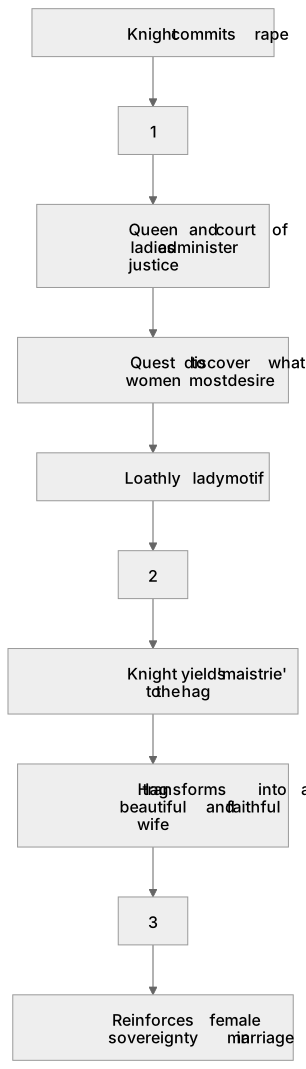
1Box 1
2Box 2
3Box 3
There is more to this lesson
The full lesson goes on to check your understanding and help you earn the marks. Create a free account to carry on, with your progress saved.
A week of Premium from your first lesson · Then the free plan continues · No card, no charge
Test your understanding of Component 3: Poetry – Section B: Specified Poetry Pre- or Post-1900 – Pre-1900 – The Medieval Period – The Wife of Bath’s Prologue and Tale, editor James Winny (Cambridge, 1994): The Wife of Bath’s Tale
Active recall beats re-reading. Take an instant quiz now to test what you’ve learned and lock it into long-term memory.
A week of Premium from your first lesson · Then the free plan continues · No card, no charge