Pearson Edexcel · A-Level · English Literature
Course version: 9ET0 · Version from Sept 2015
Poetry – Section B: Specified Poetry Pre- or Post-1900 – Pre-1900 – The…
Full specification wording
Component 3: Poetry – Section B: Specified Poetry Pre- or Post-1900 – Pre-1900 – The Romantic Period – English Romantic Verse, editor David Wright (Penguin Classics, 1973): Songs of Experience: Holy Thursday
William Blake’s ‘Holy Thursday’ from Songs of Experience challenges the spectacle of institutional charity through a sequence of questions: can child misery in a ‘rich and fruitful land’ be holy…
Checked against the Pearson Edexcel 9ET0 specification (opens in a new tab) on .
- Point 1 of 16
- 3 key terms
Study notes
From the checked teaching notes for this specification point.
The idea
William Blake’s ‘Holy Thursday’ from Songs of Experience challenges the spectacle of institutional charity through a sequence of questions: can child misery in a ‘rich and fruitful land’ be holy or joyful? The poem then answers with the paradox ‘It is a land of poverty’ and develops a landscape of sunlessness, bare fields, thorns and ‘eternal winter’. Four quatrains move from interrogation to bleak declaration and finally to a conditional vision in which sun and rain would make hunger impossible. The first quatrain rhymes ABAB (‘see’/‘misery’, ‘land’/‘hand’); analysis should distinguish this form and the poem’s severe tone from the longer couplets of the Songs of Innocence version.
What earns the marks
- Analyse Blake's use of rhetorical questions to challenge the morality of institutional charity.
- Evaluate the contrast between the 'rich and fruitful land' and the 'land of poverty' to highlight social inequality.
- Explore how four quatrains move from accusatory questions to declarative images of ‘eternal winter’ and then to the conditional hope of the final stanza.
- Connect the poem to the wider Romantic critique of the Industrial Revolution and the established Church.
Common mistakes and how to put them right
Confusing this poem with the Songs of Innocence version.
Put it right: Ensure you explicitly discuss the cynical, critical tone of the Experience poem.
Treating the poem solely as a historical document.
Put it right: To analyse the poetic methods, such as the use of paradox and natural imagery.
Misinterpreting 'usurous hand' as a literal reference to banking.
Put it right by explaining it as a metaphor for the exploitative nature of the institutions supposedly caring for the children.
Exam tips
- Always compare the tone of this poem with its Innocence counterpart if discussing Blake's dual vision.
- Focus on the sensory imagery, particularly the auditory 'trembling cry', to demonstrate how Blake evokes pity and outrage.
- Link the 'eternal winter' metaphor to the lack of spiritual warmth and compassion in society.
Try the lesson
The start of the Component 3: Poetry – Section B: Specified Poetry Pre- or Post-1900 – Pre-1900 – The Romantic Period – English Romantic Verse, editor David Wright (Penguin Classics, 1973): Songs of Experience: Holy Thursday lesson, made from checked teaching notes for this specification point.
Have a go first
How does the speaker in Blake's 'Holy Thursday' from *Songs of Experience* characterise the landscape of England in the opening stanza?
Listen
William Blake’s ‘Holy Thursday’ from Songs of Experience challenges the spectacle of institutional charity through a sequence of questions: can child misery in a ‘rich and fruitful land’ be holy or joyful? The poem then answers with the paradox ‘It is a land of poverty’ and develops a landscape of sunlessness, bare fields, thorns and ‘eternal winter’. Four quatrains move from interrogation to bleak declaration and finally to a conditional vision in which sun and rain would make hunger impossible. The first quatrain rhymes ABAB (‘see’/‘misery’, ‘land’/‘hand’); analysis should distinguish this form and the poem’s severe tone from the longer couplets of the Songs of Innocence version. A strong answer earns marks for these points. Analyse Blake's use of rhetorical questions to challenge the morality of institutional charity. Evaluate the contrast between the 'rich and fruitful land' and the 'land of poverty' to highlight social inequality. Explore how four quatrains move from accusatory questions to declarative images of ‘eternal winter’ and then to the conditional hope of the final stanza. Connect the poem to the wider Romantic critique of the Industrial Revolution and the established Church. A common slip: Misinterpreting 'usurous hand' as a literal reference to banking. Instead, explaining it as a metaphor for the exploitative nature of the institutions supposedly caring for the children. Exam tip: Always compare the tone of this poem with its Innocence counterpart if discussing Blake's dual vision.
See it
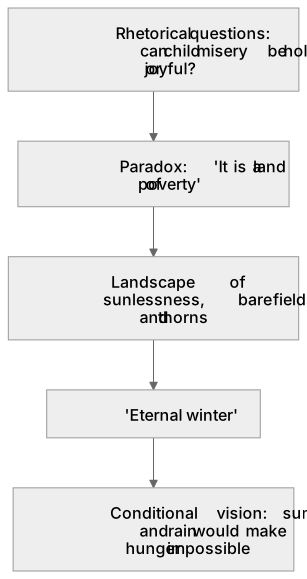
Put it in order
Put these steps in the order they happen.
- 1. Paradox: 'It is a land of poverty'
- 2. Landscape of sunlessness, bare fields and thorns
- 3. Rhetorical questions: can child misery be holy or joyful?
- 4. Conditional vision: sun and rain would make hunger impossible
- 5. 'Eternal winter'
Key words
Say what each word means before you turn the card.
Social injustice
Try answering aloud or in your head before turning the card.
Religious hypocrisy
Try answering aloud or in your head before turning the card.
Poverty and exploitation
Try answering aloud or in your head before turning the card.
See every definition
- Social injustice
- The inequality highlighted by the contrast between the 'rich and fruitful land' and the 'land of poverty'.
- Religious hypocrisy
- The poem's challenge to the morality of institutional charity through a sequence of questions about child misery.
- Poverty and exploitation
- The 'land of poverty' and the 'usurous hand', a metaphor for the exploitative nature of the institutions supposedly caring for the children.
Label the diagram
Some boxes have lost their names. Pick the right name for each number.
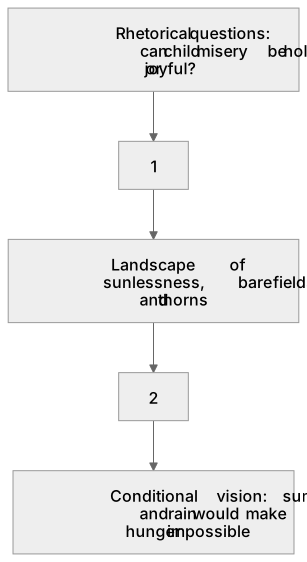
1Box 1
2Box 2
There is more to this lesson
The full lesson goes on to check your understanding and help you earn the marks. Create a free account to carry on, with your progress saved.
A week of Premium from your first lesson · Then the free plan continues · No card, no charge
Test your understanding of Component 3: Poetry – Section B: Specified Poetry Pre- or Post-1900 – Pre-1900 – The Romantic Period – English Romantic Verse, editor David Wright (Penguin Classics, 1973): Songs of Experience: Holy Thursday
Active recall beats re-reading. Take an instant quiz now to test what you’ve learned and lock it into long-term memory.
A week of Premium from your first lesson · Then the free plan continues · No card, no charge