Pearson Edexcel · A-Level · English Literature
Course version: 9ET0 · Version from Sept 2015
Poetry – Section B: Specified Poetry Pre- or Post-1900 – Pre-1900 – The…
Full specification wording
Component 3: Poetry – Section B: Specified Poetry Pre- or Post-1900 – Pre-1900 – The Romantic Period – English Romantic Verse, editor David Wright (Penguin Classics, 1973): Songs of Experience: London
William Blake’s ‘London’ presents a speaker walking through a city marked by restriction, suffering and institutional failure.
Checked against the Pearson Edexcel 9ET0 specification (opens in a new tab) on .
- Point 2 of 16
- 4 key terms
Study notes
From the checked teaching notes for this specification point.
The idea
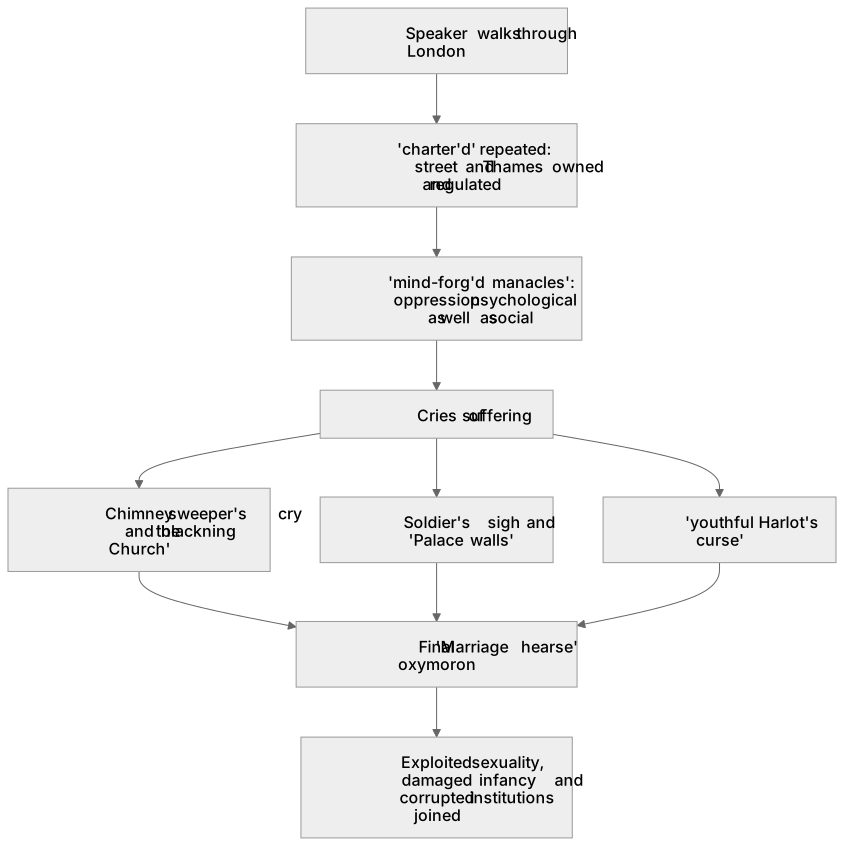
William Blake’s ‘London’ presents a speaker walking through a city marked by restriction, suffering and institutional failure. Repetition of ‘charter’d’ suggests that ownership and regulation have reached both street and Thames, while ‘mind-forg’d manacles’ makes oppression psychological as well as social. Successive cries connect the chimney sweeper with the ‘blackning Church’ and the soldier’s sigh with ‘Palace walls’. Four ABAB quatrains maintain a tight frame, but the metre varies around a four-beat pattern: many lines have an iambic base, while prominent initial stresses and substitutions disturb any claim of relentless regularity. The final ‘Marriage hearse’ oxymoron joins exploited sexuality, damaged infancy and corrupted social institutions.
What earns the marks
- Analyse the repetition of 'charter'd' and 'every' to emphasise the inescapable nature of commercial and state control.
- Evaluate the metaphor of 'mind-forg'd manacles' as a representation of internalised oppression and ideological control.
- Discuss the structural use of the rigid ABAB rhyme scheme to reflect the physical and psychological confinement of the city's inhabitants.
- Examine Blake's critique of institutions through the juxtaposition of vulnerable figures (chimney sweepers, soldiers) with the Church and State.
Common mistakes and how to put them right
Treating the poem merely as a descriptive walk through a city.
Put it right: Analyse the poem as a radical political critique of institutional corruption and social inequality.
Misinterpreting 'mind-forg'd manacles' as literal chains.
Put it right: Explain this phrase as a metaphor for self-imposed or socially conditioned mental restrictions.
Overlooking the significance of the 'youthful Harlot's curse'.
Put it right: Explore how this final image connects the exploitation of the vulnerable to the corruption of marriage and new life.
Exam tips
- Treat ‘charter’d’ as a contested image of legal, commercial and institutional restriction, and support any link to property or enclosure with the poem’s repeated wording rather than presenting one context as its only meaning.
- Focus on Blake's sensory language, particularly the auditory imagery of cries, sighs, and curses, to demonstrate how suffering permeates the city.
- Contrast the oppressive urban environment of 'London' with the pastoral ideals typical of Romantic poetry to highlight Blake's unique perspective.
Try the lesson
The start of the Component 3: Poetry – Section B: Specified Poetry Pre- or Post-1900 – Pre-1900 – The Romantic Period – English Romantic Verse, editor David Wright (Penguin Classics, 1973): Songs of Experience: London lesson, made from checked teaching notes for this specification point.
Have a go first
Which of the following best describes the metrical and stanzaic form of William Blake's poem 'London'?
Listen
William Blake’s ‘London’ presents a speaker walking through a city marked by restriction, suffering and institutional failure. Repetition of ‘charter’d’ suggests that ownership and regulation have reached both street and Thames, while ‘mind-forg’d manacles’ makes oppression psychological as well as social. Successive cries connect the chimney sweeper with the ‘blackning Church’ and the soldier’s sigh with ‘Palace walls’. Four ABAB quatrains maintain a tight frame, but the metre varies around a four-beat pattern: many lines have an iambic base, while prominent initial stresses and substitutions disturb any claim of relentless regularity. The final ‘Marriage hearse’ oxymoron joins exploited sexuality, damaged infancy and corrupted social institutions. A strong answer earns marks for these points. Analyse the repetition of 'charter'd' and 'every' to emphasise the inescapable nature of commercial and state control. Evaluate the metaphor of 'mind-forg'd manacles' as a representation of internalised oppression and ideological control. Discuss the structural use of the rigid ABAB rhyme scheme to reflect the physical and psychological confinement of the city's inhabitants. Examine Blake's critique of institutions through the juxtaposition of vulnerable figures (chimney sweepers, soldiers) with the Church and State. A common slip: Treating the poem merely as a descriptive walk through a city. Instead, analyse the poem as a radical political critique of institutional corruption and social inequality. Exam tip: Treat ‘charter’d’ as a contested image of legal, commercial and institutional restriction, and support any link to property or enclosure with the poem’s repeated wording rather than presenting one context as its only meaning.
See it
Key words
Say what each word means before you turn the card.
Oppression and Control
Try answering aloud or in your head before turning the card.
Institutional Corruption
Try answering aloud or in your head before turning the card.
Urban Decay
Try answering aloud or in your head before turning the card.
Loss of Innocence
Try answering aloud or in your head before turning the card.
See every definition
- Oppression and Control
- The restriction and suffering imposed on the city's inhabitants, made psychological as well as social through 'mind-forg'd manacles'.
- Institutional Corruption
- The failure of institutions such as Church and State, critiqued through the juxtaposition of vulnerable figures with the 'blackning Church' and 'Palace walls'.
- Urban Decay
- A city marked by restriction, suffering and institutional failure, where ownership and regulation have reached both street and Thames.
- Loss of Innocence
- The damage to infancy and exploited sexuality joined in the final 'Marriage hearse' oxymoron, which also involves corrupted social institutions.
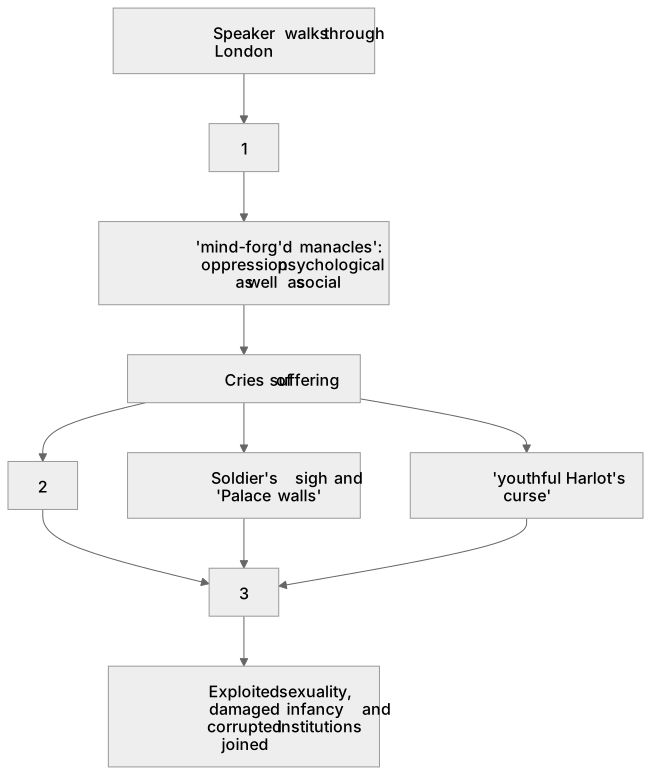
Label the diagram
Some boxes have lost their names. Pick the right name for each number.
1Box 1
2Box 2
3Box 3
There is more to this lesson
The full lesson goes on to check your understanding and help you earn the marks. Create a free account to carry on, with your progress saved.
A week of Premium from your first lesson · Then the free plan continues · No card, no charge
Test your understanding of Component 3: Poetry – Section B: Specified Poetry Pre- or Post-1900 – Pre-1900 – The Romantic Period – English Romantic Verse, editor David Wright (Penguin Classics, 1973): Songs of Experience: London
Active recall beats re-reading. Take an instant quiz now to test what you’ve learned and lock it into long-term memory.
A week of Premium from your first lesson · Then the free plan continues · No card, no charge