Pearson Edexcel · A-Level · English Literature
Course version: 9ET0 · Version from Sept 2015
Poetry – Section B: Specified Poetry Pre- or Post-1900 – Pre-1900 – The…
Full specification wording
Component 3: Poetry – Section B: Specified Poetry Pre- or Post-1900 – Pre-1900 – The Victorian Period – Christina Rossetti Selected Poems, editor Dinah Roe (Penguin, 2008): Some ladies dress in muslin full and white Christina Rossetti
Rossetti’s satirical Italian sonnet surveys people whose clothes, vehicles and concern with appearance make them targets of the speaker’s scorn.
Checked against the Pearson Edexcel 9ET0 specification (opens in a new tab) on .
- Point 1 of 18
- 4 key terms
Study notes
From the checked teaching notes for this specification point.
The idea
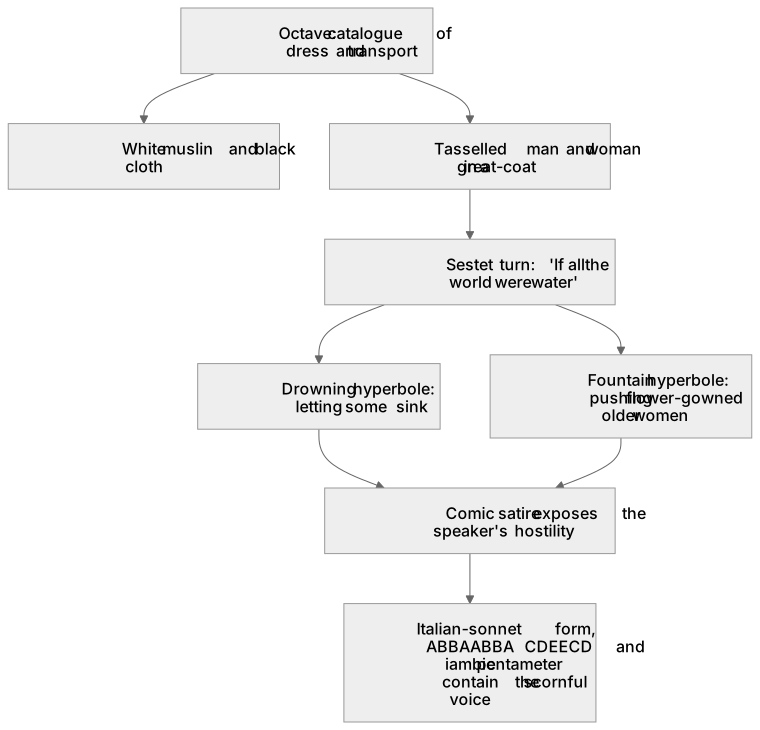
Rossetti’s satirical Italian sonnet surveys people whose clothes, vehicles and concern with appearance make them targets of the speaker’s scorn. The octave moves from conventional white muslin and black cloth to sharper caricatures: a tasselled man and a woman in a sack-like great-coat. At the sestet’s turn, irritation expands into comic hyperbole: if the world were water, the speaker would let some people sink and imagines pushing flower-gowned older women into a fountain. The controlled ABBAABBA CDEECD rhyme scheme and mainly iambic pentameter contain an increasingly biting, exaggerated voice.
What earns the marks
- Analyse how the octave catalogues dress and transport before focusing on the tasselled man and the woman in a great-coat.
- Evaluate the sestet’s drowning and fountain hyperbole as comic satire that also exposes the speaker’s hostility.
- Explore how the Italian-sonnet structure, ABBAABBA CDEECD rhyme and mainly iambic pentameter give formal control to the scornful voice.
- Discuss repetition of ‘some’, shifting pronouns and caricature as methods for turning social observation into judgement.
Common mistakes and how to put them right
Inventing a contrast between fashionable ladies and the speaker’s own ‘natural beauty’ or ‘simple gown’.
Put it right: The speaker never describes their own appearance.
Reducing the poem to a critique of women’s dress.
Put it right: It mocks gentlemen, vehicles, youth, a tasselled man and older women as well as female fashions.
Treating the speaker’s judgement as the poem’s uncontested moral.
Put it right: Analyse how the drowning and pushing fantasies make the satirical voice excessive and open to scrutiny.
Exam tips
- Track the turn at ‘If all the world were water’ and explain how observation becomes an exaggerated fantasy of punishment.
- Use the exact Italian-sonnet pattern, ABBAABBA CDEECD, to connect formal control with the speaker’s crisp judgements.
- Compare Rossetti’s treatment of appearance or social performance with another poem while keeping differences in speaker and tone precise.
Try the lesson
The start of the Component 3: Poetry – Section B: Specified Poetry Pre- or Post-1900 – Pre-1900 – The Victorian Period – Christina Rossetti Selected Poems, editor Dinah Roe (Penguin, 2008): Some ladies dress in muslin full and white Christina Rossetti lesson, made from checked teaching notes for this specification point.
Have a go first
In the opening lines of 'Some ladies dress in muslin full and white', what does the speaker primarily describe to establish the poem's initial setting?
Listen
Rossetti’s satirical Italian sonnet surveys people whose clothes, vehicles and concern with appearance make them targets of the speaker’s scorn. The octave moves from conventional white muslin and black cloth to sharper caricatures: a tasselled man and a woman in a sack-like great-coat. At the sestet’s turn, irritation expands into comic hyperbole: if the world were water, the speaker would let some people sink and imagines pushing flower-gowned older women into a fountain. The controlled ABBAABBA CDEECD rhyme scheme and mainly iambic pentameter contain an increasingly biting, exaggerated voice. A strong answer earns marks for these points. Analyse how the octave catalogues dress and transport before focusing on the tasselled man and the woman in a great-coat. Evaluate the sestet’s drowning and fountain hyperbole as comic satire that also exposes the speaker’s hostility. Explore how the Italian-sonnet structure, ABBAABBA CDEECD rhyme and mainly iambic pentameter give formal control to the scornful voice. Discuss repetition of ‘some’, shifting pronouns and caricature as methods for turning social observation into judgement. A common slip: Inventing a contrast between fashionable ladies and the speaker’s own ‘natural beauty’ or ‘simple gown’. Instead, the speaker never describes their own appearance. Exam tip: Track the turn at ‘If all the world were water’ and explain how observation becomes an exaggerated fantasy of punishment.
See it
Key words
Say what each word means before you turn the card.
Satire
Try answering aloud or in your head before turning the card.
Caricature
Try answering aloud or in your head before turning the card.
Hyperbole
Try answering aloud or in your head before turning the card.
Italian sonnet
Try answering aloud or in your head before turning the card.
See every definition
- Satire
- A mode in which the speaker's scorn targets people whose clothes, vehicles and concern with appearance make them objects of judgement.
- Caricature
- Sharper, exaggerated portraits, such as the tasselled man and the woman in a sack-like great-coat, that turn social observation into judgement.
- Hyperbole
- Comic exaggeration, as in the drowning and fountain fantasies of the sestet, which also exposes the speaker's hostility.
- Italian sonnet
- A form whose octave and sestet, with ABBAABBA CDEECD rhyme and mainly iambic pentameter, give formal control to the scornful voice.
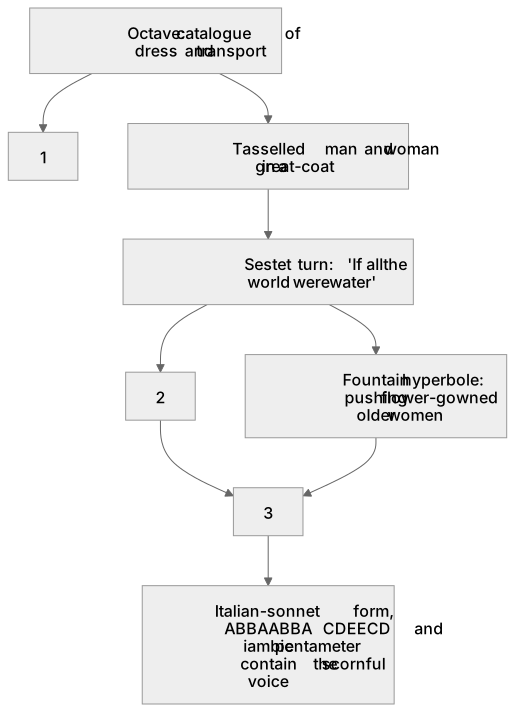
Label the diagram
Some boxes have lost their names. Pick the right name for each number.
1Box 1
2Box 2
3Box 3
There is more to this lesson
The full lesson goes on to check your understanding and help you earn the marks. Create a free account to carry on, with your progress saved.
A week of Premium from your first lesson · Then the free plan continues · No card, no charge
Test your understanding of Component 3: Poetry – Section B: Specified Poetry Pre- or Post-1900 – Pre-1900 – The Victorian Period – Christina Rossetti Selected Poems, editor Dinah Roe (Penguin, 2008): Some ladies dress in muslin full and white Christina Rossetti
Active recall beats re-reading. Take an instant quiz now to test what you’ve learned and lock it into long-term memory.
A week of Premium from your first lesson · Then the free plan continues · No card, no charge