Pearson Edexcel · A-Level · English Literature
Course version: 9ET0 · Version from Sept 2015
Poetry – Section B: Specified Poetry Pre- or Post-1900 – Pre-1900 – The…
Full specification wording
Component 3: Poetry – Section B: Specified Poetry Pre- or Post-1900 – Pre-1900 – The Victorian Period – Christina Rossetti Selected Poems, editor Dinah Roe (Penguin, 2008): Echo
"Echo" is a lyric poem by Christina Rossetti exploring themes of longing, memory, and the boundary between life and death.
Checked against the Pearson Edexcel 9ET0 specification (opens in a new tab) on .
- Point 2 of 18
- 4 key terms
Study notes
From the checked teaching notes for this specification point.
The idea
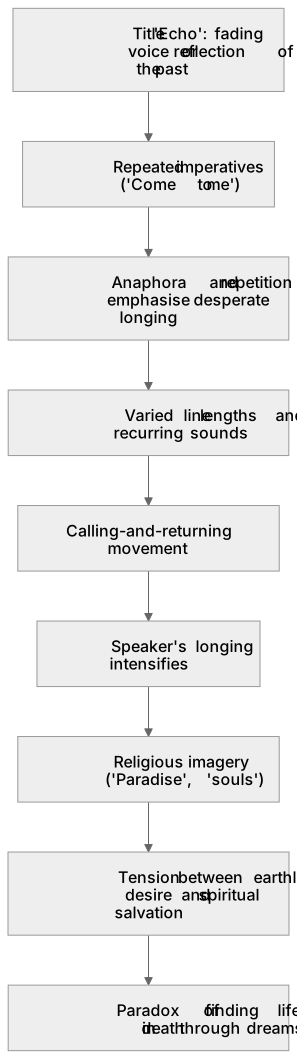
"Echo" is a lyric poem by Christina Rossetti exploring themes of longing, memory, and the boundary between life and death. The speaker yearns for a deceased lover to return in dreams, using repetition and sensory language to convey intense grief. The title itself suggests a fading voice or a reflection of the past. Structurally, repeated imperatives, varied line lengths and recurring sounds create the poem's calling-and-returning movement while allowing the speaker's longing to intensify. The poem exemplifies Victorian mourning conventions while maintaining Rossetti's characteristic ambiguity regarding earthly versus divine love.
What earns the marks
- Analyse the use of repetition and anaphora, such as 'Come to me', to emphasise the speaker's desperate longing.
- Evaluate how repeated phrases, varied line lengths and changes of pace reflect the speaker's intensifying longing.
- Explore the tension between earthly desire and spiritual salvation, noting references to 'Paradise' and 'souls'.
- Discuss the significance of the title 'Echo' as a metaphor for memory, fading presence, and the classical myth of Echo and Narcissus.
Common mistakes and how to put them right
Assuming the poem is solely about a literal living lover.
Put it right: Recognise the strong implications that the addressee is deceased and the speaker is seeking them in dreams.
Treating the rhythm as mechanically uniform.
Put it right: Track how repeated imperatives, pauses and changing line lengths alter the pace of the plea.
Treating the religious imagery as purely conventional.
Put it right: Explore how Rossetti blends physical, earthly longing with spiritual and divine vocabulary.
Exam tips
- Link the poem's exploration of death and memory to Victorian mourning culture and Rossetti's Tractarian beliefs.
- Compare the passive waiting in 'Echo' with more active or defiant stances in Rossetti's other poems, such as 'Remember' or 'No, Thank You, John'.
- Use precise terminology such as 'imperative', 'anaphora' and 'refrain' when explaining how the poem's repeated appeals create its echo effect.
Try the lesson
The start of the Component 3: Poetry – Section B: Specified Poetry Pre- or Post-1900 – Pre-1900 – The Victorian Period – Christina Rossetti Selected Poems, editor Dinah Roe (Penguin, 2008): Echo lesson, made from checked teaching notes for this specification point.
Have a go first
In Christina Rossetti's poem 'Echo', how does the speaker primarily experience the presence of their lost love?
Listen
Echo" is a lyric poem by Christina Rossetti exploring themes of longing, memory, and the boundary between life and death. The speaker yearns for a deceased lover to return in dreams, using repetition and sensory language to convey intense grief. The title itself suggests a fading voice or a reflection of the past. Structurally, repeated imperatives, varied line lengths and recurring sounds create the poem's calling-and-returning movement while allowing the speaker's longing to intensify. The poem exemplifies Victorian mourning conventions while maintaining Rossetti's characteristic ambiguity regarding earthly versus divine love. A strong answer earns marks for these points. Analyse the use of repetition and anaphora, such as 'Come to me', to emphasise the speaker's desperate longing. Evaluate how repeated phrases, varied line lengths and changes of pace reflect the speaker's intensifying longing. Explore the tension between earthly desire and spiritual salvation, noting references to 'Paradise' and 'souls'. Discuss the significance of the title 'Echo' as a metaphor for memory, fading presence, and the classical myth of Echo and Narcissus. A common slip: Assuming the poem is solely about a literal living lover. Instead, recognise the strong implications that the addressee is deceased and the speaker is seeking them in dreams. Exam tip: Link the poem's exploration of death and memory to Victorian mourning culture and Rossetti's Tractarian beliefs.
See it
Key words
Say what each word means before you turn the card.
Memory and the Past
Try answering aloud or in your head before turning the card.
Death and Mourning
Try answering aloud or in your head before turning the card.
Earthly vs Divine Love
Try answering aloud or in your head before turning the card.
The Power of Dreams
Try answering aloud or in your head before turning the card.
See every definition
- Memory and the Past
- The title suggests a fading voice or a reflection of the past, and the poem explores themes of longing and memory.
- Death and Mourning
- The speaker yearns for a deceased lover to return in dreams, and the poem exemplifies Victorian mourning conventions.
- Earthly vs Divine Love
- The poem maintains Rossetti's characteristic ambiguity regarding earthly versus divine love, blending physical, earthly longing with spiritual and divine vocabulary.
- The Power of Dreams
- The speaker seeks the deceased lover in dreams, finding a paradox of life in death through dreams.
Label the diagram
Some boxes have lost their names. Pick the right name for each number.
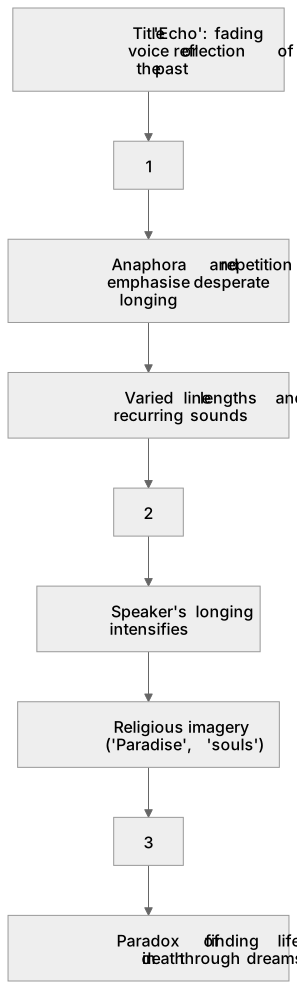
1Box 1
2Box 2
3Box 3
There is more to this lesson
The full lesson goes on to check your understanding and help you earn the marks. Create a free account to carry on, with your progress saved.
A week of Premium from your first lesson · Then the free plan continues · No card, no charge
Test your understanding of Component 3: Poetry – Section B: Specified Poetry Pre- or Post-1900 – Pre-1900 – The Victorian Period – Christina Rossetti Selected Poems, editor Dinah Roe (Penguin, 2008): Echo
Active recall beats re-reading. Take an instant quiz now to test what you’ve learned and lock it into long-term memory.
A week of Premium from your first lesson · Then the free plan continues · No card, no charge