Pearson Edexcel · A-Level · English Literature
Course version: 9ET0 · Version from Sept 2015
Poetry – Section B: Specified Poetry Pre- or Post-1900 – Pre-1900 – The…
Full specification wording
Component 3: Poetry – Section B: Specified Poetry Pre- or Post-1900 – Pre-1900 – The Victorian Period – Christina Rossetti Selected Poems, editor Dinah Roe (Penguin, 2008): May
Christina Rossetti's 'May' recalls an unnamed joy that arrived on a 'bright and breezy day' early in the month and then passed away with it.
Checked against the Pearson Edexcel 9ET0 specification (opens in a new tab) on .
- Point 3 of 18
- 4 key terms
Study notes
From the checked teaching notes for this specification point.
The idea
Christina Rossetti's 'May' recalls an unnamed joy that arrived on a 'bright and breezy day' early in the month and then passed away with it. The speaker refuses to define the experience—'I cannot tell you how it was' and 'I cannot tell you what it was'—but insists that it happened. Images of poppies not yet born, tender corn, unhatched eggs and birds still with their mates place the memory at a threshold of new life. The shorter second stanza turns from 'came to pass' to 'did but pass', using verbal repetition to transform arrival into loss. Its final monosyllabic sequence, 'old, and cold, and grey', measures the lasting change left by a joy that was experienced but could not be kept.
What earns the marks
- Analyse the repeated contrast between what the speaker cannot tell and what she insists she knows about the remembered experience.
- Explore how unborn poppies, tender corn, unhatched eggs and paired birds locate the memory at the beginning of seasonal life.
- Evaluate the wordplay between 'came to pass' and 'did but pass' as the poem converts arrival into transience.
- Examine how the shorter second stanza and the closing sequence 'old, and cold, and grey' register the experience's disappearance and its enduring effect.
Common mistakes and how to put them right
Saying the poem describes fading blossoms or autumnal decay.
Put it right: The natural images belong to early May, before poppies are born and eggs have hatched; the loss is expressed through the unnamed joy passing away.
Calling the experience a missed opportunity.
Put it right: The speaker says it 'came to pass' and then 'did but pass', so the emphasis is on a joy experienced and lost.
Defining the unnamed 'it' as a certain event.
Put it right: Preserve the poem's deliberate uncertainty and support any interpretation as an inference.
Exam tips
- Build analysis around the repeated sentence frames and the changing meanings of 'pass'.
- Use the not-yet images precisely: they create youth and expectancy rather than literal fading or decay.
- Compare the expansive first stanza with the compressed movement to 'old, and cold, and grey' in the second.
Try the lesson
The start of the Component 3: Poetry – Section B: Specified Poetry Pre- or Post-1900 – Pre-1900 – The Victorian Period – Christina Rossetti Selected Poems, editor Dinah Roe (Penguin, 2008): May lesson, made from checked teaching notes for this specification point.
Have a go first
In Christina Rossetti's poem 'May', which of the following best describes the imagery used in the first stanza to depict the natural world?
Listen
Christina Rossetti's 'May' recalls an unnamed joy that arrived on a 'bright and breezy day' early in the month and then passed away with it. The speaker refuses to define the experience—'I cannot tell you how it was' and 'I cannot tell you what it was'—but insists that it happened. Images of poppies not yet born, tender corn, unhatched eggs and birds still with their mates place the memory at a threshold of new life. The shorter second stanza turns from 'came to pass' to 'did but pass', using verbal repetition to transform arrival into loss. Its final monosyllabic sequence, 'old, and cold, and grey', measures the lasting change left by a joy that was experienced but could not be kept. A strong answer earns marks for these points. Analyse the repeated contrast between what the speaker cannot tell and what she insists she knows about the remembered experience. Explore how unborn poppies, tender corn, unhatched eggs and paired birds locate the memory at the beginning of seasonal life. Evaluate the wordplay between 'came to pass' and 'did but pass' as the poem converts arrival into transience. Examine how the shorter second stanza and the closing sequence 'old, and cold, and grey' register the experience's disappearance and its enduring effect. A common slip: Saying the poem describes fading blossoms or autumnal decay. Instead, The natural images belong to early May, before poppies are born and eggs have hatched; the loss is expressed through the unnamed joy passing away. Exam tip: Build analysis around the repeated sentence frames and the changing meanings of 'pass'.
See it
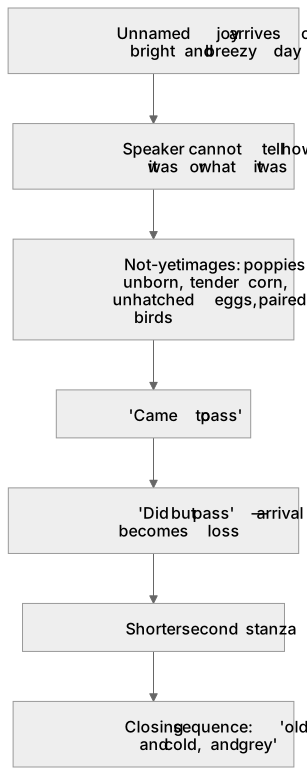
Put it in order
Put these steps in the order they happen.
- 1. Closing sequence: 'old, and cold, and grey'
- 2. Shorter second stanza
- 3. Not-yet images: poppies unborn, tender corn, unhatched eggs, paired birds
- 4. 'Did but pass' — arrival becomes loss
- 5. Unnamed joy arrives on a bright and breezy day
- 6. Speaker cannot tell how it was or what it was
- 7. 'Came to pass'
Key words
Say what each word means before you turn the card.
Transience and Time
Try answering aloud or in your head before turning the card.
Memory and Uncertainty
Try answering aloud or in your head before turning the card.
Joy and Loss
Try answering aloud or in your head before turning the card.
Youth and Aging
Try answering aloud or in your head before turning the card.
See every definition
- Transience and Time
- The movement by which an unnamed joy that arrived on a bright and breezy day early in May then passed away with it.
- Memory and Uncertainty
- The speaker's refusal to define the experience, saying she cannot tell how or what it was, while insisting that it happened.
- Joy and Loss
- A joy that was experienced but could not be kept, as arrival is transformed into loss through verbal repetition.
- Youth and Aging
- The shift from images at a threshold of new life to the closing sequence 'old, and cold, and grey'.
Label the diagram
Some boxes have lost their names. Pick the right name for each number.
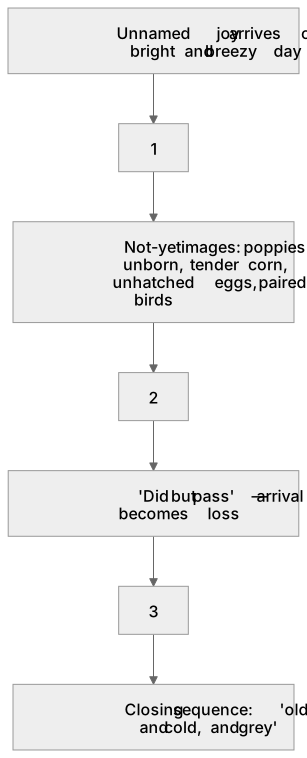
1Box 1
2Box 2
3Box 3
There is more to this lesson
The full lesson goes on to check your understanding and help you earn the marks. Create a free account to carry on, with your progress saved.
A week of Premium from your first lesson · Then the free plan continues · No card, no charge
Test your understanding of Component 3: Poetry – Section B: Specified Poetry Pre- or Post-1900 – Pre-1900 – The Victorian Period – Christina Rossetti Selected Poems, editor Dinah Roe (Penguin, 2008): May
Active recall beats re-reading. Take an instant quiz now to test what you’ve learned and lock it into long-term memory.
A week of Premium from your first lesson · Then the free plan continues · No card, no charge