Pearson Edexcel · A-Level · English Literature
Course version: 9ET0 · Version from Sept 2015
Poetry – Section B: Specified Poetry Pre- or Post-1900 – Pre-1900 – The…
Full specification wording
Component 3: Poetry – Section B: Specified Poetry Pre- or Post-1900 – Pre-1900 – The Victorian Period – Christina Rossetti Selected Poems, editor Dinah Roe (Penguin, 2008): Passing and Glassing
In 'Passing and Glassing', Christina Rossetti explores the ephemeral nature of physical beauty and the decay brought by time.
Checked against the Pearson Edexcel 9ET0 specification (opens in a new tab) on .
- Point 13 of 18
- 4 key terms
Study notes
From the checked teaching notes for this specification point.
The idea
In 'Passing and Glassing', Christina Rossetti explores the ephemeral nature of physical beauty and the decay brought by time. The poem uses the metaphor of a fading rose and a woman looking into a mirror ('glassing') to reflect on the loss of youth. Rossetti contrasts the transient nature of earthly attractiveness with the enduring value of spiritual grace. By examining the imagery of withered flowers, learners can evaluate Rossetti's critique of a society that overvalues female youth, pointing towards a Victorian Christian perspective where true worth is found beyond the physical realm.
What earns the marks
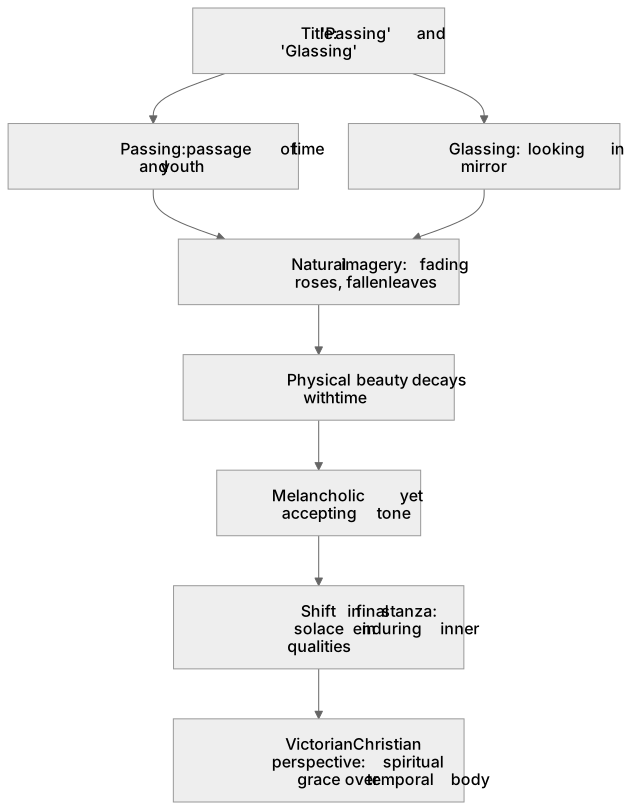
- Analysis of the title's dual meaning: 'passing' of time or youth, and 'glassing' as the act of looking in a mirror to observe these changes.
- Exploration of natural imagery, such as fading roses and fallen leaves, to represent human aging and mortality.
- Evaluation of the poem's structure, particularly how the consistent stanza form and rhyme scheme mirror the inevitable, rhythmic progression of time.
- Contextual links to Victorian attitudes towards female beauty, aging, and the Christian emphasis on the eternal soul over the temporal body.
Common mistakes and how to put them right
Assuming the poem is purely a secular lament about getting old.
Put it right: Acknowledge the underlying Christian framework that values spiritual endurance over physical decay.
Misinterpreting 'glassing' as breaking glass or fragility.
Put it right: Define 'glassing' as the act of looking into a looking-glass (mirror) to observe one's reflection.
Ignoring the shift in tone in the final stanza.
Put it right: Trace the poem's progression from mourning physical loss to finding solace in enduring inner qualities.
Exam tips
- Compare the use of natural decay in this poem with similar motifs in 'Song (When I am dead, my dearest)' or 'Remember'.
- Analyse the specific effects of the rhyme scheme in creating a sense of inevitability and resignation.
- Integrate contextual knowledge about Victorian gender expectations regarding female beauty to strengthen your AO3 analysis.
Try the lesson
The start of the Component 3: Poetry – Section B: Specified Poetry Pre- or Post-1900 – Pre-1900 – The Victorian Period – Christina Rossetti Selected Poems, editor Dinah Roe (Penguin, 2008): Passing and Glassing lesson, made from checked teaching notes for this specification point.
Have a go first
How does Rossetti use the imagery of "withered roses and the fallen peach" in the first stanza of 'Passing and Glassing' to explore the theme of female ageing?
Listen
In 'Passing and Glassing', Christina Rossetti explores the ephemeral nature of physical beauty and the decay brought by time. The poem uses the metaphor of a fading rose and a woman looking into a mirror ('glassing') to reflect on the loss of youth. Rossetti contrasts the transient nature of earthly attractiveness with the enduring value of spiritual grace. By examining the imagery of withered flowers, learners can evaluate Rossetti's critique of a society that overvalues female youth, pointing towards a Victorian Christian perspective where true worth is found beyond the physical realm. A strong answer earns marks for these points. Analysis of the title's dual meaning: 'passing' of time or youth, and 'glassing' as the act of looking in a mirror to observe these changes. Exploration of natural imagery, such as fading roses and fallen leaves, to represent human aging and mortality. Evaluation of the poem's structure, particularly how the consistent stanza form and rhyme scheme mirror the inevitable, rhythmic progression of time. Contextual links to Victorian attitudes towards female beauty, aging, and the Christian emphasis on the eternal soul over the temporal body. A common slip: Assuming the poem is purely a secular lament about getting old. Instead, Acknowledge the underlying Christian framework that values spiritual endurance over physical decay. Exam tip: Compare the use of natural decay in this poem with similar motifs in 'Song (When I am dead, my dearest)' or 'Remember'.
See it
Key words
Say what each word means before you turn the card.
Transience of beauty
Try answering aloud or in your head before turning the card.
Aging and mortality
Try answering aloud or in your head before turning the card.
Female identity
Try answering aloud or in your head before turning the card.
Spiritual versus physical worth
Try answering aloud or in your head before turning the card.
See every definition
- Transience of beauty
- The ephemeral nature of physical beauty and the decay brought by time, which Rossetti explores in the poem.
- Aging and mortality
- Human aging and mortality, represented through natural imagery such as fading roses and fallen leaves.
- Female identity
- A concern with female youth that Rossetti critiques as overvalued by society, pointing towards a Victorian Christian perspective.
- Spiritual versus physical worth
- The contrast between transient earthly attractiveness and the enduring value of spiritual grace, where true worth is found beyond the physical realm.
Label the diagram
Some boxes have lost their names. Pick the right name for each number.
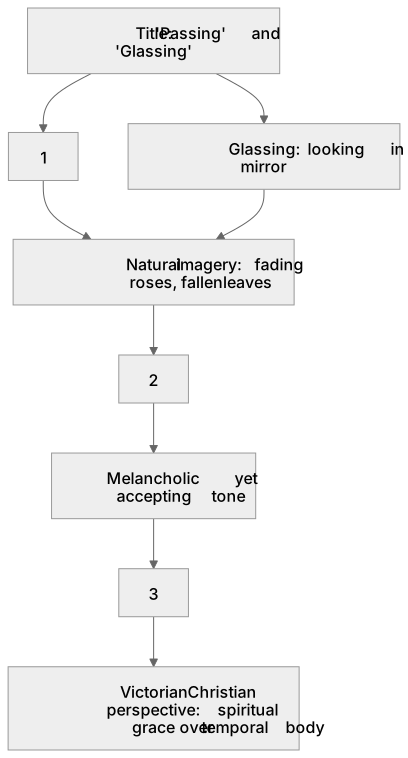
1Box 1
2Box 2
3Box 3
There is more to this lesson
The full lesson goes on to check your understanding and help you earn the marks. Create a free account to carry on, with your progress saved.
A week of Premium from your first lesson · Then the free plan continues · No card, no charge
Test your understanding of Component 3: Poetry – Section B: Specified Poetry Pre- or Post-1900 – Pre-1900 – The Victorian Period – Christina Rossetti Selected Poems, editor Dinah Roe (Penguin, 2008): Passing and Glassing
Active recall beats re-reading. Take an instant quiz now to test what you’ve learned and lock it into long-term memory.
A week of Premium from your first lesson · Then the free plan continues · No card, no charge