Pearson Edexcel · A-Level · English Literature
Course version: 9ET0 · Version from Sept 2015
Poetry – Section B: Specified Poetry Pre- or Post-1900 – Pre-1900 – The…
Full specification wording
Component 3: Poetry – Section B: Specified Poetry Pre- or Post-1900 – Pre-1900 – The Victorian Period – Christina Rossetti Selected Poems, editor Dinah Roe (Penguin, 2008): Memory
"Memory" by Christina Rossetti explores the internal conflict between earthly desires and spiritual devotion.
Checked against the Pearson Edexcel 9ET0 specification (opens in a new tab) on .
- Point 11 of 18
- 4 key terms
Study notes
From the checked teaching notes for this specification point.
The idea
"Memory" by Christina Rossetti explores the internal conflict between earthly desires and spiritual devotion. Written in two distinct parts (composed years apart), the poem reflects a transition from the painful suppression of romantic love to a state of religious resignation. Part I uses the metaphor of a 'nursing' mother hiding a secret to depict the burden of unfulfilled love, while Part II shifts towards divine love, anticipating the afterlife where earthly memories are purified.
What earns the marks
- Analyse the bipartite structure of the poem and how it reflects the passage of time and shifting perspectives on love.
- Evaluate the use of metaphors, such as the hidden, locked room, to represent repressed earthly desires.
- Explore the tension between secular romantic love and spiritual devotion, a hallmark of Rossetti's Victorian context.
- Assess the impact of punctuation and enjambment in conveying the speaker's emotional restraint and internal struggle.
Common mistakes and how to put them right
Treating the poem as a single, continuous narrative without acknowledging the significant time gap between the composition of Part I and Part II.
Put it right: Address the structural division.
Assuming the 'memory' is purely about a deceased lover.
Put it right by exploring the ambiguity of the memory as a renounced earthly desire in favour of spiritual purity.
Ignoring the religious context of the Victorian era.
Put it right: Ensure analysis connects the speaker's resignation to Tractarian or broader Anglican beliefs about self-denial.
Exam tips
- Compare the tone of Part I (anguished, secretive) with Part II (resigned, spiritually focused) to demonstrate an understanding of structural development.
- Link the motif of the 'locked heart' to other Rossetti poems that explore secrecy and the inner life, such as 'Winter: My Secret'.
- Use specific terminology like 'caesura' and 'bipartite structure' when discussing how the poem's form mirrors its thematic shift.
Try the lesson
The start of the Component 3: Poetry – Section B: Specified Poetry Pre- or Post-1900 – Pre-1900 – The Victorian Period – Christina Rossetti Selected Poems, editor Dinah Roe (Penguin, 2008): Memory lesson, made from checked teaching notes for this specification point.
Have a go first
In Christina Rossetti's poem 'Memory', how does the speaker's depiction of the titular concept shift between Part I and Part II?
Listen
Memory" by Christina Rossetti explores the internal conflict between earthly desires and spiritual devotion. Written in two distinct parts (composed years apart), the poem reflects a transition from the painful suppression of romantic love to a state of religious resignation. Part I uses the metaphor of a 'nursing' mother hiding a secret to depict the burden of unfulfilled love, while Part II shifts towards divine love, anticipating the afterlife where earthly memories are purified. A strong answer earns marks for these points. Analyse the bipartite structure of the poem and how it reflects the passage of time and shifting perspectives on love. Evaluate the use of metaphors, such as the hidden, locked room, to represent repressed earthly desires. Explore the tension between secular romantic love and spiritual devotion, a hallmark of Rossetti's Victorian context. Assess the impact of punctuation and enjambment in conveying the speaker's emotional restraint and internal struggle. A common slip: Assuming the 'memory' is purely about a deceased lover. Instead, exploring the ambiguity of the memory as a renounced earthly desire in favour of spiritual purity. Exam tip: Compare the tone of Part I (anguished, secretive) with Part II (resigned, spiritually focused) to demonstrate an understanding of structural development.
See it
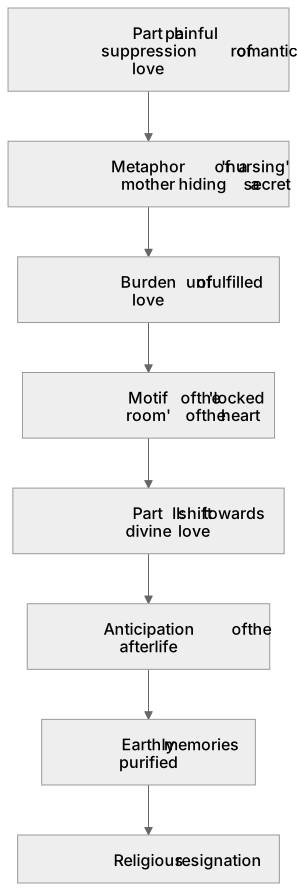
Put it in order
Put these steps in the order they happen.
- 1. Part II: shift towards divine love
- 2. Religious resignation
- 3. Anticipation of the afterlife
- 4. Part I: painful suppression of romantic love
- 5. Metaphor of a 'nursing' mother hiding a secret
- 6. Earthly memories purified
- 7. Burden of unfulfilled love
- 8. Motif of the 'locked room' of the heart
Key words
Say what each word means before you turn the card.
Renunciation and self-denial
Try answering aloud or in your head before turning the card.
Earthly versus divine love
Try answering aloud or in your head before turning the card.
The passage of time
Try answering aloud or in your head before turning the card.
Secrecy and the inner self
Try answering aloud or in your head before turning the card.
See every definition
- Renunciation and self-denial
- The speaker's resignation, connected to Tractarian or broader Anglican beliefs, in which an earthly desire is given up in favour of spiritual purity.
- Earthly versus divine love
- The tension between secular romantic love and spiritual devotion, a hallmark of Rossetti's Victorian context, moving from suppressed romantic love to divine love.
- The passage of time
- The significant time gap between the composition of Part I and Part II, reflected in the poem's bipartite structure and shifting perspectives on love.
- Secrecy and the inner self
- The hidden, locked room of the heart, a recurring motif representing repressed earthly desires and the secrecy of the inner life.
Label the diagram
Some boxes have lost their names. Pick the right name for each number.
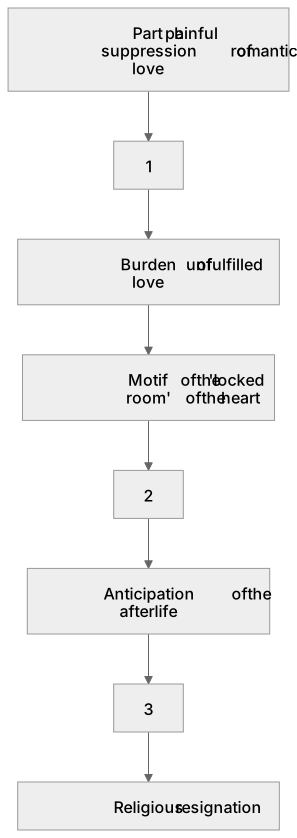
1Box 1
2Box 2
3Box 3
There is more to this lesson
The full lesson goes on to check your understanding and help you earn the marks. Create a free account to carry on, with your progress saved.
A week of Premium from your first lesson · Then the free plan continues · No card, no charge
Test your understanding of Component 3: Poetry – Section B: Specified Poetry Pre- or Post-1900 – Pre-1900 – The Victorian Period – Christina Rossetti Selected Poems, editor Dinah Roe (Penguin, 2008): Memory
Active recall beats re-reading. Take an instant quiz now to test what you’ve learned and lock it into long-term memory.
A week of Premium from your first lesson · Then the free plan continues · No card, no charge