Pearson Edexcel · A-Level · English Literature
Course version: 9ET0 · Version from Sept 2015
Poetry – Section B: Specified Poetry Pre- or Post-1900 – Pre-1900 – The…
Full specification wording
Component 3: Poetry – Section B: Specified Poetry Pre- or Post-1900 – Pre-1900 – The Victorian Period – Christina Rossetti Selected Poems, editor Dinah Roe (Penguin, 2008): Twice
'Twice' contrasts the fragility of earthly romance with the absolute security of divine love.
Checked against the Pearson Edexcel 9ET0 specification (opens in a new tab) on .
- Point 10 of 18
- 4 key terms
Study notes
From the checked teaching notes for this specification point.
The idea
'Twice' contrasts the fragility of earthly romance with the absolute security of divine love. The poem is structured around two distinct offerings of the speaker's heart. Initially, she presents it to a mortal lover who judges it 'unripe' and rejects it, leaving her emotionally shattered. In the second half, she offers the same broken heart to God, who refines it with 'fire' and accepts it unconditionally. Rossetti uses the physical motif of the heart to explore themes of female vulnerability, patriarchal judgement, and spiritual redemption.
What earns the marks
- Contrast the critical, conditional judgement of the earthly lover with the unconditional acceptance of God.
- Analyse the motif of the heart as a physical object that is offered, broken, and ultimately purified by divine fire.
- Evaluate the structural division of the poem and how it mirrors the transition from secular disappointment to religious fulfilment.
- Discuss the feminist implications of the speaker reclaiming her agency through spiritual devotion rather than earthly marriage.
Common mistakes and how to put them right
Assuming the poem is entirely a tragic love story.
Put it right: Recognise that the earthly rejection is a catalyst for the ultimate triumph of spiritual salvation.
Overlooking the significance of the title.
Put it right: Explicitly link the title 'Twice' to the two contrasting offerings of the heart and the dual structure of the poem.
Misinterpreting the 'fire' in the later stanzas as destructive.
Put it right: Explain that the fire represents divine purification and the refining of the soul, not destruction.
Exam tips
- Use 'Twice' to discuss the intersection of gender and religion, comparing the male lover's dismissive tone with God's welcoming silence.
- Pay close attention to the changing pronouns and possessive determiners (e.g., 'my heart', 'Thy hand') to track the shift in power dynamics.
- Compare the theme of renouncing earthly pleasures for divine love with similar themes in 'Apple Gathering' or 'Up-Hill'.
Try the lesson
The start of the Component 3: Poetry – Section B: Specified Poetry Pre- or Post-1900 – Pre-1900 – The Victorian Period – Christina Rossetti Selected Poems, editor Dinah Roe (Penguin, 2008): Twice lesson, made from checked teaching notes for this specification point.
Have a go first
In Christina Rossetti's poem 'Twice', what is the primary shift in the speaker's focus between the first half and the second half of the poem?
Listen
Twice' contrasts the fragility of earthly romance with the absolute security of divine love. The poem is structured around two distinct offerings of the speaker's heart. Initially, she presents it to a mortal lover who judges it 'unripe' and rejects it, leaving her emotionally shattered. In the second half, she offers the same broken heart to God, who refines it with 'fire' and accepts it unconditionally. Rossetti uses the physical motif of the heart to explore themes of female vulnerability, patriarchal judgement, and spiritual redemption. A strong answer earns marks for these points. Contrast the critical, conditional judgement of the earthly lover with the unconditional acceptance of God. Analyse the motif of the heart as a physical object that is offered, broken, and ultimately purified by divine fire. Evaluate the structural division of the poem and how it mirrors the transition from secular disappointment to religious fulfilment. Discuss the feminist implications of the speaker reclaiming her agency through spiritual devotion rather than earthly marriage. A common slip: Assuming the poem is entirely a tragic love story. Instead, Recognise that the earthly rejection is a catalyst for the ultimate triumph of spiritual salvation. Exam tip: Use 'Twice' to discuss the intersection of gender and religion, comparing the male lover's dismissive tone with God's welcoming silence.
See it
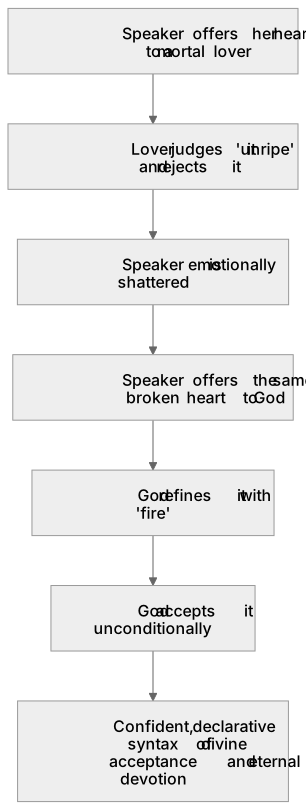
Put it in order
Put these steps in the order they happen.
- 1. Confident, declarative syntax of divine acceptance and eternal devotion
- 2. God accepts it unconditionally
- 3. Speaker is emotionally shattered
- 4. God refines it with 'fire'
- 5. Speaker offers her heart to a mortal lover
- 6. Lover judges it 'unripe' and rejects it
- 7. Speaker offers the same broken heart to God
Key words
Say what each word means before you turn the card.
Earthly versus divine love
Try answering aloud or in your head before turning the card.
Female agency and vulnerability
Try answering aloud or in your head before turning the card.
Judgement and purification
Try answering aloud or in your head before turning the card.
Spiritual devotion
Try answering aloud or in your head before turning the card.
See every definition
- Earthly versus divine love
- The contrast between the fragility of earthly romance and the absolute security of divine love, shown through the two offerings of the speaker's heart.
- Female agency and vulnerability
- The speaker's initial emotional shattering by a mortal lover's rejection, and her reclaiming of agency through spiritual devotion rather than earthly marriage.
- Judgement and purification
- The mortal lover's critical, conditional judgement of the heart as 'unripe', contrasted with God's refining of the same broken heart with 'fire' and unconditional acceptance.
- Spiritual devotion
- The speaker's confident, declarative devotion to God, expressed in the shift from hesitant rhythms to eternal devotion after divine acceptance.
Label the diagram
Some boxes have lost their names. Pick the right name for each number.
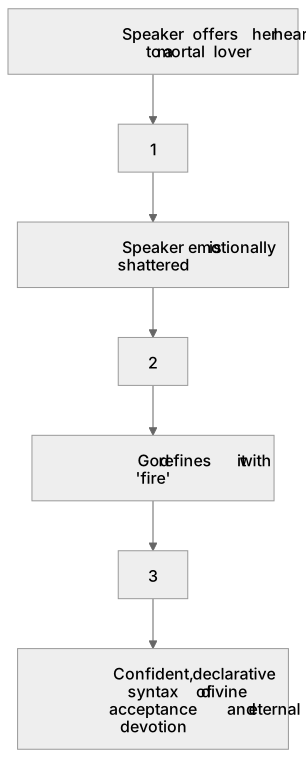
1Box 1
2Box 2
3Box 3
There is more to this lesson
The full lesson goes on to check your understanding and help you earn the marks. Create a free account to carry on, with your progress saved.
A week of Premium from your first lesson · Then the free plan continues · No card, no charge
Test your understanding of Component 3: Poetry – Section B: Specified Poetry Pre- or Post-1900 – Pre-1900 – The Victorian Period – Christina Rossetti Selected Poems, editor Dinah Roe (Penguin, 2008): Twice
Active recall beats re-reading. Take an instant quiz now to test what you’ve learned and lock it into long-term memory.
A week of Premium from your first lesson · Then the free plan continues · No card, no charge