Pearson Edexcel · A-Level · English Literature
Course version: 9ET0 · Version from Sept 2015
Poetry – Section B: Specified Poetry Pre- or Post-1900 – Pre-1900 – The…
Full specification wording
Component 3: Poetry – Section B: Specified Poetry Pre- or Post-1900 – Pre-1900 – The Victorian Period – Christina Rossetti Selected Poems, editor Dinah Roe (Penguin, 2008): What Would I Give?
In 'What Would I Give?', Rossetti's speaker longs to recover three capacities: a warm 'heart of flesh' instead of an ice-cold 'heart of stone', words instead of a spirit that has 'fallen dumb',…
Checked against the Pearson Edexcel 9ET0 specification (opens in a new tab) on .
- Point 9 of 18
- 4 key terms
Study notes
From the checked teaching notes for this specification point.
The idea
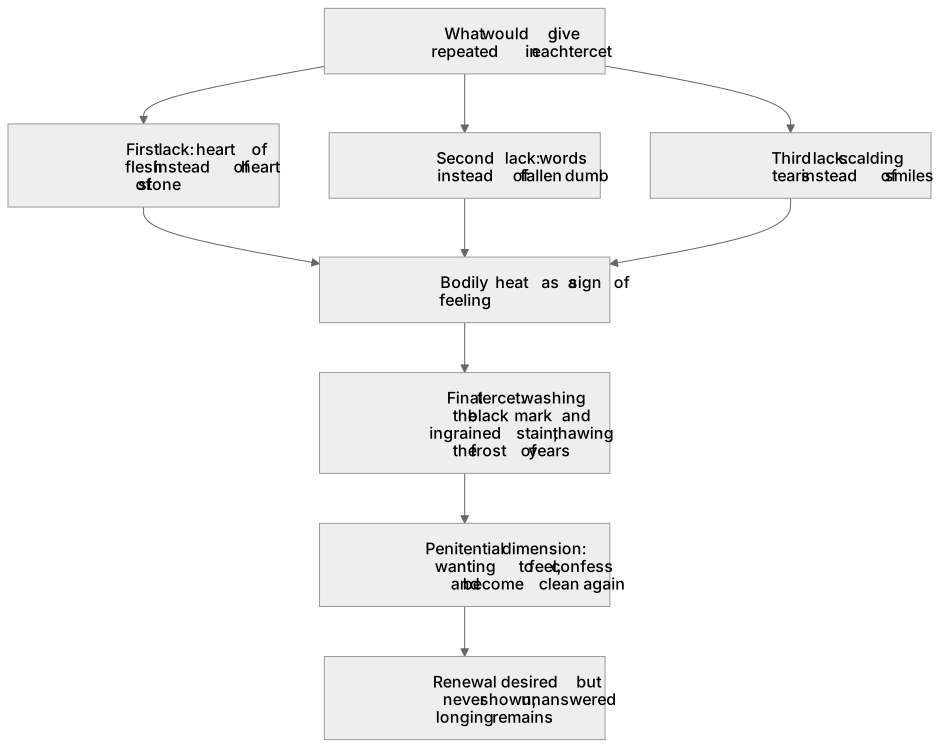
In 'What Would I Give?', Rossetti's speaker longs to recover three capacities: a warm 'heart of flesh' instead of an ice-cold 'heart of stone', words instead of a spirit that has 'fallen dumb', and 'scalding tears' instead of smiles. The three tercets repeat 'What would I give', but each request remains unanswered, making desire itself the poem's structure. Bodily heat, speech and tears become signs of feeling that the speaker cannot produce. In the final tercet, washing 'the black mark' and an ingrained stain and thawing 'the frost of years' give emotional numbness a penitential dimension: the speaker wants to feel, confess and become clean again, while the poem never shows that renewal occurring.
What earns the marks
- Analyse how the anaphoric 'What would I give' opens each tercet and makes repeated, unanswered desire the poem's organising pattern.
- Evaluate the contrast between a warming 'heart of flesh' and the speaker's 'heart of stone', described as hard, cold and small.
- Explore the second tercet's contrast between the speaker's dumb misery and the 'merry friends' who can go their way.
- Discuss how scalding tears, washing, stain and thawing combine emotional release with the language of penitence and cleansing.
Common mistakes and how to put them right
Claiming the poem moves from a 'merry heart' to a 'broken heart'.
Put it right: Those phrases are absent; the actual contrasts are heart of flesh/heart of stone, words/dumbness, and scalding tears/smiles.
Saying the poem ends in achieved forgiveness or emotional recovery.
Put it right: The final wish is to become clean again, but the repeated conditional longing remains unresolved.
Treating 'the black mark' as only a literal stain.
Put it right: Read it with the surrounding cleansing language as a possible image of guilt or sin, while grounding the interpretation in the poem's words.
Exam tips
- Structure a response around the three linked lacks—feeling, speech and tears—and explain how each tercet develops the sequence.
- Connect temperature and material imagery ('flesh', 'stone', 'ice-cold', 'frost') to the speaker's emotional condition.
- Present penitence as a text-supported interpretation of the cleansing imagery rather than claiming that the poem narrates a completed spiritual conversion.
Try the lesson
The start of the Component 3: Poetry – Section B: Specified Poetry Pre- or Post-1900 – Pre-1900 – The Victorian Period – Christina Rossetti Selected Poems, editor Dinah Roe (Penguin, 2008): What Would I Give? lesson, made from checked teaching notes for this specification point.
Have a go first
In the opening stanza of Christina Rossetti's poem 'What Would I Give?', which metaphor does the speaker use to describe their own emotional numbness?
Listen
In 'What Would I Give?', Rossetti's speaker longs to recover three capacities: a warm 'heart of flesh' instead of an ice-cold 'heart of stone', words instead of a spirit that has 'fallen dumb', and 'scalding tears' instead of smiles. The three tercets repeat 'What would I give', but each request remains unanswered, making desire itself the poem's structure. Bodily heat, speech and tears become signs of feeling that the speaker cannot produce. In the final tercet, washing 'the black mark' and an ingrained stain and thawing 'the frost of years' give emotional numbness a penitential dimension: the speaker wants to feel, confess and become clean again, while the poem never shows that renewal occurring. A strong answer earns marks for these points. Analyse how the anaphoric 'What would I give' opens each tercet and makes repeated, unanswered desire the poem's organising pattern. Evaluate the contrast between a warming 'heart of flesh' and the speaker's 'heart of stone', described as hard, cold and small. Explore the second tercet's contrast between the speaker's dumb misery and the 'merry friends' who can go their way. Discuss how scalding tears, washing, stain and thawing combine emotional release with the language of penitence and cleansing. A common slip: Claiming the poem moves from a 'merry heart' to a 'broken heart'. Instead, Those phrases are absent; the actual contrasts are heart of flesh/heart of stone, words/dumbness, and scalding tears/smiles. Exam tip: Structure a response around the three linked lacks—feeling, speech and tears—and explain how each tercet develops the sequence.
See it
Key words
Say what each word means before you turn the card.
Emotional numbness
Try answering aloud or in your head before turning the card.
Speech and isolation
Try answering aloud or in your head before turning the card.
Penitence and cleansing
Try answering aloud or in your head before turning the card.
Longing for renewal
Try answering aloud or in your head before turning the card.
See every definition
- Emotional numbness
- A condition the speaker makes concrete through bodily, thermal and cleansing images, wanting to feel, confess and become clean again.
- Speech and isolation
- The contrast between the speaker's dumb misery and the 'merry friends' who can go their way.
- Penitence and cleansing
- A text-supported interpretation of the cleansing imagery, combining emotional release with the language of penitence and cleansing.
- Longing for renewal
- Repeated, unanswered desire organised by the anaphoric 'What would I give', which opens each tercet.
Label the diagram
Some boxes have lost their names. Pick the right name for each number.
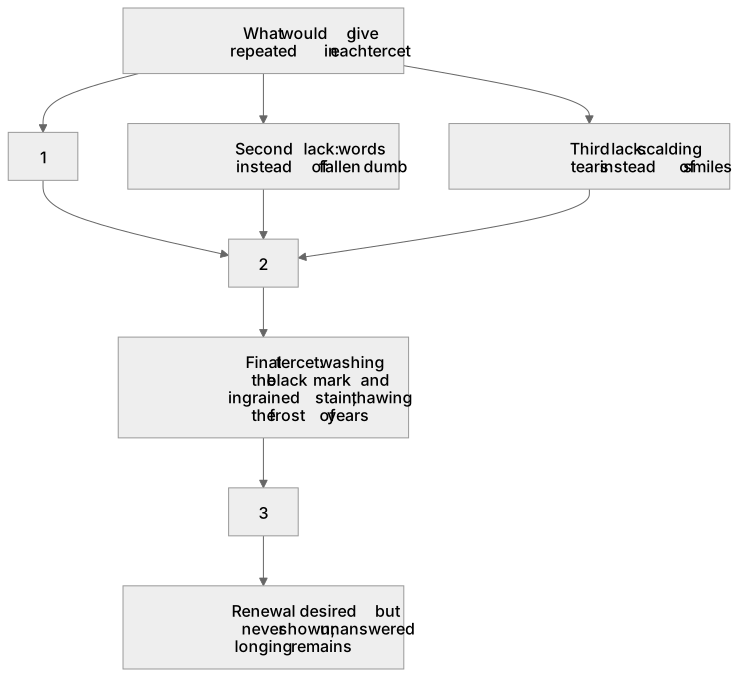
1Box 1
2Box 2
3Box 3
There is more to this lesson
The full lesson goes on to check your understanding and help you earn the marks. Create a free account to carry on, with your progress saved.
A week of Premium from your first lesson · Then the free plan continues · No card, no charge
Test your understanding of Component 3: Poetry – Section B: Specified Poetry Pre- or Post-1900 – Pre-1900 – The Victorian Period – Christina Rossetti Selected Poems, editor Dinah Roe (Penguin, 2008): What Would I Give?
Active recall beats re-reading. Take an instant quiz now to test what you’ve learned and lock it into long-term memory.
A week of Premium from your first lesson · Then the free plan continues · No card, no charge