Pearson Edexcel · A-Level · English Literature
Course version: 9ET0 · Version from Sept 2015
Poetry – Section B: Specified Poetry Pre- or Post-1900 – Pre-1900 – The…
Full specification wording
Component 3: Poetry – Section B: Specified Poetry Pre- or Post-1900 – Pre-1900 – The Victorian Period – The New Oxford Book of Victorian Verse, editor Christopher Ricks (OUP, 2008): The Visionary Emily Brontë and Charlotte Brontë
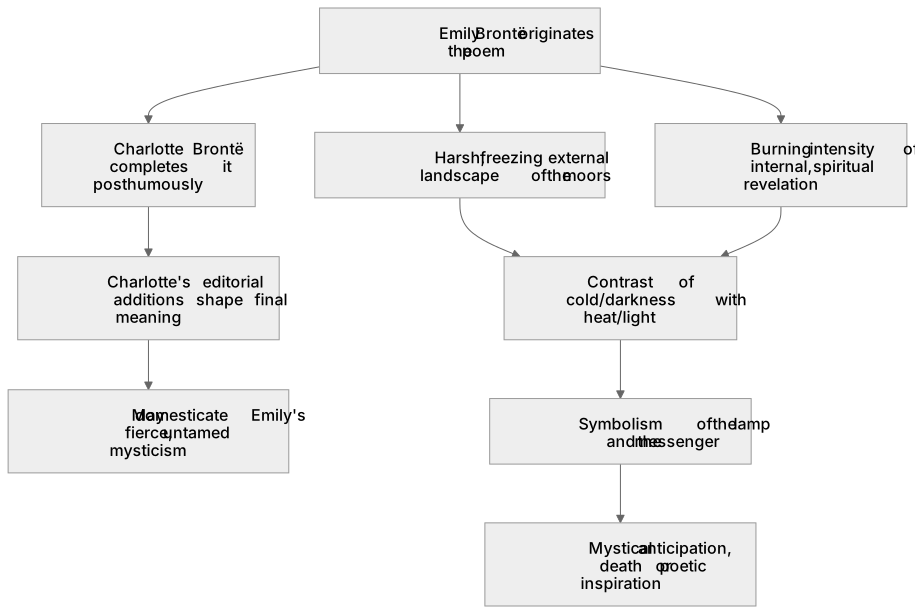
‘The Visionary’ offers a fascinating study of collaborative authorship and sibling legacy, originating with Emily Brontë and completed posthumously by Charlotte Brontë.
Checked against the Pearson Edexcel 9ET0 specification (opens in a new tab) on .
- Point 1 of 17
- 4 key terms
Study notes
From the checked teaching notes for this specification point.
The idea
‘The Visionary’ offers a fascinating study of collaborative authorship and sibling legacy, originating with Emily Brontë and completed posthumously by Charlotte Brontë. The poem contrasts a harsh, freezing external landscape with the burning intensity of internal, spiritual revelation. It is crucial to evaluate how Charlotte’s editorial additions shape the poem’s final meaning, potentially domesticating Emily’s fierce, untamed mysticism. By examining the regular AABB rhyming couplets and gothic imagery, learners can assess the text's engagement with Victorian spiritualism and isolation.
What earns the marks
- Analyse the juxtaposition between the hostile, cold external environment of the moors and the warm, illuminated interior space.
- Evaluate the symbolism of the lamp and the anticipated 'messenger' as representations of mystical vision, death, or poetic inspiration.
- Discuss the impact of Charlotte Brontë's posthumous editing and additions on the tone, structure, and meaning of Emily's original fragments.
- Explore the poem's use of gothic elements and its connection to the broader Brontë mythos of isolation and intense spiritual experience.
Common mistakes and how to put them right
Attributing the entire poem solely to Emily Brontë without acknowledging Charlotte's role.
Put it right: Explicitly discuss the poem as a composite text, noting Charlotte's posthumous additions and editorial influence.
Interpreting the 'messenger' purely as a literal romantic lover.
Put it right: Analyse the 'messenger' as a complex symbol of spiritual visitation, transcendent artistic inspiration, or even a personification of death.
Overlooking the significance of the physical setting.
Put it right: Examine how the bleak moorland winter setting actively heightens the intensity and isolation of the speaker's internal visionary experience.
Exam tips
- Contrast the untamed, mystical elements characteristic of Emily's writing with the potentially more conventional framing provided by Charlotte's additions.
- Link the poem's themes of isolation and spiritual communion to other Victorian poems exploring faith, the supernatural, or the role of the poet.
- Pay close attention to the sensory contrast between cold/darkness and heat/light in your close reading to demonstrate an understanding of the poem's atmospheric tension.
Try the lesson
The start of the Component 3: Poetry – Section B: Specified Poetry Pre- or Post-1900 – Pre-1900 – The Victorian Period – The New Oxford Book of Victorian Verse, editor Christopher Ricks (OUP, 2008): The Visionary Emily Brontë and Charlotte Brontë lesson, made from checked teaching notes for this specification point.
Have a go first
In 'The Visionary', what object does the speaker carefully tend to serve as a 'guiding-star' for the expected visitor?
Listen
The Visionary’ offers a fascinating study of collaborative authorship and sibling legacy, originating with Emily Brontë and completed posthumously by Charlotte Brontë. The poem contrasts a harsh, freezing external landscape with the burning intensity of internal, spiritual revelation. It is crucial to evaluate how Charlotte’s editorial additions shape the poem’s final meaning, potentially domesticating Emily’s fierce, untamed mysticism. By examining the regular AABB rhyming couplets and gothic imagery, learners can assess the text's engagement with Victorian spiritualism and isolation. A strong answer earns marks for these points. Analyse the juxtaposition between the hostile, cold external environment of the moors and the warm, illuminated interior space. Evaluate the symbolism of the lamp and the anticipated 'messenger' as representations of mystical vision, death, or poetic inspiration. Discuss the impact of Charlotte Brontë's posthumous editing and additions on the tone, structure, and meaning of Emily's original fragments. Explore the poem's use of gothic elements and its connection to the broader Brontë mythos of isolation and intense spiritual experience. A common slip: Attributing the entire poem solely to Emily Brontë without acknowledging Charlotte's role. Instead, Explicitly discuss the poem as a composite text, noting Charlotte's posthumous additions and editorial influence. Exam tip: Contrast the untamed, mystical elements characteristic of Emily's writing with the potentially more conventional framing provided by Charlotte's additions.
See it
Key words
Say what each word means before you turn the card.
Mysticism and the Supernatural
Try answering aloud or in your head before turning the card.
Isolation and the Natural World
Try answering aloud or in your head before turning the card.
Artistic Inspiration
Try answering aloud or in your head before turning the card.
Sibling Collaboration and Legacy
Try answering aloud or in your head before turning the card.
See every definition
- Mysticism and the Supernatural
- The poem contrasts a harsh, freezing external landscape with the burning intensity of internal, spiritual revelation, and its gothic imagery engages with Victorian spiritualism.
- Isolation and the Natural World
- The bleak moorland winter setting actively heightens the intensity and isolation of the speaker's internal visionary experience.
- Artistic Inspiration
- The symbolism of the lamp and the anticipated 'messenger' can represent mystical vision, death, or poetic inspiration.
- Sibling Collaboration and Legacy
- The poem originated with Emily Brontë and was completed posthumously by Charlotte Brontë, whose editorial additions shape the poem's final meaning.
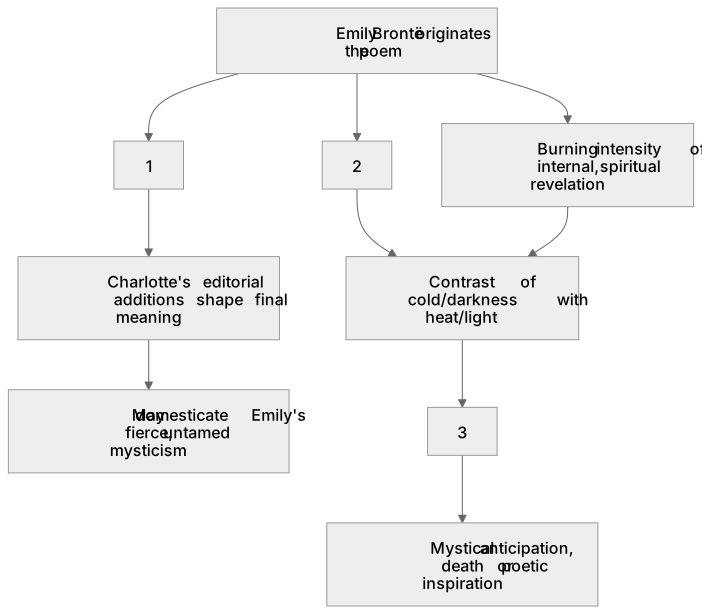
Label the diagram
Some boxes have lost their names. Pick the right name for each number.
1Box 1
2Box 2
3Box 3
There is more to this lesson
The full lesson goes on to check your understanding and help you earn the marks. Create a free account to carry on, with your progress saved.
A week of Premium from your first lesson · Then the free plan continues · No card, no charge
Test your understanding of Component 3: Poetry – Section B: Specified Poetry Pre- or Post-1900 – Pre-1900 – The Victorian Period – The New Oxford Book of Victorian Verse, editor Christopher Ricks (OUP, 2008): The Visionary Emily Brontë and Charlotte Brontë
Active recall beats re-reading. Take an instant quiz now to test what you’ve learned and lock it into long-term memory.
A week of Premium from your first lesson · Then the free plan continues · No card, no charge