Pearson Edexcel · A-Level · English Literature
Course version: 9ET0 · Version from Sept 2015
Poetry – Section B: Specified Poetry Pre- or Post-1900 – Pre-1900 – The…
Full specification wording
Component 3: Poetry – Section B: Specified Poetry Pre- or Post-1900 – Pre-1900 – The Victorian Period – The New Oxford Book of Victorian Verse, editor Christopher Ricks (OUP, 2008): Grief Elizabeth Barrett Browning
Elizabeth Barrett Browning’s sonnet 'Grief' explores the profound, paralysing nature of true sorrow, contrasting it with superficial, performative mourning.
Checked against the Pearson Edexcel 9ET0 specification (opens in a new tab) on .
- Point 2 of 17
- 2 key terms
Study notes
From the checked teaching notes for this specification point.
The idea
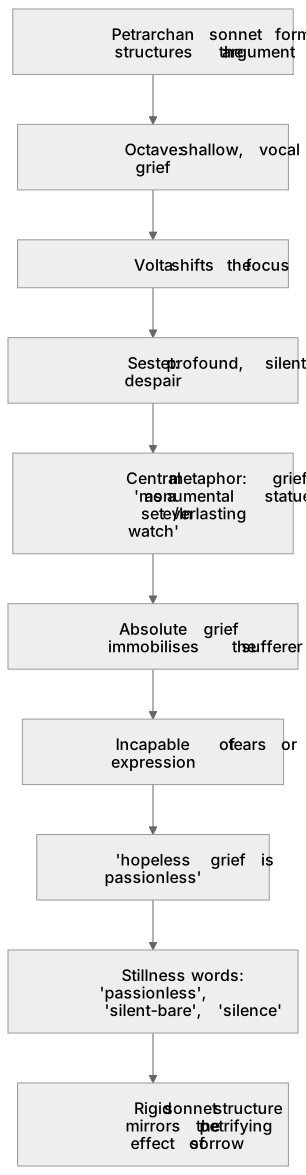
Elizabeth Barrett Browning’s sonnet 'Grief' explores the profound, paralysing nature of true sorrow, contrasting it with superficial, performative mourning. The poem uses the Petrarchan sonnet form to structure its argument, moving from the octave's depiction of shallow, vocal grief to the sestet's profound, silent despair. Barrett Browning employs striking imagery, such as the 'monumental statue set / In everlasting watch', to convey how absolute grief immobilises the sufferer, rendering them incapable of tears or expression.
What earns the marks
- Analyse the use of the Petrarchan sonnet form and how the volta shifts the focus from vocal, shallow sorrow to silent, profound grief.
- Evaluate the effectiveness of the central metaphor comparing deep grief to a 'monumental statue', highlighting the theme of emotional paralysis.
- Explore the Victorian contextual factors regarding mourning rituals and how Barrett Browning subverts expectations of performative female sorrow.
- Examine the cluster of stillness words, including 'passionless', 'silent-bare' and 'silence', to reinforce the absolute stillness of true despair.
Common mistakes and how to put them right
Confusing the poem's message by claiming it advocates for loud, expressive mourning.
Put it right: Recognise that the poem explicitly states 'hopeless grief is passionless' and critiques loud, performative sorrow.
Misidentifying the sonnet form as Shakespearean.
Put it right: Identify the poem as a Petrarchan sonnet, noting the specific octave (ABBAABBA) and sestet structure used to build the argument.
Ignoring the Victorian context of mourning.
Put it right: Integrate contextual knowledge of 19th-century mourning conventions to explain why Barrett Browning's depiction of silent, internalised grief is significant.
Exam tips
- Compare the silent, statuesque imagery in 'Grief' with the more expressive emotional displays in other Victorian poems in the anthology.
- Analyse the specific placement of the volta and how it serves as a pivot between the observation of others' grief and the definition of true despair.
- Use precise literary terminology, such as 'Petrarchan sonnet', 'volta', and 'extended metaphor', to elevate your analysis of form and structure.
Try the lesson
The start of the Component 3: Poetry – Section B: Specified Poetry Pre- or Post-1900 – Pre-1900 – The Victorian Period – The New Oxford Book of Victorian Verse, editor Christopher Ricks (OUP, 2008): Grief Elizabeth Barrett Browning lesson, made from checked teaching notes for this specification point.
Have a go first
What is the central argument about the nature of profound sorrow in Elizabeth Barrett Browning's poem 'Grief'?
Listen
Elizabeth Barrett Browning’s sonnet 'Grief' explores the profound, paralysing nature of true sorrow, contrasting it with superficial, performative mourning. The poem uses the Petrarchan sonnet form to structure its argument, moving from the octave's depiction of shallow, vocal grief to the sestet's profound, silent despair. Barrett Browning employs striking imagery, such as the 'monumental statue set / In everlasting watch', to convey how absolute grief immobilises the sufferer, rendering them incapable of tears or expression. A strong answer earns marks for these points. Analyse the use of the Petrarchan sonnet form and how the volta shifts the focus from vocal, shallow sorrow to silent, profound grief. Evaluate the effectiveness of the central metaphor comparing deep grief to a 'monumental statue', highlighting the theme of emotional paralysis. Explore the Victorian contextual factors regarding mourning rituals and how Barrett Browning subverts expectations of performative female sorrow. Examine the cluster of stillness words, including 'passionless', 'silent-bare' and 'silence', to reinforce the absolute stillness of true despair. A common slip: Confusing the poem's message by claiming it advocates for loud, expressive mourning. Instead, Recognise that the poem explicitly states 'hopeless grief is passionless' and critiques loud, performative sorrow. Exam tip: Compare the silent, statuesque imagery in 'Grief' with the more expressive emotional displays in other Victorian poems in the anthology.
See it
Key words
Say what each word means before you turn the card.
Victorian mourning conventions
Try answering aloud or in your head before turning the card.
emotional paralysis
Try answering aloud or in your head before turning the card.
See every definition
- Victorian mourning conventions
- The era's elaborate public displays of grief, contrasted with the poem's assertion that 'hopeless grief is passionless'.
- emotional paralysis
- The immobilising effect of absolute grief, conveyed through the 'monumental statue' metaphor, which renders the sufferer incapable of tears or expression.
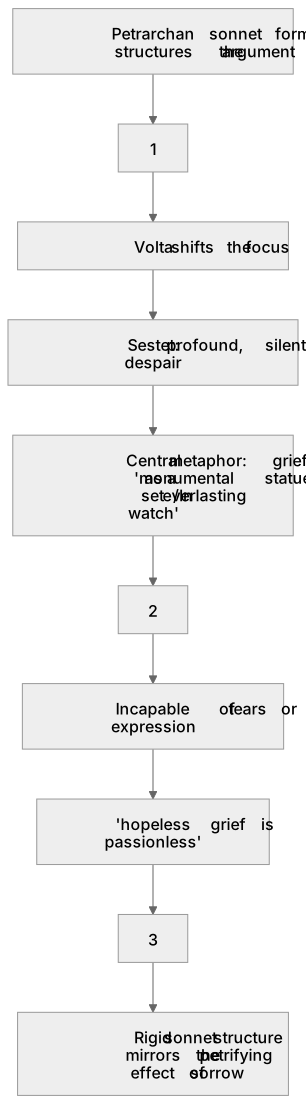
Label the diagram
Some boxes have lost their names. Pick the right name for each number.
1Box 1
2Box 2
3Box 3
There is more to this lesson
The full lesson goes on to check your understanding and help you earn the marks. Create a free account to carry on, with your progress saved.
A week of Premium from your first lesson · Then the free plan continues · No card, no charge
Test your understanding of Component 3: Poetry – Section B: Specified Poetry Pre- or Post-1900 – Pre-1900 – The Victorian Period – The New Oxford Book of Victorian Verse, editor Christopher Ricks (OUP, 2008): Grief Elizabeth Barrett Browning
Active recall beats re-reading. Take an instant quiz now to test what you’ve learned and lock it into long-term memory.
A week of Premium from your first lesson · Then the free plan continues · No card, no charge