Pearson Edexcel · A-Level · English Literature
Course version: 9ET0 · Version from Sept 2015
Poetry – Section B: Specified Poetry Pre- or Post-1900 – Pre-1900 – The…
Full specification wording
Component 3: Poetry – Section B: Specified Poetry Pre- or Post-1900 – Pre-1900 – The Victorian Period – The New Oxford Book of Victorian Verse, editor Christopher Ricks (OUP, 2008): Drummer Hodge
Thomas Hardy’s ‘Drummer Hodge’ explores the tragic reality of the Second Boer War, focusing on an unnamed, rural English soldier buried in an alien South African landscape.
Checked against the Pearson Edexcel 9ET0 specification (opens in a new tab) on .
- Point 15 of 17
- 4 key terms
Study notes
From the checked teaching notes for this specification point.
The idea
Thomas Hardy’s ‘Drummer Hodge’ explores the tragic reality of the Second Boer War, focusing on an unnamed, rural English soldier buried in an alien South African landscape. As a late Victorian poem, it subverts traditional elegies by highlighting the insignificance of the individual amidst imperial conflict. Hardy uses unfamiliar Afrikaans vocabulary, such as ‘kopje’ and ‘veldt’, to emphasise Hodge’s profound dislocation from his Wessex home. The regular ABABAB rhyme scheme and rhythmic meter ironically contrast with the chaotic, unceremonious nature of his burial. Ultimately, the poem suggests a cosmic, pantheistic assimilation, where the young soldier’s body physically merges with the foreign earth to become a permanent part of the ‘Southern tree’, reflecting Victorian anxieties about empire, mortality, and the natural world.
What earns the marks
- Analyse Hardy's use of Afrikaans terminology to highlight the soldier's alienation and the unfamiliarity of the landscape.
- Evaluate the significance of the title 'Drummer Hodge' as a representation of the anonymous, rural working class sacrificed in imperial wars.
- Explore the pantheistic imagery in the final stanza where Hodge becomes a permanent, physical part of the foreign environment.
- Connect the poem's themes of imperial conflict and rural loss to late Victorian anxieties regarding the human cost of empire.
Common mistakes and how to put them right
Assuming the poem is a patriotic celebration of war.
Put it right by identifying its anti-war, elegiac tone mourning a senseless loss.
Misinterpreting 'Hodge' as the soldier's actual surname.
Put it right by explaining it was a generic, often derogatory, term for an agricultural labourer.
Ignoring the specific historical context.
Put it right: Explicitly linking the poem to the Second Boer War and late Victorian imperialism.
Exam tips
- Compare the cosmic imagery of the constellations in 'Drummer Hodge' with other Victorian poems dealing with isolation or nature.
- Analyse how the rigid stanza structure contrasts with the chaotic, unceremonious burial described in the opening lines.
- Use the term 'pantheism' when discussing how Hodge's body is absorbed into the natural environment of the veldt.
Try the lesson
The start of the Component 3: Poetry – Section B: Specified Poetry Pre- or Post-1900 – Pre-1900 – The Victorian Period – The New Oxford Book of Victorian Verse, editor Christopher Ricks (OUP, 2008): Drummer Hodge lesson, made from checked teaching notes for this specification point.
Have a go first
In Thomas Hardy's poem 'Drummer Hodge', what is the primary setting where the titular character is buried?
Listen
Thomas Hardy’s ‘Drummer Hodge’ explores the tragic reality of the Second Boer War, focusing on an unnamed, rural English soldier buried in an alien South African landscape. As a late Victorian poem, it subverts traditional elegies by highlighting the insignificance of the individual amidst imperial conflict. Hardy uses unfamiliar Afrikaans vocabulary, such as ‘kopje’ and ‘veldt’, to emphasise Hodge’s profound dislocation from his Wessex home. The regular ABABAB rhyme scheme and rhythmic meter ironically contrast with the chaotic, unceremonious nature of his burial. Ultimately, the poem suggests a cosmic, pantheistic assimilation, where the young soldier’s body physically merges with the foreign earth to become a permanent part of the ‘Southern tree’, reflecting Victorian anxieties about empire, mortality, and the natural world. A strong answer earns marks for these points. Analyse Hardy's use of Afrikaans terminology to highlight the soldier's alienation and the unfamiliarity of the landscape. Evaluate the significance of the title 'Drummer Hodge' as a representation of the anonymous, rural working class sacrificed in imperial wars. Explore the pantheistic imagery in the final stanza where Hodge becomes a permanent, physical part of the foreign environment. Connect the poem's themes of imperial conflict and rural loss to late Victorian anxieties regarding the human cost of empire. A common slip: Assuming the poem is a patriotic celebration of war. Instead, identifying its anti-war, elegiac tone mourning a senseless loss. Exam tip: Compare the cosmic imagery of the constellations in 'Drummer Hodge' with other Victorian poems dealing with isolation or nature.
See it
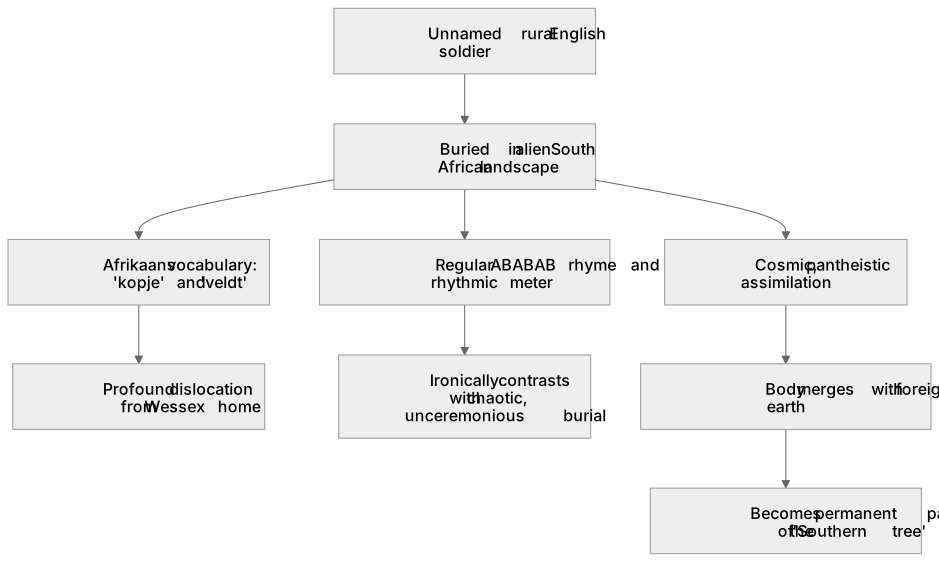
Key words
Say what each word means before you turn the card.
Imperialism and War
Try answering aloud or in your head before turning the card.
Alienation and Isolation
Try answering aloud or in your head before turning the card.
Nature and the Cosmos
Try answering aloud or in your head before turning the card.
The Rural Working Class
Try answering aloud or in your head before turning the card.
See every definition
- Imperialism and War
- The imperial conflict of the Second Boer War, in which an unnamed rural English soldier is sacrificed, reflecting late Victorian anxieties about the human cost of empire.
- Alienation and Isolation
- Hodge's profound dislocation from his Wessex home, emphasised by unfamiliar Afrikaans vocabulary such as 'kopje' and 'veldt' and his burial in an alien South African landscape.
- Nature and the Cosmos
- A cosmic, pantheistic assimilation in which the young soldier's body physically merges with the foreign earth to become a permanent part of the 'Southern tree'.
- The Rural Working Class
- The anonymous agricultural labourer represented by the title 'Drummer Hodge', a generic, often derogatory term for such a worker sacrificed in imperial wars.
Label the diagram
Some boxes have lost their names. Pick the right name for each number.
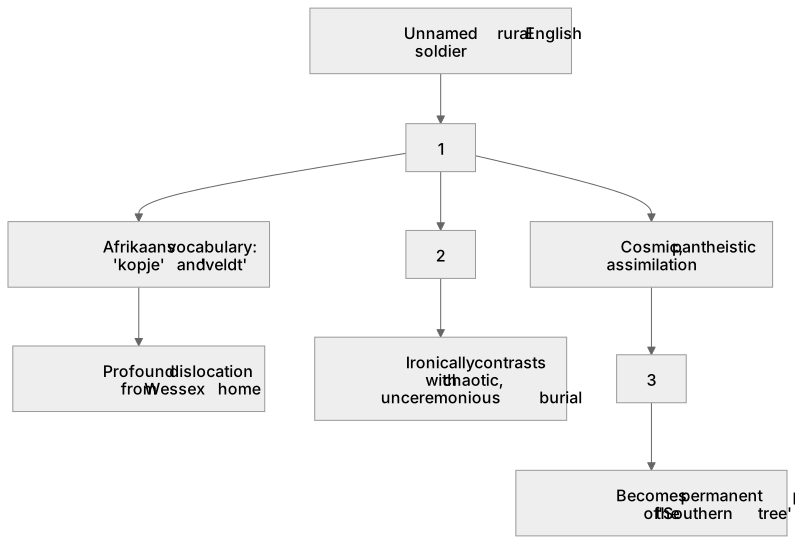
1Box 1
2Box 2
3Box 3
There is more to this lesson
The full lesson goes on to check your understanding and help you earn the marks. Create a free account to carry on, with your progress saved.
A week of Premium from your first lesson · Then the free plan continues · No card, no charge
Test your understanding of Component 3: Poetry – Section B: Specified Poetry Pre- or Post-1900 – Pre-1900 – The Victorian Period – The New Oxford Book of Victorian Verse, editor Christopher Ricks (OUP, 2008): Drummer Hodge
Active recall beats re-reading. Take an instant quiz now to test what you’ve learned and lock it into long-term memory.
A week of Premium from your first lesson · Then the free plan continues · No card, no charge