Pearson Edexcel · A-Level · English Literature
Course version: 9ET0 · Version from Sept 2015
Poetry – Section B: Specified Poetry Pre- or Post-1900 – Pre-1900 – The…
Full specification wording
Component 3: Poetry – Section B: Specified Poetry Pre- or Post-1900 – Pre-1900 – The Victorian Period – The New Oxford Book of Victorian Verse, editor Christopher Ricks (OUP, 2008): ‘I Look into My Glass’
In ‘I Look into My Glass’, Thomas Hardy presents a poignant meditation on the cruel disparity between physical ageing and enduring emotional vitality.
Checked against the Pearson Edexcel 9ET0 specification (opens in a new tab) on .
- Point 14 of 17
- 4 key terms
Study notes
From the checked teaching notes for this specification point.
The idea
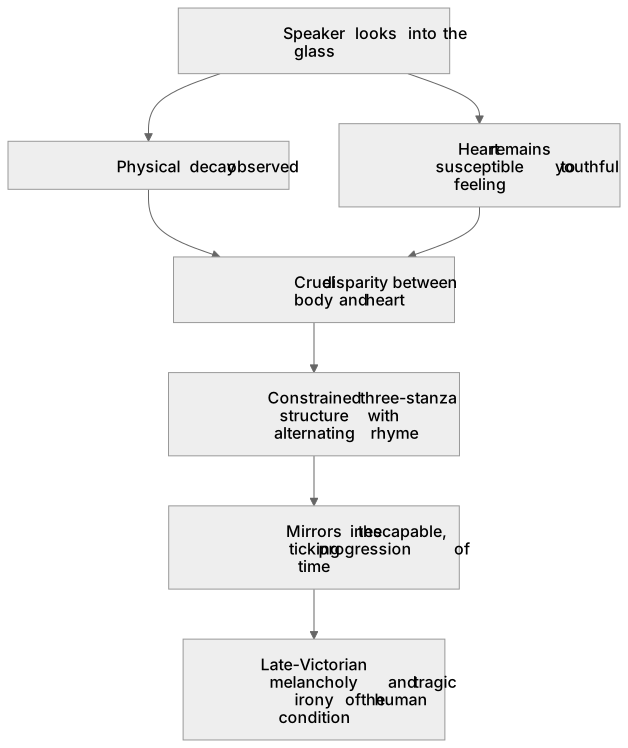
In ‘I Look into My Glass’, Thomas Hardy presents a poignant meditation on the cruel disparity between physical ageing and enduring emotional vitality. The speaker confronts his reflection, observing his physical decay, yet laments that his heart remains as susceptible to the intense feelings of youth as ever. Hardy uses a highly constrained three-stanza structure with a relentless alternating rhyme scheme to mirror the inescapable, ticking progression of time. By contrasting the shrinking, fragile physical body with the expansive, enduring capacity for emotional pain, the poem captures a distinctly late-Victorian sense of melancholy and the tragic irony of the human condition.
What earns the marks
- Analyse the central juxtaposition between physical decay and emotional endurance.
- Evaluate the significance of the 'glass' as a motif for harsh, objective truth and self-reflection.
- Explore how the concise, rigid structure and regular rhyme scheme reflect the inevitability of ageing.
- Discuss the use of emotive language, such as 'throbbings of noontide', to convey the persistence of youthful passion.
Common mistakes and how to put them right
Treating the poem merely as a complaint about old age.
Put it right: Focus on the tension between the ageing body and the youthful, feeling heart.
Overlooking the structural brevity.
Put it right: Analyse how the short, tightly controlled stanzas emphasize the inescapable reality of time.
Misinterpreting 'noontide'; correction: understand 'noontide' as a metaphor for the peak of life and youthful passion, not a literal time of day.
Exam tips
- Link the poem's melancholic tone to broader late-Victorian anxieties about time and mortality.
- Compare the motif of the mirror and self-reflection with similar devices in other anthology poems.
- Examine the contrast between the objective reality of the mirror and the subjective experience of the speaker's heart.
Try the lesson
The start of the Component 3: Poetry – Section B: Specified Poetry Pre- or Post-1900 – Pre-1900 – The Victorian Period – The New Oxford Book of Victorian Verse, editor Christopher Ricks (OUP, 2008): ‘I Look into My Glass’ lesson, made from checked teaching notes for this specification point.
Have a go first
What is the primary contrast explored by the speaker in Thomas Hardy's poem 'I Look into My Glass'?
Listen
In ‘I Look into My Glass’, Thomas Hardy presents a poignant meditation on the cruel disparity between physical ageing and enduring emotional vitality. The speaker confronts his reflection, observing his physical decay, yet laments that his heart remains as susceptible to the intense feelings of youth as ever. Hardy uses a highly constrained three-stanza structure with a relentless alternating rhyme scheme to mirror the inescapable, ticking progression of time. By contrasting the shrinking, fragile physical body with the expansive, enduring capacity for emotional pain, the poem captures a distinctly late-Victorian sense of melancholy and the tragic irony of the human condition. A strong answer earns marks for these points. Analyse the central juxtaposition between physical decay and emotional endurance. Evaluate the significance of the 'glass' as a motif for harsh, objective truth and self-reflection. Explore how the concise, rigid structure and regular rhyme scheme reflect the inevitability of ageing. Discuss the use of emotive language, such as 'throbbings of noontide', to convey the persistence of youthful passion. A common slip: Treating the poem merely as a complaint about old age. Instead, focus on the tension between the ageing body and the youthful, feeling heart. Exam tip: Link the poem's melancholic tone to broader late-Victorian anxieties about time and mortality.
See it
Key words
Say what each word means before you turn the card.
Ageing and mortality
Try answering aloud or in your head before turning the card.
The duality of body and mind
Try answering aloud or in your head before turning the card.
Time and memory
Try answering aloud or in your head before turning the card.
Melancholy and isolation
Try answering aloud or in your head before turning the card.
See every definition
- Ageing and mortality
- The poem presents a meditation on the cruel disparity between physical ageing and enduring emotional vitality, capturing a late-Victorian sense of melancholy.
- The duality of body and mind
- Hardy contrasts the shrinking, fragile physical body with the expansive, enduring capacity for emotional pain, showing the tragic irony of the human condition.
- Time and memory
- A constrained three-stanza structure with a relentless alternating rhyme scheme mirrors the inescapable, ticking progression of time.
- Melancholy and isolation
- The poem captures a distinctly late-Victorian sense of melancholy and the tragic irony of the human condition.
Label the diagram
Some boxes have lost their names. Pick the right name for each number.
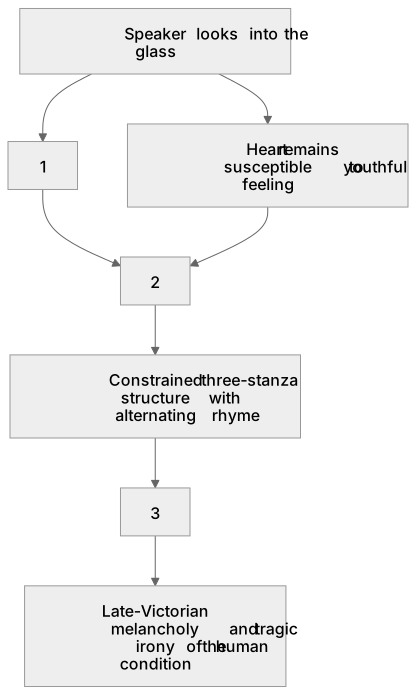
1Box 1
2Box 2
3Box 3
There is more to this lesson
The full lesson goes on to check your understanding and help you earn the marks. Create a free account to carry on, with your progress saved.
A week of Premium from your first lesson · Then the free plan continues · No card, no charge
Test your understanding of Component 3: Poetry – Section B: Specified Poetry Pre- or Post-1900 – Pre-1900 – The Victorian Period – The New Oxford Book of Victorian Verse, editor Christopher Ricks (OUP, 2008): ‘I Look into My Glass’
Active recall beats re-reading. Take an instant quiz now to test what you’ve learned and lock it into long-term memory.
A week of Premium from your first lesson · Then the free plan continues · No card, no charge