Pearson Edexcel · A-Level · English Literature
Course version: 9ET0 · Version from Sept 2015
Poetry – Section B: Specified Poetry Pre- or Post-1900 – Pre-1900 – The…
Full specification wording
Component 3: Poetry – Section B: Specified Poetry Pre- or Post-1900 – Pre-1900 – The Victorian Period – The New Oxford Book of Victorian Verse, editor Christopher Ricks (OUP, 2008): Stanzas – [‘Often rebuked, yet always back returning’] Charlotte Brontë (perhaps by Emily Brontë)
Stanzas – ['Often rebuked, yet always back returning'] explores the profound tension between societal duty and the irresistible pull of the natural world and untamed imagination.
Checked against the Pearson Edexcel 9ET0 specification (opens in a new tab) on .
- Point 8 of 17
- 4 key terms
Study notes
From the checked teaching notes for this specification point.
The idea
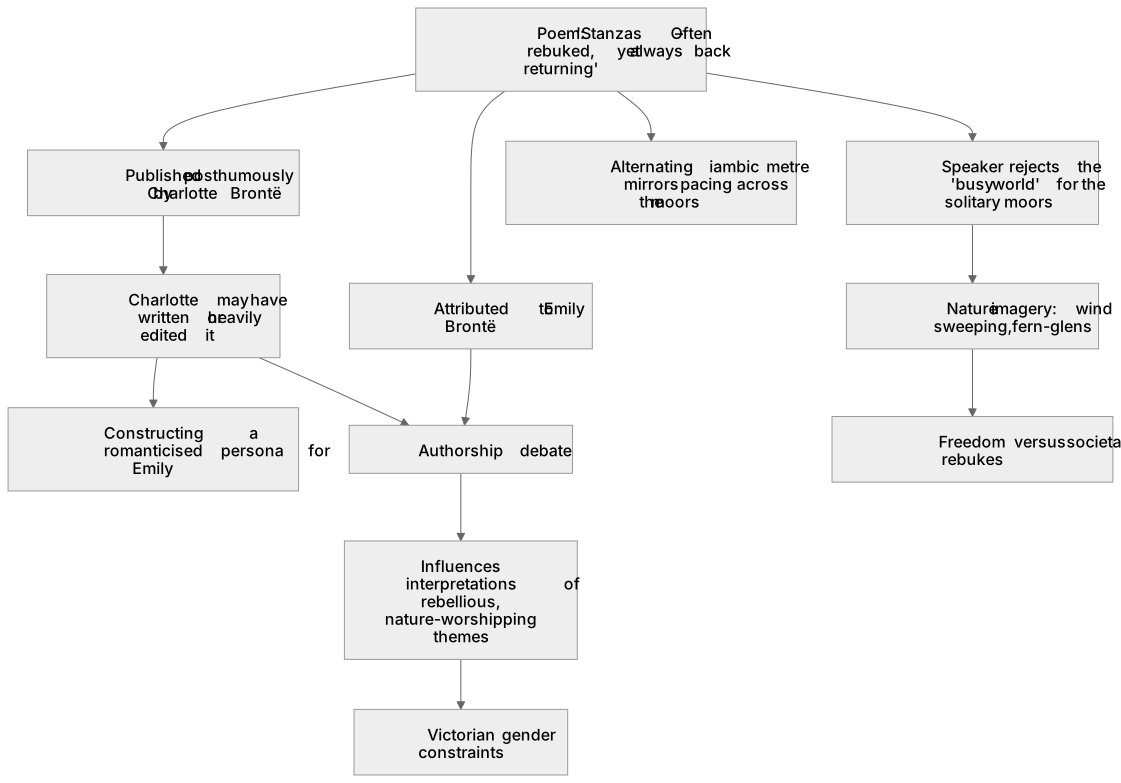
Stanzas – ['Often rebuked, yet always back returning'] explores the profound tension between societal duty and the irresistible pull of the natural world and untamed imagination. The speaker rejects the 'busy world' in favour of the solitary moors, symbolising a retreat into authentic selfhood. Analysing this poem requires examining its alternating iambic metre, which mirrors the speaker's pacing across the moors, and evaluating how the contested authorship influences interpretations of its rebellious, nature-worshipping themes within Victorian gender constraints.
What earns the marks
- Analyse the use of nature imagery, such as the wind sweeping and fern-glens, as a symbol of freedom versus societal rebukes.
- Evaluate the structural use of alternating rhyme and iambic rhythm to reflect the steady, determined physical and mental journey of the speaker.
- Discuss the contextual significance of the authorship debate, exploring how Charlotte Brontë's potential framing of Emily alters the poem's reception.
- Connect the poem's themes of isolation and imagination to broader Victorian Romantic legacies and gendered expectations of women's writing.
Common mistakes and how to put them right
Ignoring the authorship debate entirely.
Put it right: Acknowledge that the poem may have been written or heavily edited by Charlotte Brontë to shape Emily's posthumous image.
Treating the poem solely as a literal walk on the moors.
Put it right: Analyse the moors as a metaphorical landscape representing the untamed imagination and spiritual independence.
Misidentifying the poetic form as free verse.
Put it right: Identify and analyse the structured quatrains and regular metre, contrasting this formal control with the wildness of the subject matter.
Exam tips
- Use the authorship ambiguity as an analytical tool to discuss how Victorian women writers were curated and presented to the public.
- Compare the poem's treatment of nature as a sanctuary with other Victorian poets' more hostile or religious depictions of the natural world.
- Focus on the active verbs in the poem to demonstrate how the speaker's connection to nature is dynamic rather than passive.
Try the lesson
The start of the Component 3: Poetry – Section B: Specified Poetry Pre- or Post-1900 – Pre-1900 – The Victorian Period – The New Oxford Book of Victorian Verse, editor Christopher Ricks (OUP, 2008): Stanzas – [‘Often rebuked, yet always back returning’] Charlotte Brontë (perhaps by Emily Brontë) lesson, made from checked teaching notes for this specification point.
Have a go first
In the opening of 'Stanzas [Often rebuked, yet always back returning]', what central conflict does the speaker immediately establish?
Listen
Stanzas – ['Often rebuked, yet always back returning'] explores the profound tension between societal duty and the irresistible pull of the natural world and untamed imagination. The speaker rejects the 'busy world' in favour of the solitary moors, symbolising a retreat into authentic selfhood. Analysing this poem requires examining its alternating iambic metre, which mirrors the speaker's pacing across the moors, and evaluating how the contested authorship influences interpretations of its rebellious, nature-worshipping themes within Victorian gender constraints. A strong answer earns marks for these points. Analyse the use of nature imagery, such as the wind sweeping and fern-glens, as a symbol of freedom versus societal rebukes. Evaluate the structural use of alternating rhyme and iambic rhythm to reflect the steady, determined physical and mental journey of the speaker. Discuss the contextual significance of the authorship debate, exploring how Charlotte Brontë's potential framing of Emily alters the poem's reception. Connect the poem's themes of isolation and imagination to broader Victorian Romantic legacies and gendered expectations of women's writing. A common slip: Ignoring the authorship debate entirely. Instead, acknowledge that the poem may have been written or heavily edited by Charlotte Brontë to shape Emily's posthumous image. Exam tip: Use the authorship ambiguity as an analytical tool to discuss how Victorian women writers were curated and presented to the public.
See it
Key words
Say what each word means before you turn the card.
The restorative power of nature
Try answering aloud or in your head before turning the card.
Societal constraint versus individual freedom
Try answering aloud or in your head before turning the card.
The untamed imagination
Try answering aloud or in your head before turning the card.
Authorship and constructed identity
Try answering aloud or in your head before turning the card.
See every definition
- The restorative power of nature
- The pull of the natural world, which the speaker embraces by rejecting the busy world in favour of the solitary moors.
- Societal constraint versus individual freedom
- The profound tension between societal duty and the pull of the natural world and untamed imagination.
- The untamed imagination
- The wildness represented by the moors as a metaphorical landscape rather than a literal walk.
- Authorship and constructed identity
- The debate over whether Charlotte Brontë wrote or heavily edited the poem to construct a romanticised persona for her sister.
Label the diagram
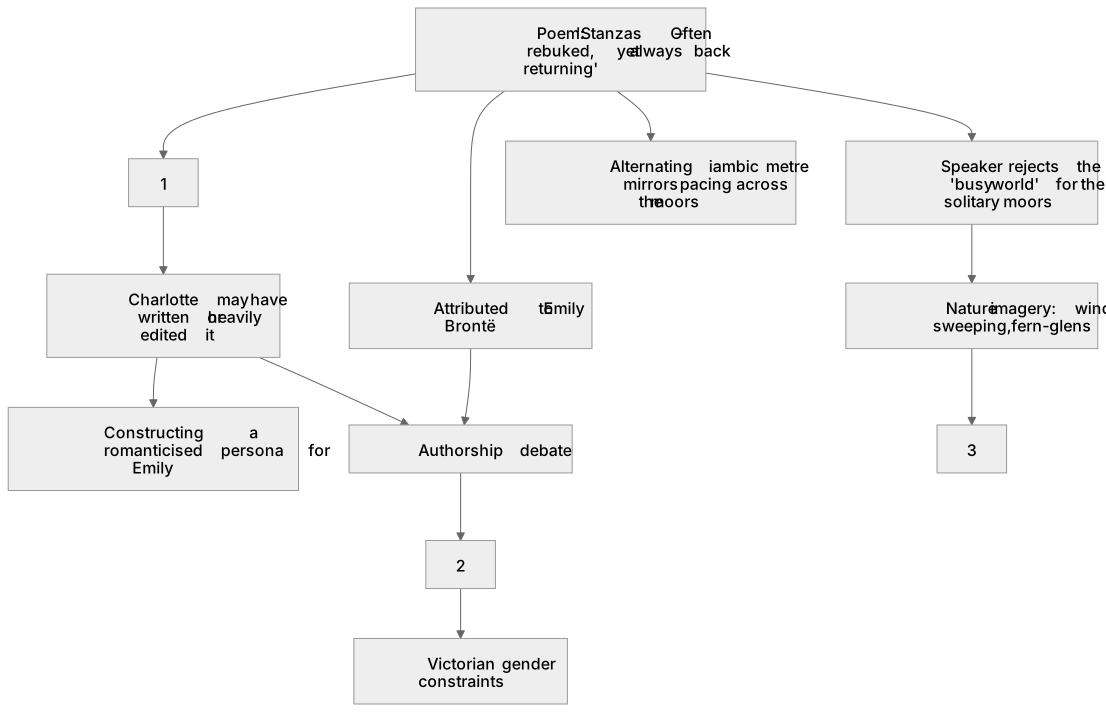
Some boxes have lost their names. Pick the right name for each number.
1Box 1
2Box 2
3Box 3
There is more to this lesson
The full lesson goes on to check your understanding and help you earn the marks. Create a free account to carry on, with your progress saved.
A week of Premium from your first lesson · Then the free plan continues · No card, no charge
Test your understanding of Component 3: Poetry – Section B: Specified Poetry Pre- or Post-1900 – Pre-1900 – The Victorian Period – The New Oxford Book of Victorian Verse, editor Christopher Ricks (OUP, 2008): Stanzas – [‘Often rebuked, yet always back returning’] Charlotte Brontë (perhaps by Emily Brontë)
Active recall beats re-reading. Take an instant quiz now to test what you’ve learned and lock it into long-term memory.
A week of Premium from your first lesson · Then the free plan continues · No card, no charge