Pearson Edexcel · A-Level · English Literature
Course version: 9ET0 · Version from Sept 2015
Poetry – Section B: Specified Poetry Pre- or Post-1900 – Pre-1900 – The…
Full specification wording
Component 3: Poetry – Section B: Specified Poetry Pre- or Post-1900 – Pre-1900 – The Victorian Period – The New Oxford Book of Victorian Verse, editor Christopher Ricks (OUP, 2008): Remember Christina Rossetti
Christina Rossetti’s Remember is a poignant Petrarchan sonnet that navigates the complex emotions surrounding death, memory, and selfless love.
Checked against the Pearson Edexcel 9ET0 specification (opens in a new tab) on .
- Point 9 of 17
- 4 key terms
Study notes
From the checked teaching notes for this specification point.
The idea
Christina Rossetti’s Remember is a poignant Petrarchan sonnet that navigates the complex emotions surrounding death, memory, and selfless love. The octave establishes a melancholic, imperative plea for the beloved to remember the speaker after she has gone into the 'silent land', reflecting Victorian preoccupations with mourning and the afterlife. However, the crucial volta at the sestet shifts the poem's emotional trajectory. The speaker transitions from a desire for preservation in memory to a compassionate acceptance of being forgotten, prioritising the survivor's happiness over her own legacy.
What earns the marks
- Analyse the use of the Petrarchan sonnet form, specifically how the octave and sestet structure the shift from a plea for remembrance to an acceptance of being forgotten.
- Examine the significance of the volta introduced by 'Yet if you should forget me for a while', marking a shift from selfish desire to selfless love.
- Explore the euphemistic imagery of death, such as the 'silent land', in the context of Victorian religious beliefs and mourning practices.
- Evaluate the changing tone and impact of the repeated imperative verb 'remember' throughout the poem.
Common mistakes and how to put them right
Describing the poem as a Shakespearean sonnet.
Put it right: Correctly identify it as a Petrarchan sonnet and analyse the specific function of its octave and sestet.
Assuming the speaker is terrified of death.
Put it right: Focus on the speaker's acceptance of death and her primary concern for the emotional well-being of the lover she leaves behind.
Overlooking the shift in tone after the volta.
Put it right: Explicitly contrast the demanding tone of the octave with the consoling, selfless tone of the sestet.
Exam tips
- Track the frequency and placement of the word 'remember' to show how its power diminishes as the speaker relinquishes control.
- Connect the poem's themes of self-effacement to Victorian gender ideals regarding female sacrifice and devotion.
- Compare Rossetti's quiet, internalised approach to grief with more dramatic or public expressions of mourning in other anthology poems.
Try the lesson
The start of the Component 3: Poetry – Section B: Specified Poetry Pre- or Post-1900 – Pre-1900 – The Victorian Period – The New Oxford Book of Victorian Verse, editor Christopher Ricks (OUP, 2008): Remember Christina Rossetti lesson, made from checked teaching notes for this specification point.
Have a go first
Which poetic form does Christina Rossetti use in 'Remember'?
Listen
Christina Rossetti’s Remember is a poignant Petrarchan sonnet that navigates the complex emotions surrounding death, memory, and selfless love. The octave establishes a melancholic, imperative plea for the beloved to remember the speaker after she has gone into the 'silent land', reflecting Victorian preoccupations with mourning and the afterlife. However, the crucial volta at the sestet shifts the poem's emotional trajectory. The speaker transitions from a desire for preservation in memory to a compassionate acceptance of being forgotten, prioritising the survivor's happiness over her own legacy. A strong answer earns marks for these points. Analyse the use of the Petrarchan sonnet form, specifically how the octave and sestet structure the shift from a plea for remembrance to an acceptance of being forgotten. Examine the significance of the volta introduced by 'Yet if you should forget me for a while', marking a shift from selfish desire to selfless love. Explore the euphemistic imagery of death, such as the 'silent land', in the context of Victorian religious beliefs and mourning practices. Evaluate the changing tone and impact of the repeated imperative verb 'remember' throughout the poem. A common slip: Describing the poem as a Shakespearean sonnet. Instead, Correctly identify it as a Petrarchan sonnet and analyse the specific function of its octave and sestet. Exam tip: Track the frequency and placement of the word 'remember' to show how its power diminishes as the speaker relinquishes control.
See it
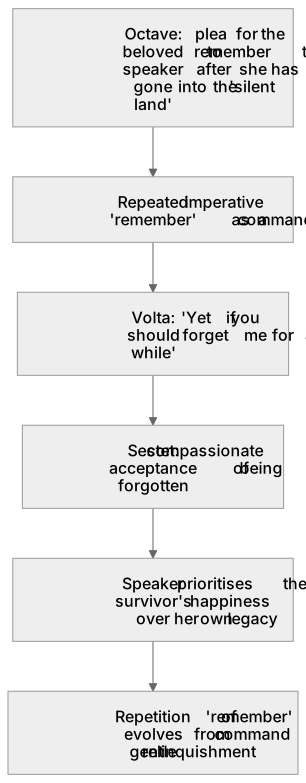
Put it in order
Put these steps in the order they happen.
- 1. Volta: 'Yet if you should forget me for a while'
- 2. Repeated imperative 'remember' as a command
- 3. Octave: plea for the beloved to remember the speaker after she has gone into the 'silent land'
- 4. Repetition of 'remember' evolves from command to gentle relinquishment
- 5. Speaker prioritises the survivor's happiness over her own legacy
- 6. Sestet: compassionate acceptance of being forgotten
Key words
Say what each word means before you turn the card.
Petrarchan sonnet
Try answering aloud or in your head before turning the card.
Volta
Try answering aloud or in your head before turning the card.
Victorian mourning conventions
Try answering aloud or in your head before turning the card.
Selfless love versus ego
Try answering aloud or in your head before turning the card.
See every definition
- Petrarchan sonnet
- A strict sonnet form whose octave and sestet structure contains the intense grief and organises the shift from a plea for remembrance to an acceptance of being forgotten.
- Volta
- The turn in the sestet, introduced by 'Yet if you should forget me for a while', marking a shift from selfish desire to selfless love.
- Victorian mourning conventions
- The Victorian preoccupations with mourning and the afterlife, and the conventional mourning rituals that the poem's compassionate acceptance of being forgotten challenges.
- Selfless love versus ego
- The movement from a desire for preservation in memory to a compassionate acceptance of being forgotten, prioritising the survivor's happiness over the speaker's own legacy.
Label the diagram
Some boxes have lost their names. Pick the right name for each number.
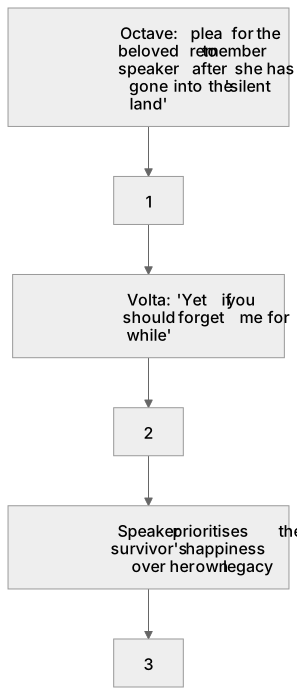
1Box 1
2Box 2
3Box 3
There is more to this lesson
The full lesson goes on to check your understanding and help you earn the marks. Create a free account to carry on, with your progress saved.
A week of Premium from your first lesson · Then the free plan continues · No card, no charge
Test your understanding of Component 3: Poetry – Section B: Specified Poetry Pre- or Post-1900 – Pre-1900 – The Victorian Period – The New Oxford Book of Victorian Verse, editor Christopher Ricks (OUP, 2008): Remember Christina Rossetti
Active recall beats re-reading. Take an instant quiz now to test what you’ve learned and lock it into long-term memory.
A week of Premium from your first lesson · Then the free plan continues · No card, no charge