Pearson Edexcel · A-Level · English Literature
Course version: 9ET0 · Version from Sept 2015
Poetry – Section B: Specified Poetry Pre- or Post-1900 – Pre-1900 – The…
Full specification wording
Component 3: Poetry – Section B: Specified Poetry Pre- or Post-1900 – Pre-1900 – The Victorian Period – The New Oxford Book of Victorian Verse, editor Christopher Ricks (OUP, 2008): Meeting at Night
Robert Browning's "Meeting at Night" is a highly sensory, dynamic poem capturing the urgency and secrecy of an illicit romantic encounter.
Checked against the Pearson Edexcel 9ET0 specification (opens in a new tab) on .
- Point 6 of 17
- 4 key terms
Study notes
From the checked teaching notes for this specification point.
The idea
Robert Browning's "Meeting at Night" is a highly sensory, dynamic poem capturing the urgency and secrecy of an illicit romantic encounter. The poem is structured in two six-line stanzas, mirroring the journey's two phases: the arduous sea voyage and the final, breathless approach across land. Browning employs vivid imagery, such as the "grey sea and the long black land" and the "fiery ringlets," to evoke both the physical landscape and the speaker's mounting passion. The transition from the expansive, muted seascape to the sharp, auditory climax of the "tap at the pane" and the "quick sharp scratch" of a match highlights the intense, private connection between the lovers, culminating in their beating hearts.
What earns the marks
- Analyse the use of sensory imagery, including visual, auditory, and tactile details, to convey the speaker's anticipation and the secrecy of the meeting.
- Evaluate the structural division of the poem into two stanzas, reflecting the distinct phases of the sea journey and the land journey.
- Explore the use of pathetic fallacy and dynamic verbs, such as "startle" and "leap", to project the speaker's passion onto the surrounding landscape.
- Discuss the significance of the auditory climax in the final lines, contrasting the vast silence of the journey with the intimate sounds of the lovers' reunion.
Common mistakes and how to put them right
Assuming the poem is a conventional Victorian love lyric.
Put it right: Recognise its focus on illicit, secret passion rather than idealised, socially sanctioned courtship.
Ignoring the specific metrical choices.
Put it right: Analyse how the iambic and anapestic rhythms mimic the movement of the boat and the speaker's racing heartbeat.
Treating the landscape merely as a passive setting.
Put it right: Discuss how the landscape is actively personified to reflect the speaker's internal emotional state.
Exam tips
- Link the poem's focus on secret, transgressive love to broader Victorian anxieties about morality and the division between private and public spheres.
- Compare the sensory progression in this poem with other Victorian works that use landscape to mirror psychological states.
- Focus closely on the transition from visual imagery in stanza one to auditory and tactile imagery in stanza two to demonstrate nuanced close reading.
Try the lesson
The start of the Component 3: Poetry – Section B: Specified Poetry Pre- or Post-1900 – Pre-1900 – The Victorian Period – The New Oxford Book of Victorian Verse, editor Christopher Ricks (OUP, 2008): Meeting at Night lesson, made from checked teaching notes for this specification point.
Have a go first
Which of the following best describes the physical progression of the speaker's journey in Robert Browning's poem 'Meeting at Night'?
Listen
Robert Browning's "Meeting at Night" is a highly sensory, dynamic poem capturing the urgency and secrecy of an illicit romantic encounter. The poem is structured in two six-line stanzas, mirroring the journey's two phases: the arduous sea voyage and the final, breathless approach across land. Browning employs vivid imagery, such as the "grey sea and the long black land" and the "fiery ringlets," to evoke both the physical landscape and the speaker's mounting passion. The transition from the expansive, muted seascape to the sharp, auditory climax of the "tap at the pane" and the "quick sharp scratch" of a match highlights the intense, private connection between the lovers, culminating in their beating hearts. A strong answer earns marks for these points. Analyse the use of sensory imagery, including visual, auditory, and tactile details, to convey the speaker's anticipation and the secrecy of the meeting. Evaluate the structural division of the poem into two stanzas, reflecting the distinct phases of the sea journey and the land journey. Explore the use of pathetic fallacy and dynamic verbs, such as "startle" and "leap", to project the speaker's passion onto the surrounding landscape. Discuss the significance of the auditory climax in the final lines, contrasting the vast silence of the journey with the intimate sounds of the lovers' reunion. A common slip: Assuming the poem is a conventional Victorian love lyric. Instead, recognise its focus on illicit, secret passion rather than idealised, socially sanctioned courtship. Exam tip: Link the poem's focus on secret, transgressive love to broader Victorian anxieties about morality and the division between private and public spheres.
See it
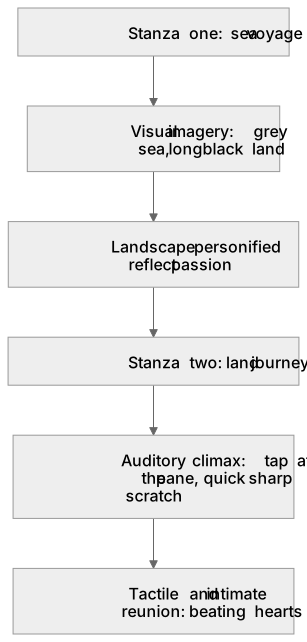
Put it in order
Put these steps in the order they happen.
- 1. Landscape personified to reflect passion
- 2. Visual imagery: grey sea, long black land
- 3. Stanza one: sea voyage
- 4. Tactile and intimate reunion: beating hearts
- 5. Auditory climax: tap at the pane, quick sharp scratch
- 6. Stanza two: land journey
Key words
Say what each word means before you turn the card.
Illicit love and secrecy
Try answering aloud or in your head before turning the card.
Anticipation and desire
Try answering aloud or in your head before turning the card.
Pathetic fallacy
Try answering aloud or in your head before turning the card.
Auditory climax
Try answering aloud or in your head before turning the card.
See every definition
- Illicit love and secrecy
- The poem captures the urgency and secrecy of an illicit romantic encounter rather than idealised, socially sanctioned courtship.
- Anticipation and desire
- Sensory imagery conveys the speaker's anticipation and mounting passion as the meeting approaches.
- Pathetic fallacy
- The landscape is actively personified to reflect the speaker's internal emotional state, projecting passion onto the surroundings.
- Auditory climax
- The intimate sounds of the lovers' reunion in the final lines contrast with the vast silence of the journey.
Label the diagram
Some boxes have lost their names. Pick the right name for each number.
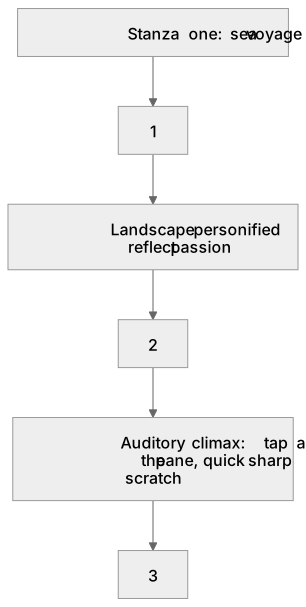
1Box 1
2Box 2
3Box 3
There is more to this lesson
The full lesson goes on to check your understanding and help you earn the marks. Create a free account to carry on, with your progress saved.
A week of Premium from your first lesson · Then the free plan continues · No card, no charge
Test your understanding of Component 3: Poetry – Section B: Specified Poetry Pre- or Post-1900 – Pre-1900 – The Victorian Period – The New Oxford Book of Victorian Verse, editor Christopher Ricks (OUP, 2008): Meeting at Night
Active recall beats re-reading. Take an instant quiz now to test what you’ve learned and lock it into long-term memory.
A week of Premium from your first lesson · Then the free plan continues · No card, no charge