Pearson Edexcel · A-Level · English Literature
Course version: 9ET0 · Version from Sept 2015
Poetry – Section B: Specified Poetry Pre- or Post-1900 – Pre-1900 – The…
Full specification wording
Component 3: Poetry – Section B: Specified Poetry Pre- or Post-1900 – Pre-1900 – The Victorian Period – The New Oxford Book of Victorian Verse, editor Christopher Ricks (OUP, 2008): Home-Thoughts, from Abroad
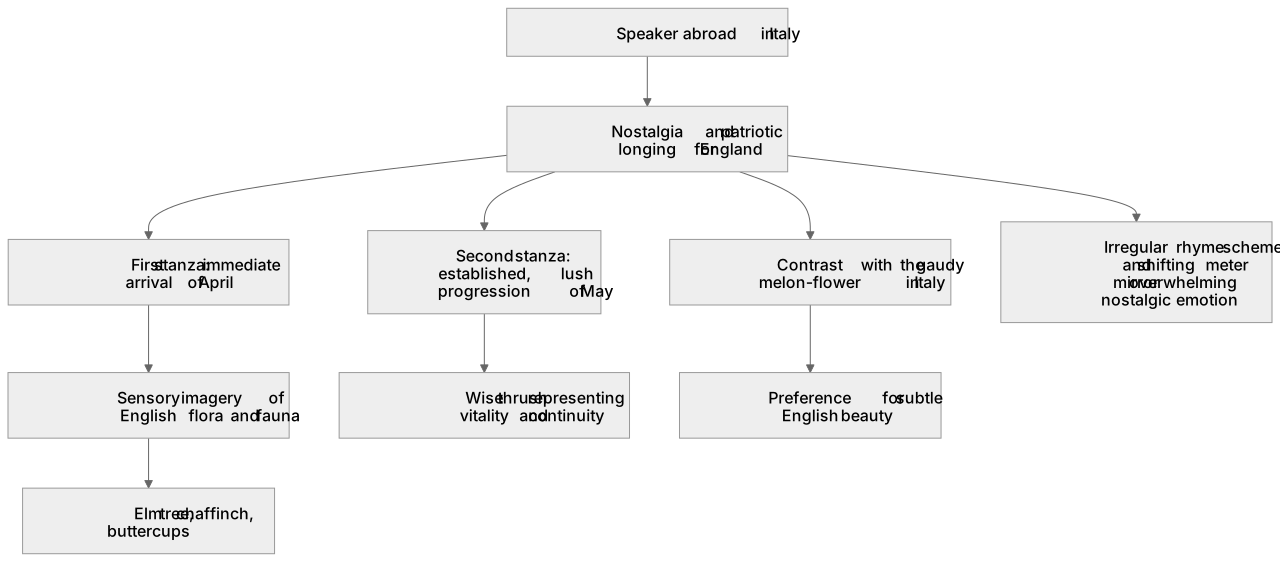
Robert Browning’s ‘Home-Thoughts, from Abroad’ is a lyrical exploration of intense nostalgia and patriotic longing for the English countryside during springtime.
Checked against the Pearson Edexcel 9ET0 specification (opens in a new tab) on .
- Point 5 of 17
- 4 key terms
Study notes
From the checked teaching notes for this specification point.
The idea
Robert Browning’s ‘Home-Thoughts, from Abroad’ is a lyrical exploration of intense nostalgia and patriotic longing for the English countryside during springtime. Written while Browning was in Italy, the poem contrasts the vibrant beauty of an English April and May with the speaker’s foreign surroundings. The poem’s irregular rhyme scheme and shifting meter reflect the spontaneous, emotional outpouring of the speaker’s homesickness. Examine how Browning elevates the ordinary details of English nature to evoke a profound sense of national identity and personal yearning.
What earns the marks
- Analyse the use of vivid, sensory natural imagery to convey a deep sense of nostalgia and longing for England.
- Evaluate the structural shift between the two stanzas, moving from the immediate arrival of April to the more established, lush progression of May.
- Explore the contrast between the subtle, familiar beauty of the English landscape and the implied gaudiness of the 'gaudy melon-flower' in Italy.
- Contextualise the poem within Victorian romanticism and the idealisation of the rural English landscape amidst increasing industrialisation.
Common mistakes and how to put them right
Treating the poem as a simple nature poem.
Put it right: Analyse it as a poem about memory, exile, and the psychological experience of homesickness.
Misidentifying the location of the speaker.
Put it right: Ensure you state the speaker is abroad in Italy looking back at England, not currently experiencing the English spring.
Overlooking the specific bird imagery.
Put it right: Explicitly discuss the role of the chaffinch and the wise thrush in representing the vitality and continuity of English nature.
Exam tips
- Contrast the exclamation 'Oh, to be in England' with the concluding image of the 'gaudy melon-flower' to highlight the speaker's preference for subtle English beauty.
- Analyse the use of dynamic verbs and present participles to create a sense of immediate, unfolding life in the remembered landscape.
- Discuss how the irregular meter and rhyme scheme mirror the unpredictable, overwhelming rush of nostalgic emotion.
Try the lesson
The start of the Component 3: Poetry – Section B: Specified Poetry Pre- or Post-1900 – Pre-1900 – The Victorian Period – The New Oxford Book of Victorian Verse, editor Christopher Ricks (OUP, 2008): Home-Thoughts, from Abroad lesson, made from checked teaching notes for this specification point.
Have a go first
In Robert Browning's "Home-Thoughts, from Abroad", which bird is specifically described as singing "each song twice over" to recapture its "first fine careless rapture"?
Listen
Robert Browning’s ‘Home-Thoughts, from Abroad’ is a lyrical exploration of intense nostalgia and patriotic longing for the English countryside during springtime. Written while Browning was in Italy, the poem contrasts the vibrant beauty of an English April and May with the speaker’s foreign surroundings. The poem’s irregular rhyme scheme and shifting meter reflect the spontaneous, emotional outpouring of the speaker’s homesickness. Examine how Browning elevates the ordinary details of English nature to evoke a profound sense of national identity and personal yearning. A strong answer earns marks for these points. Analyse the use of vivid, sensory natural imagery to convey a deep sense of nostalgia and longing for England. Evaluate the structural shift between the two stanzas, moving from the immediate arrival of April to the more established, lush progression of May. Explore the contrast between the subtle, familiar beauty of the English landscape and the implied gaudiness of the 'gaudy melon-flower' in Italy. Contextualise the poem within Victorian romanticism and the idealisation of the rural English landscape amidst increasing industrialisation. A common slip: Treating the poem as a simple nature poem. Instead, analyse it as a poem about memory, exile, and the psychological experience of homesickness. Exam tip: Contrast the exclamation 'Oh, to be in England' with the concluding image of the 'gaudy melon-flower' to highlight the speaker's preference for subtle English beauty.
See it
Key words
Say what each word means before you turn the card.
Nostalgia and memory
Try answering aloud or in your head before turning the card.
Nature and the seasons
Try answering aloud or in your head before turning the card.
Patriotism and national identity
Try answering aloud or in your head before turning the card.
Exile and isolation
Try answering aloud or in your head before turning the card.
See every definition
- Nostalgia and memory
- The intense longing for the English countryside felt by the speaker, who is abroad in Italy and looking back at England.
- Nature and the seasons
- The sensory imagery of flora and fauna, such as the elm tree, the chaffinch and the buttercups, that depicts the English springtime.
- Patriotism and national identity
- The profound sense of national identity evoked by elevating the ordinary details of English nature.
- Exile and isolation
- The psychological experience of homesickness analysed in the poem, which contrasts the speaker's foreign surroundings with England.
Label the diagram
Some boxes have lost their names. Pick the right name for each number.
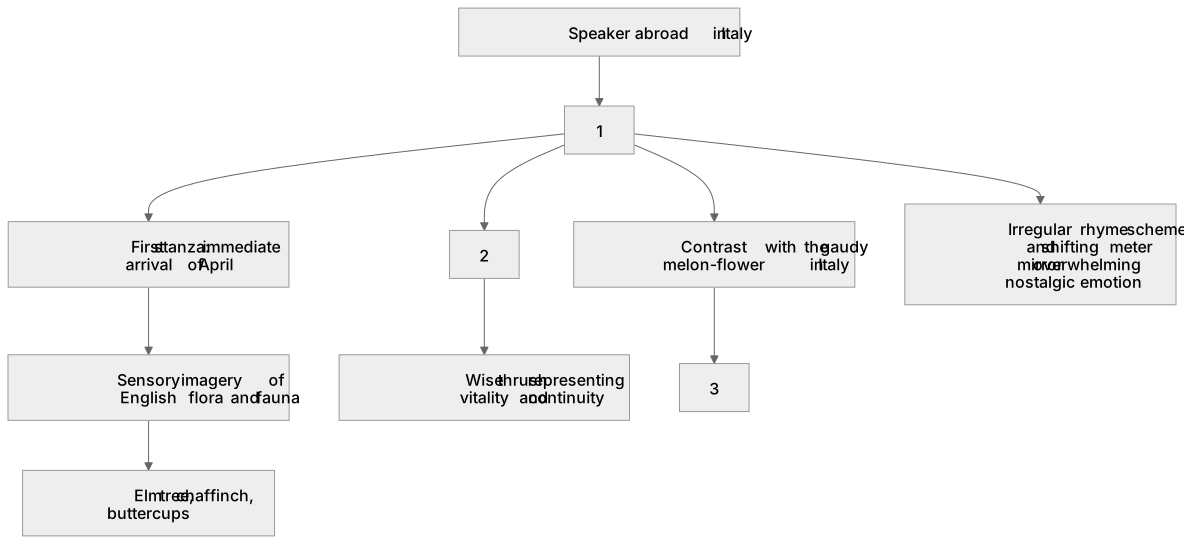
1Box 1
2Box 2
3Box 3
There is more to this lesson
The full lesson goes on to check your understanding and help you earn the marks. Create a free account to carry on, with your progress saved.
A week of Premium from your first lesson · Then the free plan continues · No card, no charge
Test your understanding of Component 3: Poetry – Section B: Specified Poetry Pre- or Post-1900 – Pre-1900 – The Victorian Period – The New Oxford Book of Victorian Verse, editor Christopher Ricks (OUP, 2008): Home-Thoughts, from Abroad
Active recall beats re-reading. Take an instant quiz now to test what you’ve learned and lock it into long-term memory.
A week of Premium from your first lesson · Then the free plan continues · No card, no charge