Pearson Edexcel · A-Level · English Literature
Course version: 9ET0 · Version from Sept 2015
Poetry – Section B: Specified Poetry Pre- or Post-1900 – Pre-1900 – The…
Full specification wording
Component 3: Poetry – Section B: Specified Poetry Pre- or Post-1900 – Pre-1900 – The Victorian Period – The New Oxford Book of Victorian Verse, editor Christopher Ricks (OUP, 2008): At an Inn Thomas Hardy
Thomas Hardy’s ‘At an Inn’ explores the painful irony of unfulfilled love against the backdrop of restrictive Victorian social conventions.
Checked against the Pearson Edexcel 9ET0 specification (opens in a new tab) on .
- Point 13 of 17
- 4 key terms
Study notes
From the checked teaching notes for this specification point.
The idea
Thomas Hardy’s ‘At an Inn’ explores the painful irony of unfulfilled love against the backdrop of restrictive Victorian social conventions. Based on Hardy’s visit to a Winchester inn with the married Florence Henniker, the poem contrasts the inn staff’s assumption that they are a passionate, married couple with the stark reality of their platonic, doomed relationship. Hardy employs a rigid, alternating rhyme scheme and shifting metre to mirror the inescapable constraints of society and the passage of time. By personifying ‘Love’ and ‘Laws’, Hardy critiques the Victorian moral framework that prevents their union, leaving the speaker reflecting on missed opportunities and the cruel irony of fate.
What earns the marks
- Analyse the use of irony in the contrast between the inn staff's perception and the reality of the relationship.
- Evaluate how the personification of 'Love' and 'Laws' critiques Victorian societal constraints.
- Explore the structural impact of the rigid rhyme scheme in reflecting the inescapable nature of their situation.
- Discuss the significance of the setting as a transient space that highlights the impossibility of a permanent union.
Common mistakes and how to put them right
Assuming the poem celebrates a consummated affair.
Put it right: Recognise that the poem laments an unfulfilled, platonic relationship restricted by societal laws.
Ignoring the Victorian context.
Put it right: Explicitly link the personified 'Laws' to the strict moral and marital conventions of the Victorian era.
Focusing only on the narrative without analysing form.
Put it right: Analyse how the alternating metre and rhyme scheme mirror the tension between desire and restriction.
Exam tips
- Compare the theme of unfulfilled desire in 'At an Inn' with other Victorian poems in the anthology.
- Use specific quotations, such as 'Love lingered numb', to demonstrate Hardy's pessimistic view of fate.
- Discuss how the transient setting of the inn contrasts with the permanence of the societal 'Laws' keeping them apart.
Try the lesson
The start of the Component 3: Poetry – Section B: Specified Poetry Pre- or Post-1900 – Pre-1900 – The Victorian Period – The New Oxford Book of Victorian Verse, editor Christopher Ricks (OUP, 2008): At an Inn Thomas Hardy lesson, made from checked teaching notes for this specification point.
Have a go first
In Thomas Hardy's poem 'At an Inn', what is the central irony regarding the relationship between the speaker and his female companion?
Listen
Thomas Hardy’s ‘At an Inn’ explores the painful irony of unfulfilled love against the backdrop of restrictive Victorian social conventions. Based on Hardy’s visit to a Winchester inn with the married Florence Henniker, the poem contrasts the inn staff’s assumption that they are a passionate, married couple with the stark reality of their platonic, doomed relationship. Hardy employs a rigid, alternating rhyme scheme and shifting metre to mirror the inescapable constraints of society and the passage of time. By personifying ‘Love’ and ‘Laws’, Hardy critiques the Victorian moral framework that prevents their union, leaving the speaker reflecting on missed opportunities and the cruel irony of fate. A strong answer earns marks for these points. Analyse the use of irony in the contrast between the inn staff's perception and the reality of the relationship. Evaluate how the personification of 'Love' and 'Laws' critiques Victorian societal constraints. Explore the structural impact of the rigid rhyme scheme in reflecting the inescapable nature of their situation. Discuss the significance of the setting as a transient space that highlights the impossibility of a permanent union. A common slip: Assuming the poem celebrates a consummated affair. Instead, recognise that the poem laments an unfulfilled, platonic relationship restricted by societal laws. Exam tip: Compare the theme of unfulfilled desire in 'At an Inn' with other Victorian poems in the anthology.
See it
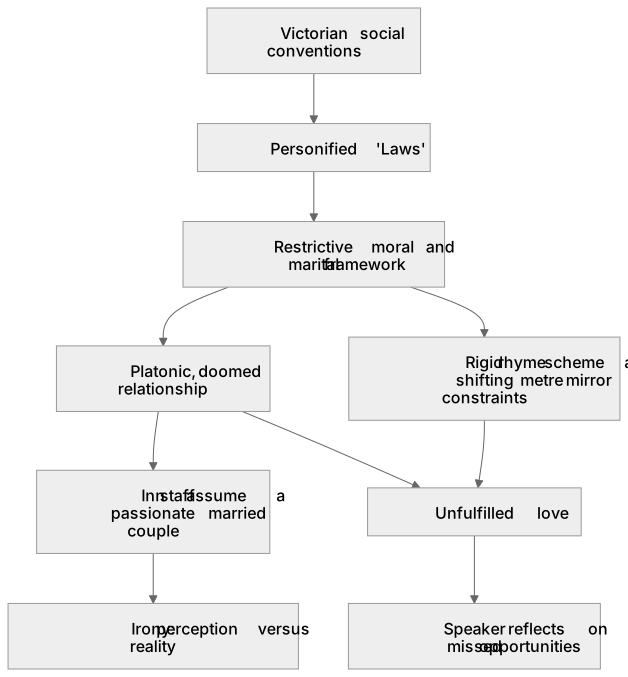
Key words
Say what each word means before you turn the card.
Unfulfilled love
Try answering aloud or in your head before turning the card.
Societal constraints
Try answering aloud or in your head before turning the card.
Irony and perception
Try answering aloud or in your head before turning the card.
Fate and time
Try answering aloud or in your head before turning the card.
See every definition
- Unfulfilled love
- The painful irony of a platonic, doomed relationship that is never consummated, lamented rather than celebrated.
- Societal constraints
- Restrictive Victorian social conventions and moral framework that prevent union, critiqued through the personification of 'Laws'.
- Irony and perception
- The contrast between the inn staff's assumption that they are a passionate, married couple and the stark reality of their relationship.
- Fate and time
- The cruel irony of fate and the passage of time, mirrored by shifting metre, leaving the speaker reflecting on missed opportunities.
Label the diagram
Some boxes have lost their names. Pick the right name for each number.
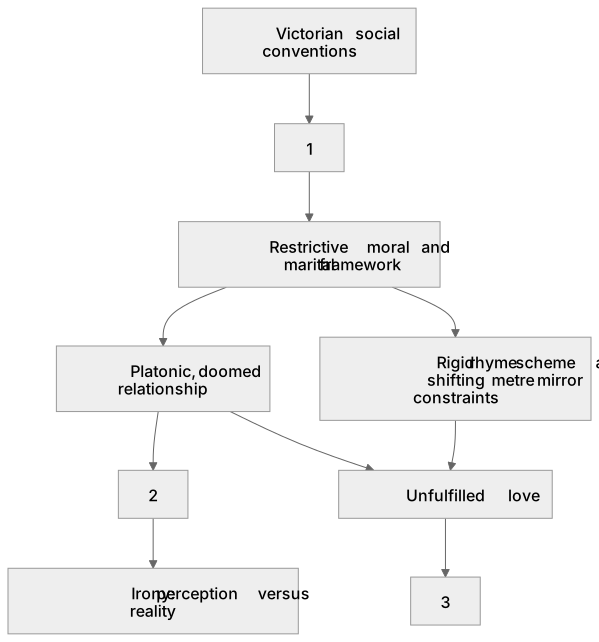
1Box 1
2Box 2
3Box 3
There is more to this lesson
The full lesson goes on to check your understanding and help you earn the marks. Create a free account to carry on, with your progress saved.
A week of Premium from your first lesson · Then the free plan continues · No card, no charge
Test your understanding of Component 3: Poetry – Section B: Specified Poetry Pre- or Post-1900 – Pre-1900 – The Victorian Period – The New Oxford Book of Victorian Verse, editor Christopher Ricks (OUP, 2008): At an Inn Thomas Hardy
Active recall beats re-reading. Take an instant quiz now to test what you’ve learned and lock it into long-term memory.
A week of Premium from your first lesson · Then the free plan continues · No card, no charge