Pearson Edexcel · A-Level · English Literature
Course version: 9ET0 · Version from Sept 2015
Poetry: show knowledge and understanding of the function of genre features…
Full specification wording
Component 3: Poetry: show knowledge and understanding of the function of genre features and conventions in poetry
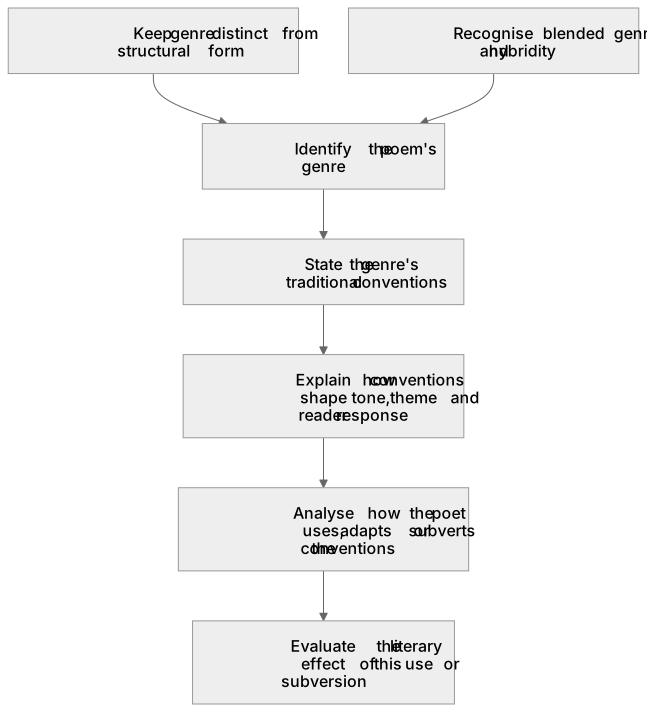
To analyse poetic genre, identify the expectations of categories such as elegy, pastoral, satire or love poetry, then explain how a poet uses, adapts or subverts them.
Checked against the Pearson Edexcel 9ET0 specification (opens in a new tab) on .
- Point 1 of 3
- 3 key terms
Study notes
From the checked teaching notes for this specification point.
The idea
To analyse poetic genre, identify the expectations of categories such as elegy, pastoral, satire or love poetry, then explain how a poet uses, adapts or subverts them. Keep genre distinct from structural form: a sonnet is a fourteen-line form that may carry the conventions of love poetry, devotion, argument or other genres. A Petrarchan octave-sestet turn, for example, is a formal feature whose function depends on the poem's genre and argument. Move beyond labels by showing how a convention shapes tone, theme and reader response.
What earns the marks
- Accurate identification of specific poetic genres (e.g., lyric, dramatic monologue, elegy).
- Clear explanation of the traditional features and conventions associated with the identified genre.
- Critical analysis of the function of these conventions, explaining how they construct meaning or guide the reader's interpretation.
- Evaluation of how the poet subverts, adapts, or challenges genre expectations to create specific literary effects.
Common mistakes and how to put them right
Merely labelling the genre of a poem without explaining its significance.
Put it right: Link the identification of a genre to an analysis of how its conventions shape the poem's meaning.
Assuming all poems fit neatly into a single, rigid genre category.
Put it right: Recognise that many poems blend genres or deliberately subvert conventions, and analyse the effect of this hybridity.
Confusing form (e.g., sonnet) with genre (e.g., love poetry), treating them as entirely separate.
Put it right: Discuss how structural forms often carry inherent genre expectations and analyse them together.
Exam tips
- When introducing a poem, explicitly state its genre and immediately connect this to the poet's overarching purpose.
- Look for moments where a poem breaks from its expected genre conventions, as these deviations often highlight key thematic shifts.
- Use precise literary terminology when discussing genre features, such as 'elegiac tone', 'pastoral imagery', or 'satirical voice'.
Try the lesson
The start of the Component 3: Poetry: show knowledge and understanding of the function of genre features and conventions in poetry lesson, made from checked teaching notes for this specification point.
Have a go first
What is the primary function of the 'volta' as a conventional feature within the genre of the sonnet?
Listen
To analyse poetic genre, identify the expectations of categories such as elegy, pastoral, satire or love poetry, then explain how a poet uses, adapts or subverts them. Keep genre distinct from structural form: a sonnet is a fourteen-line form that may carry the conventions of love poetry, devotion, argument or other genres. A Petrarchan octave-sestet turn, for example, is a formal feature whose function depends on the poem's genre and argument. Move beyond labels by showing how a convention shapes tone, theme and reader response. A strong answer earns marks for these points. Accurate identification of specific poetic genres (e.g., lyric, dramatic monologue, elegy). Clear explanation of the traditional features and conventions associated with the identified genre. Critical analysis of the function of these conventions, explaining how they construct meaning or guide the reader's interpretation. Evaluation of how the poet subverts, adapts, or challenges genre expectations to create specific literary effects. A common slip: Merely labelling the genre of a poem without explaining its significance. Instead, link the identification of a genre to an analysis of how its conventions shape the poem's meaning. Exam tip: When introducing a poem, explicitly state its genre and immediately connect this to the poet's overarching purpose.
See it
Key words
Say what each word means before you turn the card.
Genre conventions
Try answering aloud or in your head before turning the card.
Subversion of expectations
Try answering aloud or in your head before turning the card.
Form and structure
Try answering aloud or in your head before turning the card.
See every definition
- Genre conventions
- The traditional features associated with a poetic genre, whose function shapes tone, theme and reader response.
- Subversion of expectations
- How a poet adapts or challenges genre expectations to create specific literary effects, often highlighting key thematic shifts.
- Form and structure
- Structural form, such as a sonnet, kept distinct from genre yet often carrying inherent genre expectations to be analysed together.
Label the diagram
Some boxes have lost their names. Pick the right name for each number.
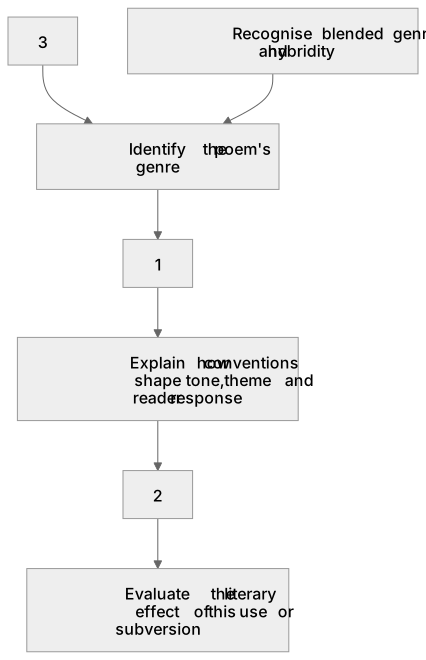
1Box 1
2Box 2
3Box 3
There is more to this lesson
The full lesson goes on to check your understanding and help you earn the marks. Create a free account to carry on, with your progress saved.
A week of Premium from your first lesson · Then the free plan continues · No card, no charge
Test your understanding of Component 3: Poetry: show knowledge and understanding of the function of genre features and conventions in poetry
Active recall beats re-reading. Take an instant quiz now to test what you’ve learned and lock it into long-term memory.
A week of Premium from your first lesson · Then the free plan continues · No card, no charge