Pearson Edexcel · A-Level · English Literature
Course version: 9ET0 · Version from Sept 2015
Poetry: use literary critical concepts and terminology with understanding…
Full specification wording
Component 3: Poetry: use literary critical concepts and terminology with understanding and discrimination
Effective poetic analysis requires the precise application of subject-specific vocabulary to illuminate meaning, rather than merely listing devices.
Checked against the Pearson Edexcel 9ET0 specification (opens in a new tab) on .
- Point 3 of 3
- 4 key terms
Study notes
From the checked teaching notes for this specification point.
The idea
Effective poetic analysis requires the precise application of subject-specific vocabulary to illuminate meaning, rather than merely listing devices. For instance, instead of simply noting that a poem uses free verse, explain how the absence of a regular metrical pattern mirrors the speaker's psychological fragmentation. This selective approach ensures that vocabulary serves the argument, demonstrating a sophisticated grasp of how form and language actively construct the reader's experience.
What earns the marks
- Select highly relevant poetic terminology to support analytical arguments rather than feature-spotting.
- Define and apply advanced structural terms accurately within the context of the poem.
- Integrate critical vocabulary seamlessly into sentences to explain the effect of a device on the reader.
- Demonstrate discrimination by focusing only on the linguistic features that most significantly shape the text's meaning.
Common mistakes and how to put them right
Listing terms without explaining their effect.
Put it right: Link the device directly to the poem's meaning or tone.
Using complex terminology incorrectly to sound sophisticated.
Put it right: Rely on simpler, accurate terms if unsure of a concept's exact definition.
Treating structural features as an afterthought.
Put it right: Integrate discussions of form and metre alongside linguistic analysis.
Exam tips
- When introducing a technical term, immediately follow it with an analysis of its specific function in that exact line.
- Prioritise terminology that relates to the poem's overarching structure or voice, as this often yields deeper analysis.
- Avoid generic phrases like 'makes it flow better'; specify exactly how the rhythm or sound device alters the mood.
Try the lesson
The start of the Component 3: Poetry: use literary critical concepts and terminology with understanding and discrimination lesson, made from checked teaching notes for this specification point.
Have a go first
Which literary term specifically describes the continuation of a sentence without a pause beyond the end of a line, couplet, or stanza in a poem?
Listen
Effective poetic analysis requires the precise application of subject-specific vocabulary to illuminate meaning, rather than merely listing devices. For instance, instead of simply noting that a poem uses free verse, explain how the absence of a regular metrical pattern mirrors the speaker's psychological fragmentation. This selective approach ensures that vocabulary serves the argument, demonstrating a sophisticated grasp of how form and language actively construct the reader's experience. A strong answer earns marks for these points. Select highly relevant poetic terminology to support analytical arguments rather than feature-spotting. Define and apply advanced structural terms accurately within the context of the poem. Integrate critical vocabulary seamlessly into sentences to explain the effect of a device on the reader. Demonstrate discrimination by focusing only on the linguistic features that most significantly shape the text's meaning. Exam tip: When introducing a technical term, immediately follow it with an analysis of its specific function in that exact line.
See it
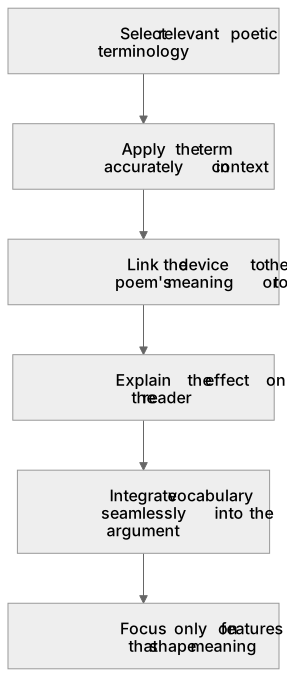
Put it in order
Put these steps in the order they happen.
- 1. Link the device to the poem's meaning or tone
- 2. Apply the term accurately in context
- 3. Select relevant poetic terminology
- 4. Focus only on features that shape meaning
- 5. Integrate vocabulary seamlessly into the argument
- 6. Explain the effect on the reader
Key words
Say what each word means before you turn the card.
Form and structure
Try answering aloud or in your head before turning the card.
Linguistic analysis
Try answering aloud or in your head before turning the card.
Critical vocabulary
Try answering aloud or in your head before turning the card.
Authorial methods
Try answering aloud or in your head before turning the card.
See every definition
- Form and structure
- Structural features should be integrated with linguistic analysis rather than treated as an afterthought, since form and language actively construct the reader's experience.
- Linguistic analysis
- Discussion of form and metre should be integrated alongside linguistic analysis, focusing on the features that most significantly shape the text's meaning.
- Critical vocabulary
- Subject-specific terms should be integrated seamlessly into sentences to explain the effect of a device on the reader.
- Authorial methods
- Appropriate technical vocabulary is selected to describe specific poetic methods, connecting them explicitly to the poem's thematic impact.
Label the diagram
Some boxes have lost their names. Pick the right name for each number.
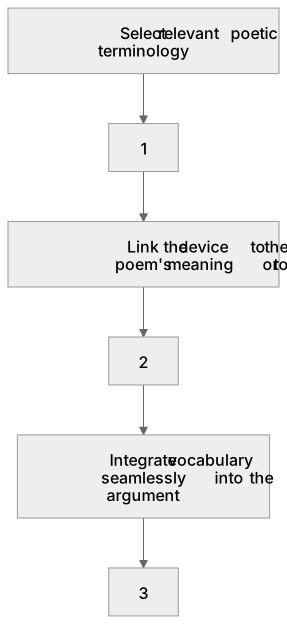
1Box 1
2Box 2
3Box 3
There is more to this lesson
The full lesson goes on to check your understanding and help you earn the marks. Create a free account to carry on, with your progress saved.
A week of Premium from your first lesson · Then the free plan continues · No card, no charge
Test your understanding of Component 3: Poetry: use literary critical concepts and terminology with understanding and discrimination
Active recall beats re-reading. Take an instant quiz now to test what you’ve learned and lock it into long-term memory.
A week of Premium from your first lesson · Then the free plan continues · No card, no charge