OCR · GCSE · Food Preparation and Nutrition
Food miles and sustainability
This study guide delves into the critical topic of food miles and sustainability for OCR GCSE Food Preparation and Nutrition. It unpacks the 'Farm to Fork' journey, equipping candidates with the specific knowledge and analytical skills needed to evaluate the environmental, ethical, and economic impacts of our food choices, which is crucial for achieving high marks in the exam.
- 5 min read
- 3 worked examples
- 5 practice questions
- 6 key terms
Study Notes
Overview
This section of the OCR J309 specification requires candidates to move beyond simple definitions and critically engage with the complexities of our global food system. Examiners expect a detailed understanding of the entire 'Farm to Fork' process, from agricultural production to final consumption. This includes a rigorous evaluation of the environmental consequences of food transport (food miles), the benefits and drawbacks of different farming systems, and the role of technology and assurance schemes in creating a more sustainable future. To secure top marks, candidates must demonstrate analytical skills by weighing up conflicting factors, such as the tension between providing affordable food (food security) and protecting the planet. This guide will provide the specific knowledge, worked examples, and exam techniques needed to master this challenging but rewarding topic.
The Farm to Fork Journey
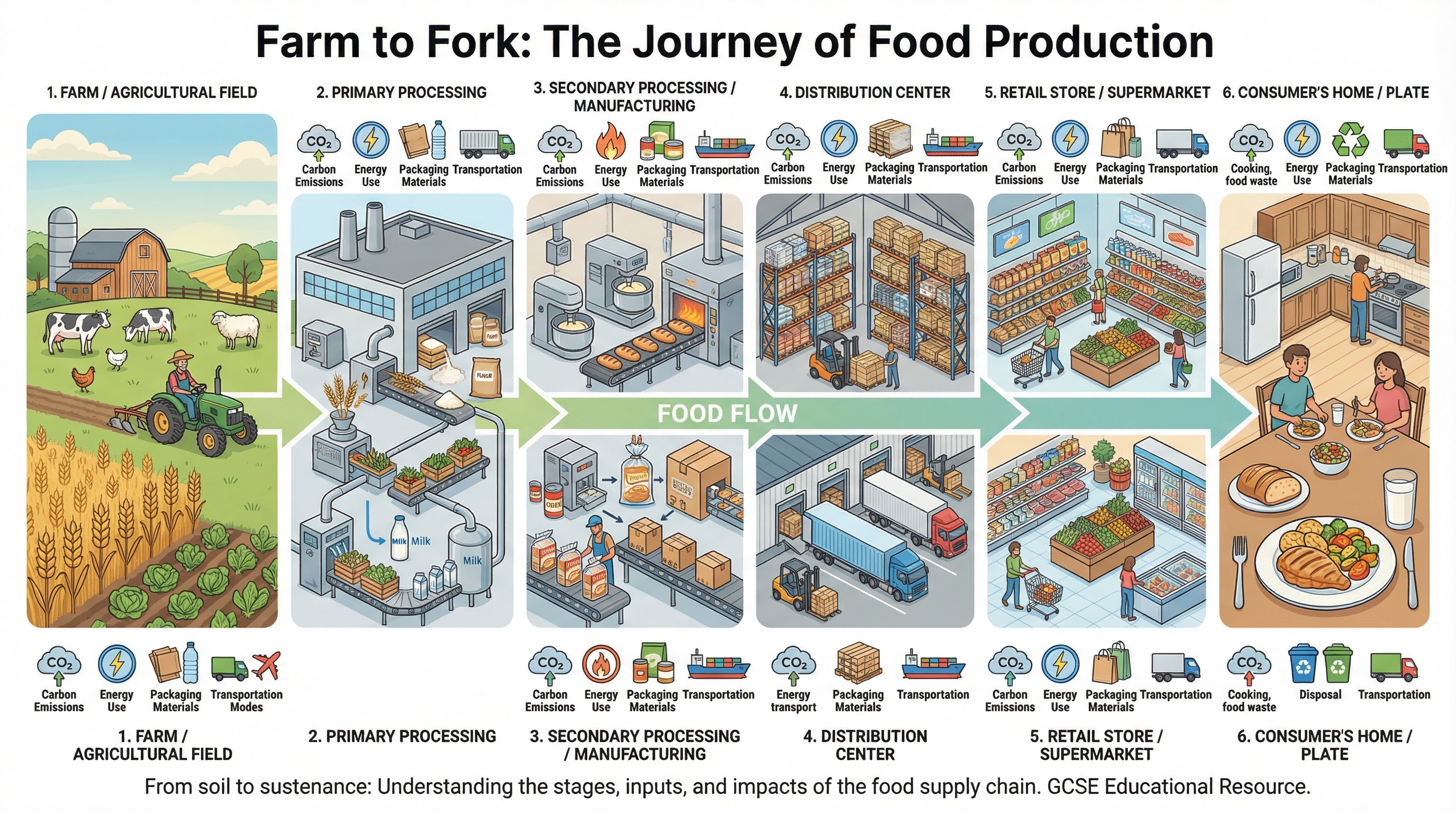
The journey of food from producer to consumer is a key concept. Candidates must be able to identify each stage and analyse its sustainability implications.
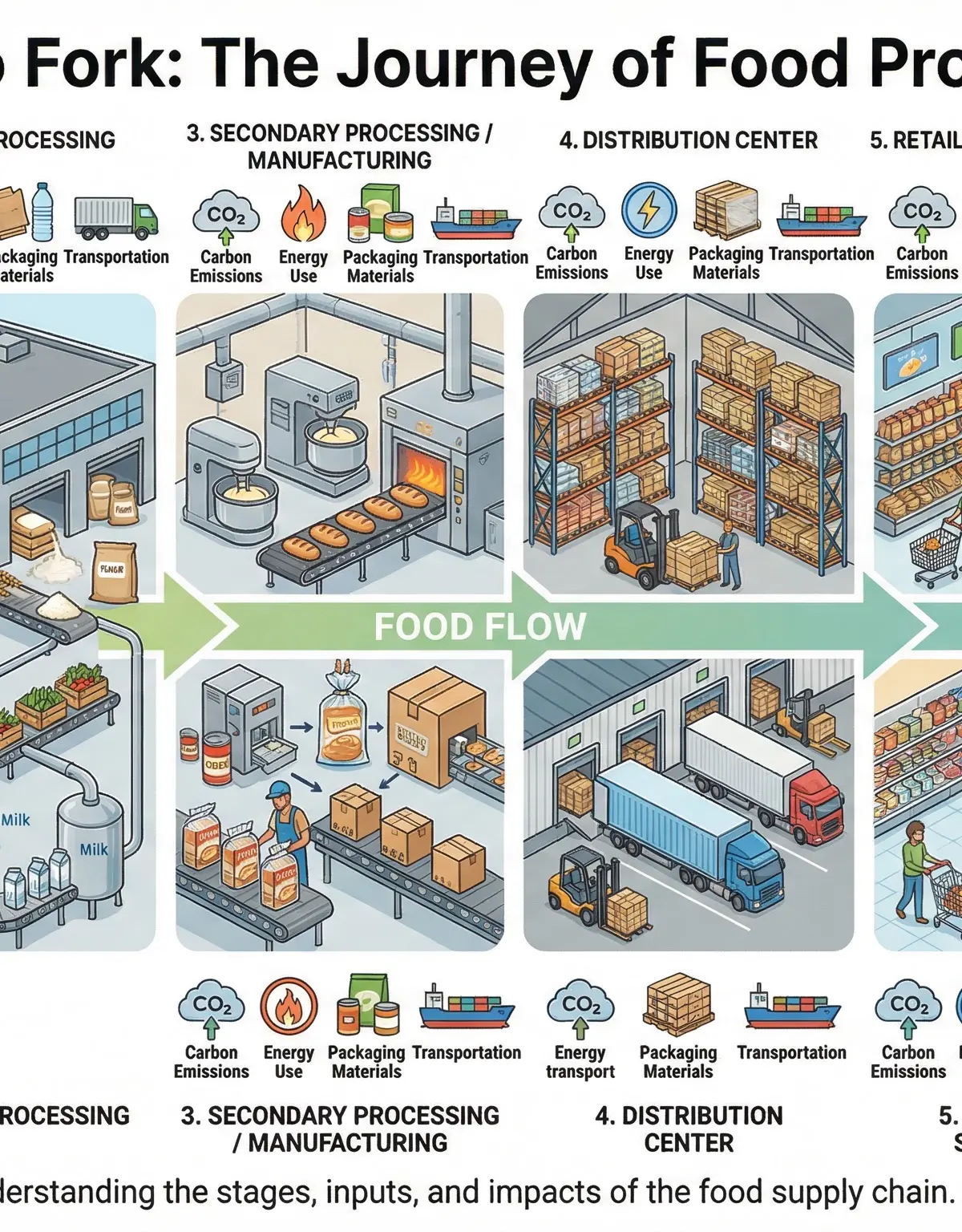
What happened: The modern food system has evolved into a complex global network. The key stages are:
- Farming/Agriculture: Cultivation of crops and rearing of livestock.
- Primary Processing: Raw materials are converted into basic food products (e.g., milling wheat into flour).
- Secondary Processing: Ingredients are combined to create finished food products (e.g., baking bread).
- Distribution: Food is transported to warehouses and distribution centres.
- Retail: Products are sold to consumers through supermarkets, markets, and other outlets.
- Consumption: Food is purchased, prepared, and eaten by consumers.
Why it matters: At every stage, resources are consumed, and waste is produced. Examiners award credit for identifying specific impacts, such as energy use in factories, fuel for transportation, the creation of packaging waste, and the significant food losses that can occur along the chain. Understanding this entire process is fundamental to answering questions about food provenance and sustainability.
Specific Knowledge: Candidates should be able to provide examples for each stage, such as the primary processing of milk (pasteurisation) or the secondary processing of fruit (jam making).
Food Miles & Carbon Footprint
This is a core area where candidates can gain significant marks by using precise data and avoiding generalisations.
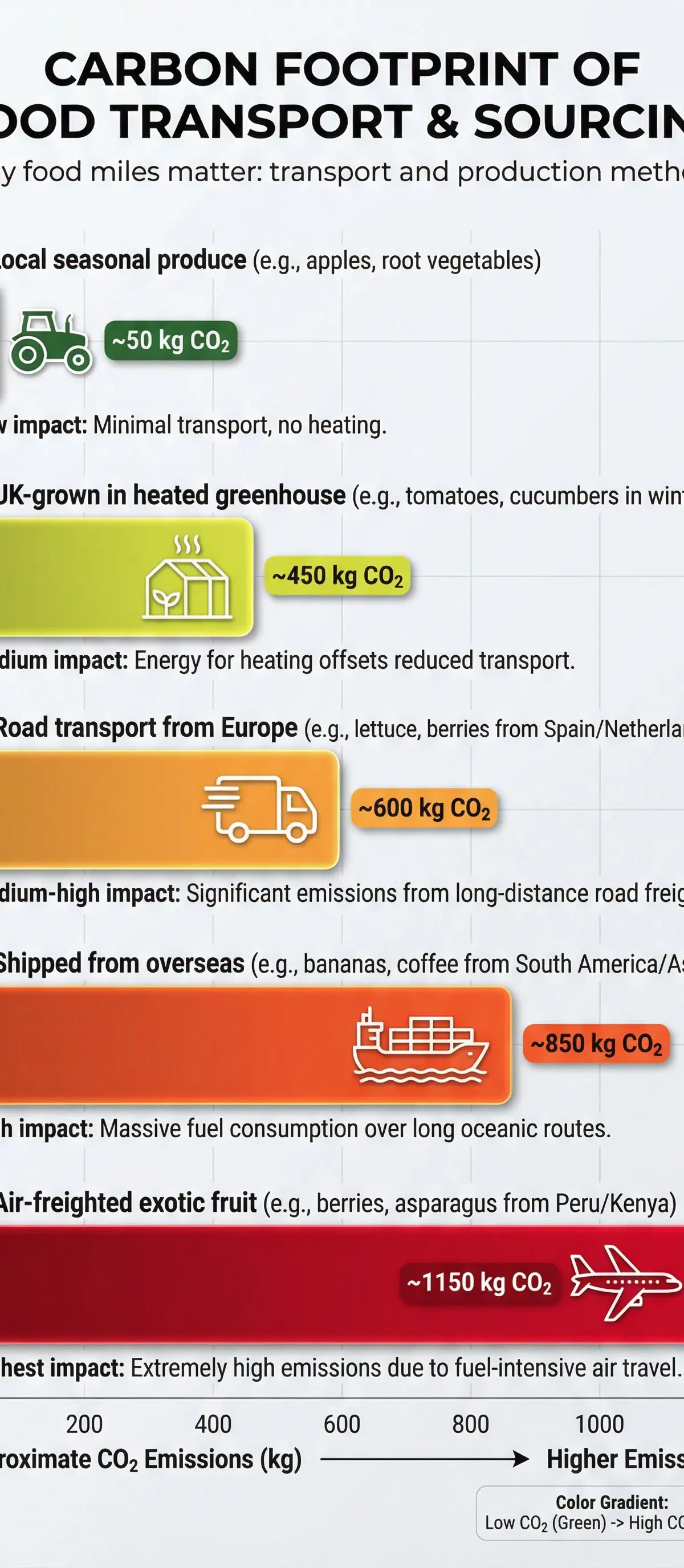
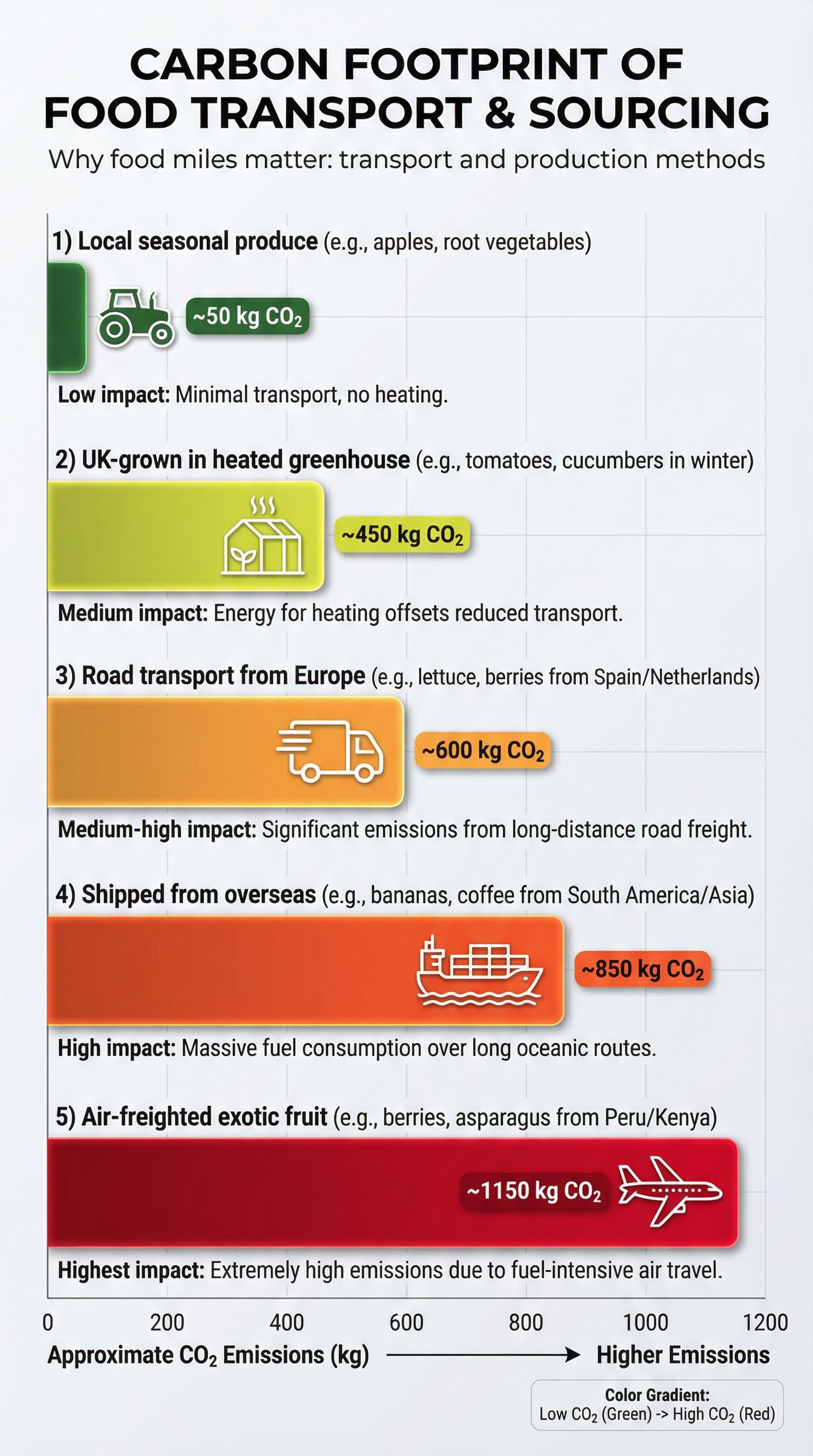
What happened: 'Food miles' refers to the distance food is transported from the point of production to the consumer. This has increased dramatically with globalisation, allowing year-round availability of most foods. However, this convenience comes at a high environmental cost.
Why it matters: The transport of food, particularly by air, is a major contributor to greenhouse gas emissions. Examiners expect candidates to link food miles directly to fossil fuel consumption and its impact on climate change. A common mistake is to assume 'local is always better'. While reducing transport is important, the method of production can have a greater impact. For example, tomatoes grown in a heated UK greenhouse in winter can have a larger carbon footprint than tomatoes imported from Spain where they are grown naturally.
Specific Knowledge: Be able to compare transport methods. Air-freighted goods (e.g., exotic fruits from Peru) have the highest carbon footprint, followed by road freight, sea freight, and finally local, seasonal produce. Quoting comparative figures (e.g., air freight producing over 20 times the CO2 of local produce) demonstrates strong AO1 knowledge.
Food Assurance Schemes
Understanding these schemes is essential for evaluation questions. Candidates must know the specific criteria for each, not just their general purpose.
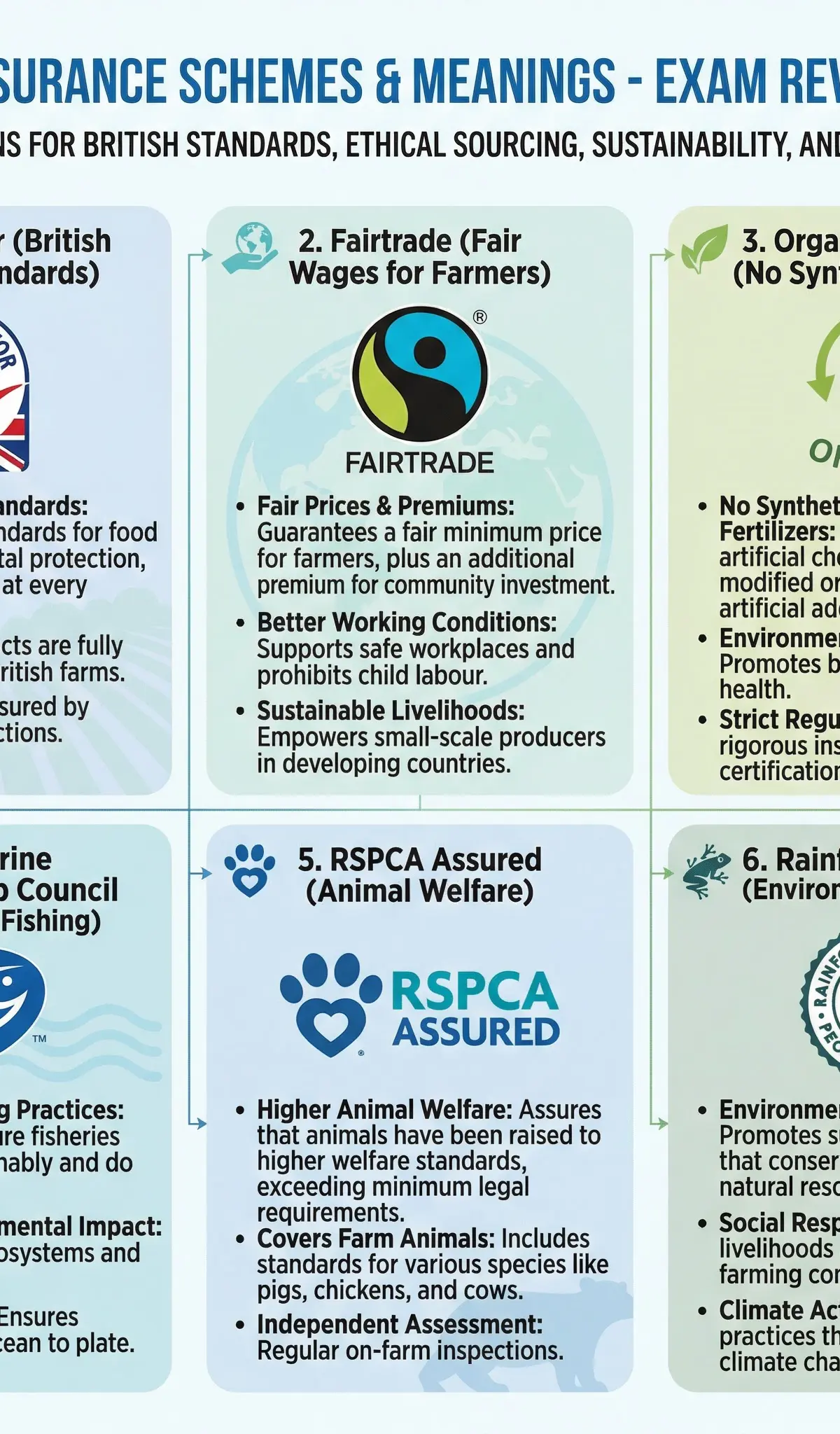
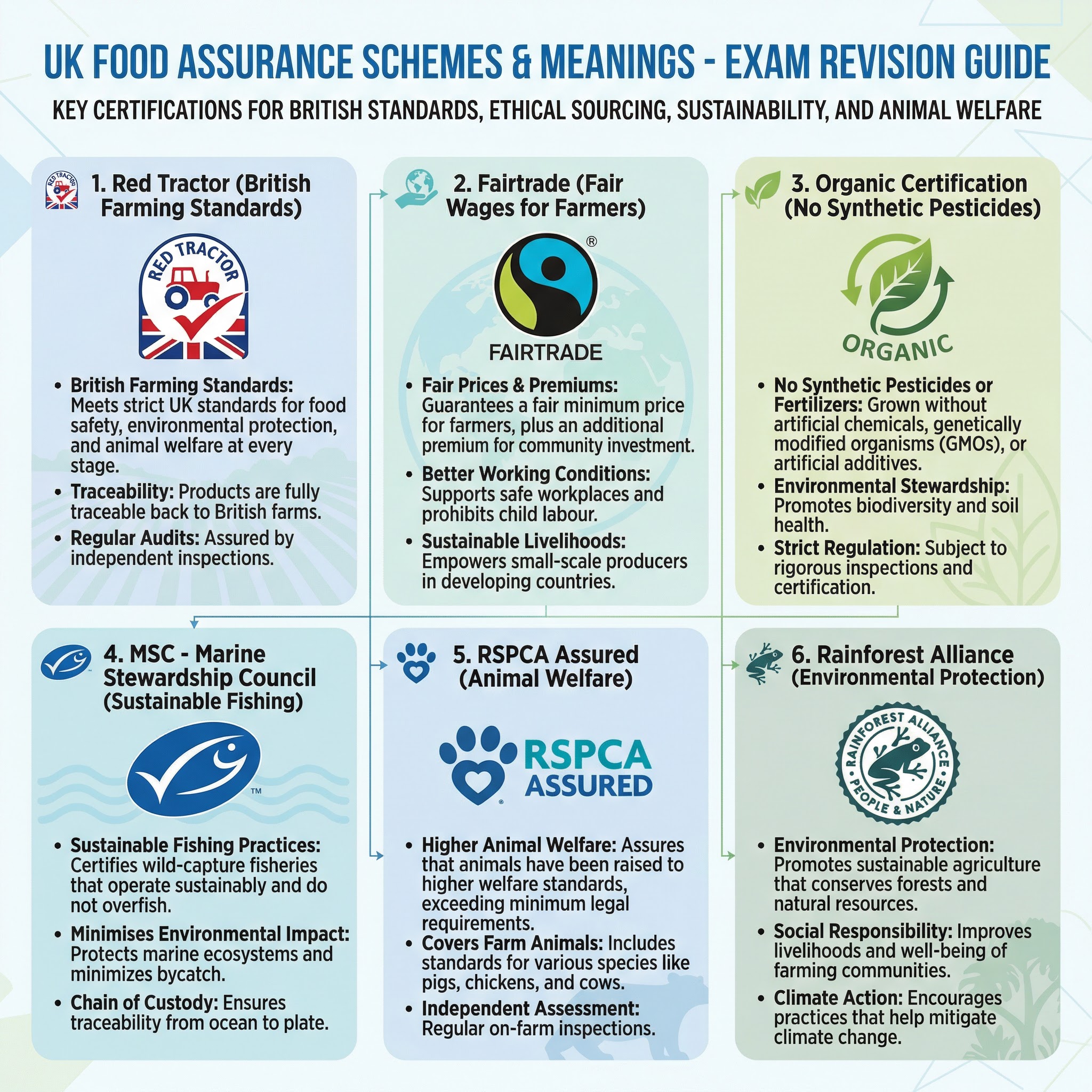
What happened: Various organisations have created certification schemes to provide consumers with information about the standards to which their food has been produced.
Why it matters: These schemes allow consumers to make informed ethical and environmental choices. In the exam, candidates must be able to evaluate their effectiveness. For example, while Fairtrade ensures a better price for farmers, it doesn't necessarily guarantee environmentally friendly farming methods. A top-level answer will discuss both the strengths and limitations of a scheme.
Specific Knowledge: Memorise the key functions of at least four schemes:
- Red Tractor: Certifies British food meets standards on food safety, animal welfare, and environmental protection.
- Fairtrade: Ensures farmers in developing countries receive a fair price and have decent working conditions.
- MSC (Marine Stewardship Council): Certifies that fish has been caught from sustainable stocks.
- RSPCA Assured: Focuses on higher animal welfare standards than the legal minimum.
- Organic (e.g., Soil Association): Certifies food is produced without synthetic pesticides or fertilisers.
Visual Resources
3 diagrams and illustrations
Interactive Diagrams
1 interactive diagram to visualise key concepts
Conceptual Flow Outline
A simplified flowchart of the Farm to Fork journey, showing the key stages from production to consumption and waste.
Worked Examples
3 worked examples — open one to explore the question and available guidance.
Practice Questions
Test your understanding — click to reveal model answers
Describe two ways in which consumers can reduce the environmental impact of their food choices. (4 marks)
Hint: Think about both purchasing habits and actions at home. For each way, give a point and a development.
Explain how two different food assurance schemes aim to promote sustainability. (6 marks)
Hint: Choose two schemes that cover different aspects of sustainability (e.g., environmental, social, animal welfare).
To what extent is reducing food waste the most effective way for a UK household to reduce its carbon footprint from food? (12 marks)
Hint: This is an evaluation question. Argue for food waste reduction, but then introduce and evaluate other factors like diet choice and sourcing.
Explain the term 'seasonal food'. (2 marks)
Hint: Define the term and give an example.
Analyse the environmental impacts of using plastic packaging for food. (6 marks)
Hint: This is an 'analyse' question, so you need to look at both the negative and positive impacts to provide a balanced view.
Test your understanding of Food miles and sustainability
Active recall beats re-reading. Take an instant quiz now to test what you’ve learned and lock it into long-term memory.
7 days Premium · Then free forever · No card, no charge