AQA · A-Level · Geography
Course version: 7037 · Version from Sept 2018
Coastlines of emergence and submergence. Origin and development of…
Full specification wording
Coastal landscape development: Coastlines of emergence and submergence. Origin and development of associated landforms: raised beaches, marine platforms; rias, fjords, Dalmatian coasts.
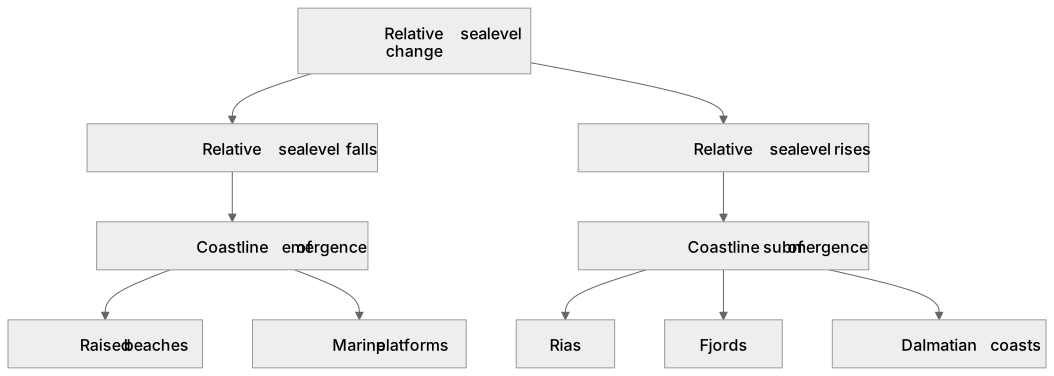
Coastlines of emergence form when relative sea level falls, typically due to isostatic rebound following deglaciation outpacing eustatic sea-level rise.
Checked against the AQA 7037 specification (opens in a new tab) on .
- Point 5 of 6
- 4 key terms
Study notes
From the checked teaching notes for this specification point.
The idea
Coastlines of emergence form when relative sea level falls, typically due to isostatic rebound following deglaciation outpacing eustatic sea-level rise. This exposes former coastal features, creating raised beaches (relict beaches above current high tide) and marine platforms (uplifted wave-cut platforms), as seen in Fife, Scotland. Conversely, coastlines of submergence occur when relative sea level rises, flooding existing topography. Rias are drowned river valleys with dendritic patterns, like the Kingsbridge Estuary. Fjords are drowned glacial troughs with steep sides and a shallow rock lip, such as Sognefjord. Dalmatian coasts form where valleys parallel to the coast are flooded, leaving islands aligned with the mainland, as in Croatia.
What earns the marks
- Explain the difference between eustatic (global water volume) and isostatic (local land level) changes in creating emergent or submergent coastlines.
- Describe the formation of raised beaches and marine platforms through successive phases of isostatic uplift and wave action.
- Differentiate rias (drowned V-shaped river valleys) from fjords (drowned U-shaped glacial valleys with a threshold lip).
- Explain the formation of Dalmatian coasts through the submergence of concordant coastlines where valleys run parallel to the shore.
Common mistakes and how to put them right
Confusing rias and fjords.
Put it right: Rias are drowned river valleys with a dendritic profile, whereas fjords are drowned glacial troughs with steep sides and a shallow lip.
Stating that emergent coastlines are caused solely by sea-level fall.
Put it right: They are usually the result of local isostatic uplift exceeding global eustatic sea-level rise.
Describing Dalmatian coasts as discordant.
Put it right: They actually form on concordant coastlines where the geological structure runs parallel to the sea.
Exam tips
- Use specific named examples for each landform, such as the Isle of Arran for raised beaches or the Dalmatian coast in Croatia.
- When explaining fjords, always mention the shallow rock threshold (lip) at the mouth, as this is a key distinguishing feature from rias.
- Clearly link the formation of these landforms to the concepts of eustatic and isostatic sea-level change over geological timescales.
Try the lesson
The start of the Coastal landscape development: Coastlines of emergence and submergence. Origin and development of associated landforms: raised beaches, marine platforms; rias, fjords, Dalmatian coasts. lesson, made from checked teaching notes for this specification point.
Have a go first
Which of the following landforms is primarily associated with a coastline of emergence?
Listen
Coastlines of emergence form when relative sea level falls, typically due to isostatic rebound following deglaciation outpacing eustatic sea-level rise. This exposes former coastal features, creating raised beaches (relict beaches above current high tide) and marine platforms (uplifted wave-cut platforms), as seen in Fife, Scotland. Conversely, coastlines of submergence occur when relative sea level rises, flooding existing topography. Rias are drowned river valleys with dendritic patterns, like the Kingsbridge Estuary. Fjords are drowned glacial troughs with steep sides and a shallow rock lip, such as Sognefjord. Dalmatian coasts form where valleys parallel to the coast are flooded, leaving islands aligned with the mainland, as in Croatia. A strong answer earns marks for these points. Explain the difference between eustatic (global water volume) and isostatic (local land level) changes in creating emergent or submergent coastlines. Describe the formation of raised beaches and marine platforms through successive phases of isostatic uplift and wave action. Differentiate rias (drowned V-shaped river valleys) from fjords (drowned U-shaped glacial valleys with a threshold lip). Explain the formation of Dalmatian coasts through the submergence of concordant coastlines where valleys run parallel to the shore. Exam tip: Use specific named examples for each landform, such as the Isle of Arran for raised beaches or the Dalmatian coast in Croatia.
See it
Key words
Say what each word means before you turn the card.
Coastlines of emergence
Try answering aloud or in your head before turning the card.
Coastlines of submergence
Try answering aloud or in your head before turning the card.
Rias
Try answering aloud or in your head before turning the card.
Fjords
Try answering aloud or in your head before turning the card.
See every definition
- Coastlines of emergence
- Form when relative sea level falls, typically due to isostatic rebound following deglaciation outpacing eustatic sea-level rise, exposing former coastal features.
- Coastlines of submergence
- Occur when relative sea level rises, flooding existing topography.
- Rias
- Drowned river valleys with dendritic patterns.
- Fjords
- Drowned glacial troughs with steep sides and a shallow rock lip.
Label the diagram
Some boxes have lost their names. Pick the right name for each number.
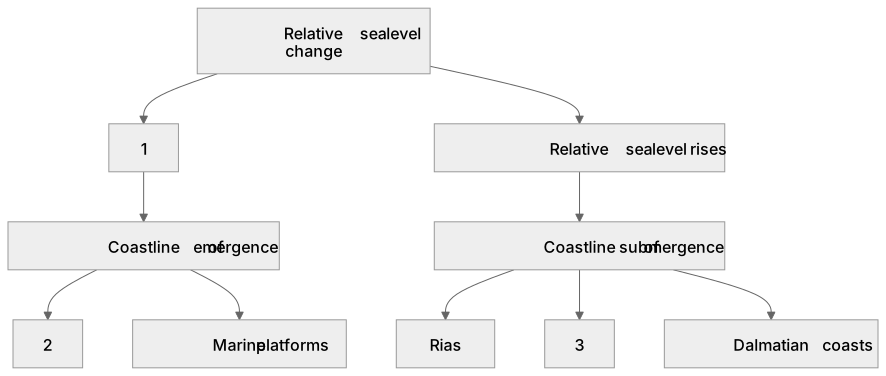
1Box 1
2Box 2
3Box 3
There is more to this lesson
The full lesson goes on to check your understanding and help you earn the marks. Create a free account to carry on, with your progress saved.
A week of Premium from your first lesson · Then the free plan continues · No card, no charge
Test your understanding of Coastal landscape development: Coastlines of emergence and submergence. Origin and development of associated landforms: raised beaches, marine platforms; rias, fjords, Dalmatian coasts.
Active recall beats re-reading. Take an instant quiz now to test what you’ve learned and lock it into long-term memory.
A week of Premium from your first lesson · Then the free plan continues · No card, no charge