AQA · A-Level · Geography
Course version: 7037 · Version from Sept 2018
Eustatic, isostatic and tectonic sea level change: major changes in sea…
Full specification wording
Coastal landscape development: Eustatic, isostatic and tectonic sea level change: major changes in sea level in the last 10,000 years.
Sea-level change occurs through eustatic, isostatic, and tectonic processes.
Checked against the AQA 7037 specification (opens in a new tab) on .
- Point 4 of 6
- 4 key terms
Study notes
From the checked teaching notes for this specification point.
The idea
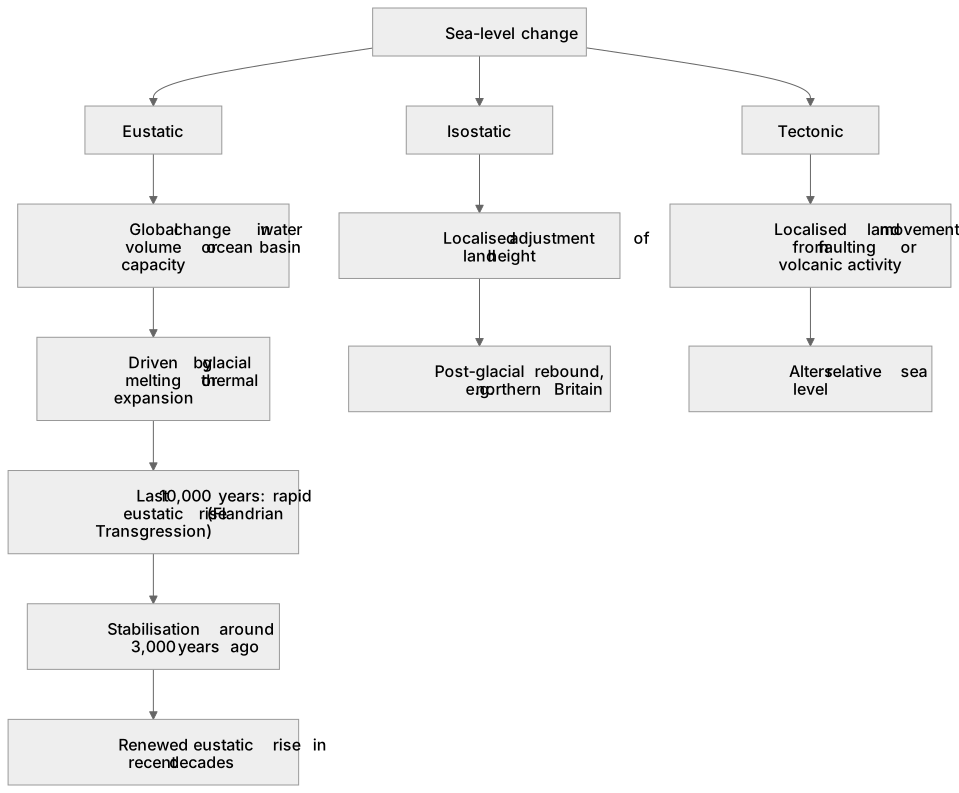
Sea-level change occurs through eustatic, isostatic, and tectonic processes. Eustatic change is a global alteration in sea volume or ocean basin capacity, often driven by glacial melting or thermal expansion. Isostatic change is a localised adjustment of land height, such as the post-glacial rebound occurring in northern Britain following the melting of Pleistocene ice sheets. Tectonic changes involve localised land movements from faulting or volcanic activity, altering relative sea levels. Over the last 10,000 years (the Holocene), global eustatic sea levels rose rapidly due to the melting of the last major ice sheets (the Flandrian Transgression), before stabilising around 3,000 years ago, though recent decades show renewed eustatic rise.
What earns the marks
- Define eustatic sea-level change as a global change in the volume of water in the oceans or the shape of ocean basins.
- Define isostatic sea-level change as a local or regional change in the level of the land relative to the sea, such as post-glacial rebound.
- Explain how tectonic activity can cause sudden, localised changes in relative sea level through land uplift or subsidence.
- Outline the major sea-level changes over the last 10,000 years, specifically the rapid eustatic rise known as the Flandrian Transgression and subsequent stabilisation.
Common mistakes and how to put them right
Confusing eustatic and isostatic changes.
Put it right: Eustatic is a global change in water volume, whereas isostatic is a local change in land level.
Stating that sea levels have risen continuously at the same rate for 10,000 years.
Put it right: The rate of rise slowed significantly and stabilised around 3,000 to 4,000 years ago before recent anthropogenic increases.
Ignoring tectonic sea-level change.
Put it right: Tectonic uplift or subsidence must be included as a distinct mechanism that alters relative sea level independently of ice melt.
Exam tips
- Use the UK as a case study to contrast isostatic rebound in the north (Scotland) with isostatic subsidence in the south (England).
- Refer to the Flandrian Transgression when discussing the rapid eustatic sea-level rise at the start of the Holocene epoch.
- Clearly distinguish between global (eustatic) and local (isostatic/tectonic) impacts on relative sea level in your answers.
Try the lesson
The start of the Coastal landscape development: Eustatic, isostatic and tectonic sea level change: major changes in sea level in the last 10,000 years. lesson, made from checked teaching notes for this specification point.
Have a go first
Which statement best describes the cause of eustatic sea level change?
Listen
Sea-level change occurs through eustatic, isostatic, and tectonic processes. Eustatic change is a global alteration in sea volume or ocean basin capacity, often driven by glacial melting or thermal expansion. Isostatic change is a localised adjustment of land height, such as the post-glacial rebound occurring in northern Britain following the melting of Pleistocene ice sheets. Tectonic changes involve localised land movements from faulting or volcanic activity, altering relative sea levels. Over the last 10,000 years (the Holocene), global eustatic sea levels rose rapidly due to the melting of the last major ice sheets (the Flandrian Transgression), before stabilising around 3,000 years ago, though recent decades show renewed eustatic rise. A strong answer earns marks for these points. Define eustatic sea-level change as a global change in the volume of water in the oceans or the shape of ocean basins. Define isostatic sea-level change as a local or regional change in the level of the land relative to the sea, such as post-glacial rebound. Explain how tectonic activity can cause sudden, localised changes in relative sea level through land uplift or subsidence. Outline the major sea-level changes over the last 10,000 years, specifically the rapid eustatic rise known as the Flandrian Transgression and subsequent stabilisation. Exam tip: Use the UK as a case study to contrast isostatic rebound in the north (Scotland) with isostatic subsidence in the south (England).
See it
Key words
Say what each word means before you turn the card.
Eustatic change
Try answering aloud or in your head before turning the card.
Isostatic change
Try answering aloud or in your head before turning the card.
Tectonic changes
Try answering aloud or in your head before turning the card.
Flandrian Transgression
Try answering aloud or in your head before turning the card.
See every definition
- Eustatic change
- A global alteration in sea volume or ocean basin capacity, often driven by glacial melting or thermal expansion.
- Isostatic change
- A localised adjustment of land height, such as the post-glacial rebound occurring in northern Britain following the melting of Pleistocene ice sheets.
- Tectonic changes
- Localised land movements from faulting or volcanic activity, altering relative sea levels.
- Flandrian Transgression
- The rapid global eustatic sea-level rise due to the melting of the last major ice sheets over the last 10,000 years.
Label the diagram
Some boxes have lost their names. Pick the right name for each number.
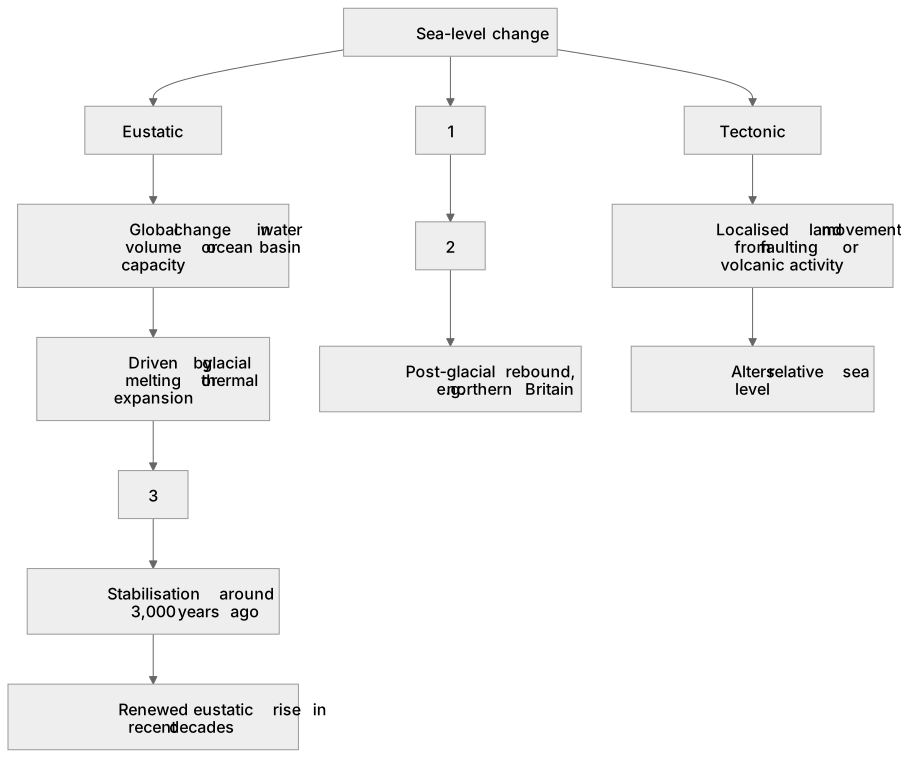
1Box 1
2Box 2
3Box 3
There is more to this lesson
The full lesson goes on to check your understanding and help you earn the marks. Create a free account to carry on, with your progress saved.
A week of Premium from your first lesson · Then the free plan continues · No card, no charge
Test your understanding of Coastal landscape development: Eustatic, isostatic and tectonic sea level change: major changes in sea level in the last 10,000 years.
Active recall beats re-reading. Take an instant quiz now to test what you’ve learned and lock it into long-term memory.
A week of Premium from your first lesson · Then the free plan continues · No card, no charge