AQA · A-Level · Geography
Course version: 7037 · Version from Sept 2018
Estuarine mudflat/saltmarsh environments and associated landscapes;…
Full specification wording
Coastal landscape development: Estuarine mudflat/saltmarsh environments and associated landscapes; factors and processes in their development.
Estuarine mudflats and saltmarshes develop in low-energy, sheltered coastal environments like the Severn Estuary.
Checked against the AQA 7037 specification (opens in a new tab) on .
- Point 3 of 6
- 4 key terms
Study notes
From the checked teaching notes for this specification point.
The idea
Estuarine mudflats and saltmarshes develop in low-energy, sheltered coastal environments like the Severn Estuary. The primary process is flocculation, where fine clay particles aggregate in saline water, becoming heavier and settling out of suspension to form mudflats. Over time, pioneer halophytes like Spartina colonise the mud, their roots stabilising the sediment and trapping further material. This initiates a halosere succession, raising the land surface and allowing less salt-tolerant plants to establish, eventually forming a mature saltmarsh landscape with associated features like tidal creeks and salt pans. Key factors influencing this development include tidal range, sediment supply, wave energy, and sea-level changes.
What earns the marks
- Explain the role of flocculation in the deposition of fine sediments in low-energy estuarine environments.
- Describe the process of plant succession (halosere) starting with pioneer species like Spartina.
- Identify how vegetation traps further sediment, raising the marsh height and altering the local environment.
- Discuss the influence of physical factors such as tidal range, sediment availability, and sheltered topography on mudflat and saltmarsh development.
Common mistakes and how to put them right
Confusing mudflats with saltmarshes.
Put it right: Mudflats are the initial unvegetated stage, whereas saltmarshes are vegetated by halophytes.
Stating that sediment is deposited solely because water stops moving.
Put it right: Deposition is significantly enhanced by the chemical process of flocculation in brackish water.
Assuming saltmarshes are static landscapes.
Put it right: They are dynamic environments constantly evolving through succession and responding to sea-level changes.
Exam tips
- Use specific examples of pioneer species, such as Spartina or Glasswort, to illustrate the biological processes of saltmarsh development.
- Clearly link the physical process of flocculation to the biological process of succession when explaining landscape evolution.
- Mention associated landscape features like tidal creeks and salt pans to demonstrate a comprehensive understanding of the environment.
Try the lesson
The start of the Coastal landscape development: Estuarine mudflat/saltmarsh environments and associated landscapes; factors and processes in their development. lesson, made from checked teaching notes for this specification point.
Have a go first
Which process is primarily responsible for the deposition of fine clay particles in an estuarine mudflat environment?
Listen
Estuarine mudflats and saltmarshes develop in low-energy, sheltered coastal environments like the Severn Estuary. The primary process is flocculation, where fine clay particles aggregate in saline water, becoming heavier and settling out of suspension to form mudflats. Over time, pioneer halophytes like Spartina colonise the mud, their roots stabilising the sediment and trapping further material. This initiates a halosere succession, raising the land surface and allowing less salt-tolerant plants to establish, eventually forming a mature saltmarsh landscape with associated features like tidal creeks and salt pans. Key factors influencing this development include tidal range, sediment supply, wave energy, and sea-level changes. A strong answer earns marks for these points. Explain the role of flocculation in the deposition of fine sediments in low-energy estuarine environments. Describe the process of plant succession (halosere) starting with pioneer species like Spartina. Identify how vegetation traps further sediment, raising the marsh height and altering the local environment. Discuss the influence of physical factors such as tidal range, sediment availability, and sheltered topography on mudflat and saltmarsh development. Exam tip: Use specific examples of pioneer species, such as Spartina or Glasswort, to illustrate the biological processes of saltmarsh development.
See it
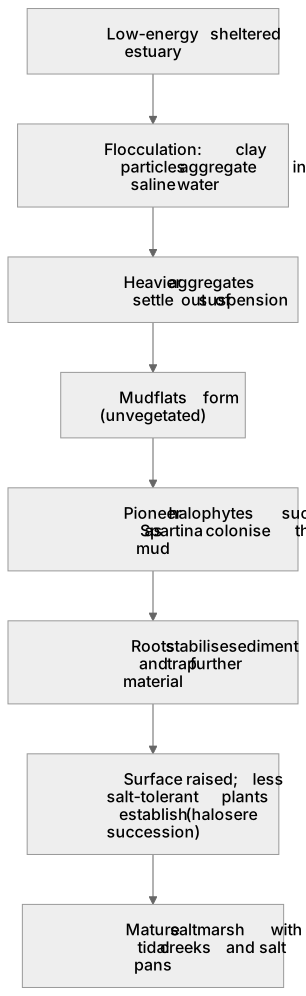
Put it in order
Put these steps in the order they happen.
- 1. Pioneer halophytes such as Spartina colonise the mud
- 2. Mature saltmarsh with tidal creeks and salt pans
- 3. Roots stabilise sediment and trap further material
- 4. Low-energy sheltered estuary
- 5. Flocculation: clay particles aggregate in saline water
- 6. Surface raised; less salt-tolerant plants establish (halosere succession)
- 7. Heavier aggregates settle out of suspension
- 8. Mudflats form (unvegetated)
Key words
Say what each word means before you turn the card.
Coastal deposition
Try answering aloud or in your head before turning the card.
Plant succession (halosere)
Try answering aloud or in your head before turning the card.
Low-energy environments
Try answering aloud or in your head before turning the card.
Geomorphological processes
Try answering aloud or in your head before turning the card.
See every definition
- Coastal deposition
- The settling out of material to form features such as mudflats, significantly enhanced by flocculation in brackish water.
- Plant succession (halosere)
- A succession initiated as pioneer halophytes colonise the mud, raising the land surface and allowing less salt-tolerant plants to establish.
- Low-energy environments
- Sheltered coastal settings, such as the Severn Estuary, in which estuarine mudflats and saltmarshes develop.
- Geomorphological processes
- The processes forming these landscapes, including flocculation, colonisation by pioneer halophytes and the trapping of further sediment.
Label the diagram
Some boxes have lost their names. Pick the right name for each number.
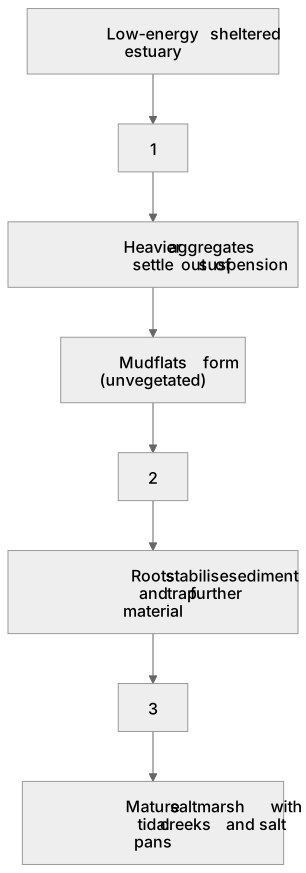
1Box 1
2Box 2
3Box 3
There is more to this lesson
The full lesson goes on to check your understanding and help you earn the marks. Create a free account to carry on, with your progress saved.
A week of Premium from your first lesson · Then the free plan continues · No card, no charge
Test your understanding of Coastal landscape development: Estuarine mudflat/saltmarsh environments and associated landscapes; factors and processes in their development.
Active recall beats re-reading. Take an instant quiz now to test what you’ve learned and lock it into long-term memory.
A week of Premium from your first lesson · Then the free plan continues · No card, no charge