AQA · A-Level · Geography
Course version: 7037 · Version from Sept 2018
Geomorphological processes: weathering, mass movement, erosion,…
Full specification wording
Coastal systems and landscapes - 3.1.3.2 Systems and processes: Geomorphological processes: weathering, mass movement, erosion, transportation and deposition.
Coastal landscapes are shaped by five key geomorphological processes.
Checked against the AQA 7037 specification (opens in a new tab) on .
- Point 3 of 4
Study notes
From the checked teaching notes for this specification point.
The idea
Coastal landscapes are shaped by five key geomorphological processes. Weathering breaks down rocks in situ through mechanical, chemical, or biological means, such as freeze-thaw action. Mass movement involves the downslope transfer of this material under gravity, seen in rotational slumping on clay cliffs. Erosion actively wears away the coastline using energy from waves, through mechanisms like hydraulic action and abrasion. The eroded material undergoes transportation via longshore drift, traction, or suspension. Finally, deposition occurs when wave energy decreases, dropping the sediment to form features like spits and beaches. Together, these interconnected processes continuously modify the coastal system.
What earns the marks
- Distinguish weathering as an in situ process from erosion, which involves the active removal of material by a moving medium like waves.
- Explain specific mass movement processes, such as rockfalls or rotational slumping, linking them to cliff lithology and moisture content.
- Detail marine erosion mechanisms, including hydraulic action, abrasion, attrition, and corrosion (solution).
- Describe the four main methods of coastal transportation: traction, saltation, suspension, and solution, alongside the overarching process of longshore drift.
- Explain that deposition occurs when the velocity and energy of the transporting agent fall below the critical threshold required to carry the sediment load.
Common mistakes and how to put them right
Confusing weathering with erosion.
Put it right: Define weathering as the breakdown of rock in situ (without movement), whereas erosion involves the wearing away and removal of rock by a moving force.
Using 'attrition' to describe waves smashing into cliffs.
Put it right: Use 'abrasion' or 'corrasion' for waves throwing rocks at cliffs, and reserve 'attrition' for rocks colliding with each other in the water.
Treating mass movement as a marine process.
Put it right: Categorise mass movement as a sub-aerial process driven by gravity, though it is often exacerbated by marine undercutting.
Exam tips
- Always link specific geomorphological processes to the formation of specific landforms, such as linking abrasion to wave-cut notches.
- Use precise terminology for transportation, ensuring you can differentiate between saltation (bouncing) and traction (rolling).
- Discuss how sub-aerial processes (weathering and mass movement) work in tandem with marine processes (erosion) to cause rapid cliff retreat.
Try the lesson
The start of the Coastal systems and landscapes - 3.1.3.2 Systems and processes: Geomorphological processes: weathering, mass movement, erosion, transportation and deposition. lesson, made from checked teaching notes for this specification point.
Have a go first
Which coastal erosion process involves the physical smashing of rocks and pebbles against the cliff face by breaking waves?
Listen
Coastal landscapes are shaped by five key geomorphological processes. Weathering breaks down rocks in situ through mechanical, chemical, or biological means, such as freeze-thaw action. Mass movement involves the downslope transfer of this material under gravity, seen in rotational slumping on clay cliffs. Erosion actively wears away the coastline using energy from waves, through mechanisms like hydraulic action and abrasion. The eroded material undergoes transportation via longshore drift, traction, or suspension. Finally, deposition occurs when wave energy decreases, dropping the sediment to form features like spits and beaches. Together, these interconnected processes continuously modify the coastal system. A strong answer earns marks for these points. Distinguish weathering as an in situ process from erosion, which involves the active removal of material by a moving medium like waves. Explain specific mass movement processes, such as rockfalls or rotational slumping, linking them to cliff lithology and moisture content. Detail marine erosion mechanisms, including hydraulic action, abrasion, attrition, and corrosion (solution). Describe the four main methods of coastal transportation: traction, saltation, suspension, and solution, alongside the overarching process of longshore drift. A common slip: Confusing weathering with erosion. Instead, Define weathering as the breakdown of rock in situ (without movement), whereas erosion involves the wearing away and removal of rock by a moving force. Exam tip: Always link specific geomorphological processes to the formation of specific landforms, such as linking abrasion to wave-cut notches.
See it
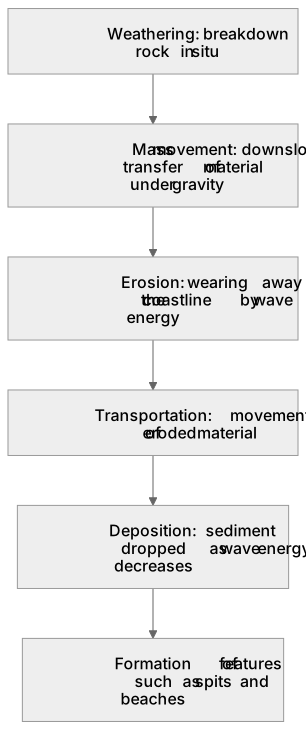
Put it in order
Put these steps in the order they happen.
- 1. Erosion: wearing away of the coastline by wave energy
- 2. Mass movement: downslope transfer of material under gravity
- 3. Weathering: breakdown of rock in situ
- 4. Formation of features such as spits and beaches
- 5. Deposition: sediment dropped as wave energy decreases
- 6. Transportation: movement of eroded material
Label the diagram
Some boxes have lost their names. Pick the right name for each number.
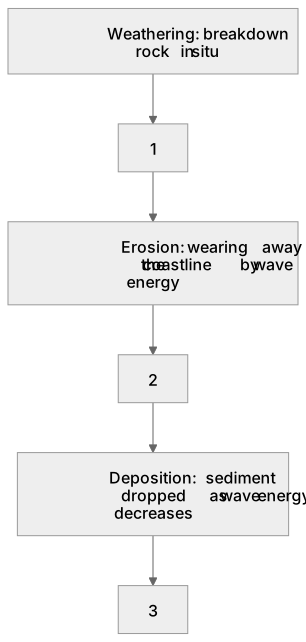
1Box 1
2Box 2
3Box 3
There is more to this lesson
The full lesson goes on to check your understanding and help you earn the marks. Create a free account to carry on, with your progress saved.
A week of Premium from your first lesson · Then the free plan continues · No card, no charge
Test your understanding of Coastal systems and landscapes - 3.1.3.2 Systems and processes: Geomorphological processes: weathering, mass movement, erosion, transportation and deposition.
Active recall beats re-reading. Take an instant quiz now to test what you’ve learned and lock it into long-term memory.
A week of Premium from your first lesson · Then the free plan continues · No card, no charge