AQA · A-Level · Geography
Course version: 7037 · Version from Sept 2018
Sediment sources, cells and budgets.
Full specification wording
Coastal systems and landscapes - 3.1.3.2 Systems and processes: Sediment sources, cells and budgets.
Coastal sediment originates from various sources, including cliff erosion, fluvial discharge, and offshore deposits.
Checked against the AQA 7037 specification (opens in a new tab) on .
- Point 2 of 4
- 4 key terms
Study notes
From the checked teaching notes for this specification point.
The idea
Coastal sediment originates from various sources, including cliff erosion, fluvial discharge, and offshore deposits. This material moves within sediment cells, which are largely self-contained stretches of coastline where sediment circulates, such as the Flamborough Head to Spurn Point cell. Within these cells, a sediment budget represents the balance between sediment inputs (sources) and outputs (sinks). If inputs exceed outputs, a positive budget creates a surplus, leading to coastal accretion and the formation of depositional landforms like beaches. Conversely, a negative budget causes a deficit, resulting in coastal retreat and erosion. Understanding these interconnected components is vital for effective shoreline management.
What earns the marks
- Identify primary sediment sources, distinguishing between terrestrial (rivers, cliff erosion) and marine (offshore bars) inputs.
- Explain the concept of a sediment cell as a closed system with distinct boundaries, typically defined by major headlands or estuaries.
- Calculate or interpret a sediment budget by comparing the volume of sediment inputs against outputs, often measured in m³ per year.
- Link a positive sediment budget to coastal accretion and a negative budget to coastal erosion and shoreline retreat.
Common mistakes and how to put them right
Confusing sediment cells with open systems.
Put it right: Describe sediment cells as largely closed systems, though acknowledge that fine sediment can occasionally bypass boundaries.
Assuming cliff erosion is the largest sediment source globally.
Put it right: State that fluvial (river) input is typically the most significant source of coastal sediment worldwide.
Using the terms 'source' and 'sink' interchangeably.
Put it right: Use 'source' for sediment inputs (e.g., eroding cliffs) and 'sink' for permanent depositional outputs (e.g., deep offshore waters).
Exam tips
- Use a named example of a sediment cell, such as the Holderness Coast (Flamborough Head to Spurn Point), to contextualise your answers.
- When discussing sediment budgets, explicitly use the terms 'positive budget' (surplus) and 'negative budget' (deficit) to demonstrate geographical terminology.
- Evaluate how human interventions, like dam construction on rivers, can disrupt sediment budgets by reducing fluvial inputs.
Try the lesson
The start of the Coastal systems and landscapes - 3.1.3.2 Systems and processes: Sediment sources, cells and budgets. lesson, made from checked teaching notes for this specification point.
Have a go first
Which of the following best describes a coastal sediment cell?
Listen
Coastal sediment originates from various sources, including cliff erosion, fluvial discharge, and offshore deposits. This material moves within sediment cells, which are largely self-contained stretches of coastline where sediment circulates, such as the Flamborough Head to Spurn Point cell. Within these cells, a sediment budget represents the balance between sediment inputs (sources) and outputs (sinks). If inputs exceed outputs, a positive budget creates a surplus, leading to coastal accretion and the formation of depositional landforms like beaches. Conversely, a negative budget causes a deficit, resulting in coastal retreat and erosion. Understanding these interconnected components is vital for effective shoreline management. A strong answer earns marks for these points. Identify primary sediment sources, distinguishing between terrestrial (rivers, cliff erosion) and marine (offshore bars) inputs. Explain the concept of a sediment cell as a closed system with distinct boundaries, typically defined by major headlands or estuaries. Calculate or interpret a sediment budget by comparing the volume of sediment inputs against outputs, often measured in m³ per year. Link a positive sediment budget to coastal accretion and a negative budget to coastal erosion and shoreline retreat. A common slip: Confusing sediment cells with open systems. Instead, Describe sediment cells as largely closed systems, though acknowledge that fine sediment can occasionally bypass boundaries. Exam tip: Use a named example of a sediment cell, such as the Holderness Coast (Flamborough Head to Spurn Point), to contextualise your answers.
See it
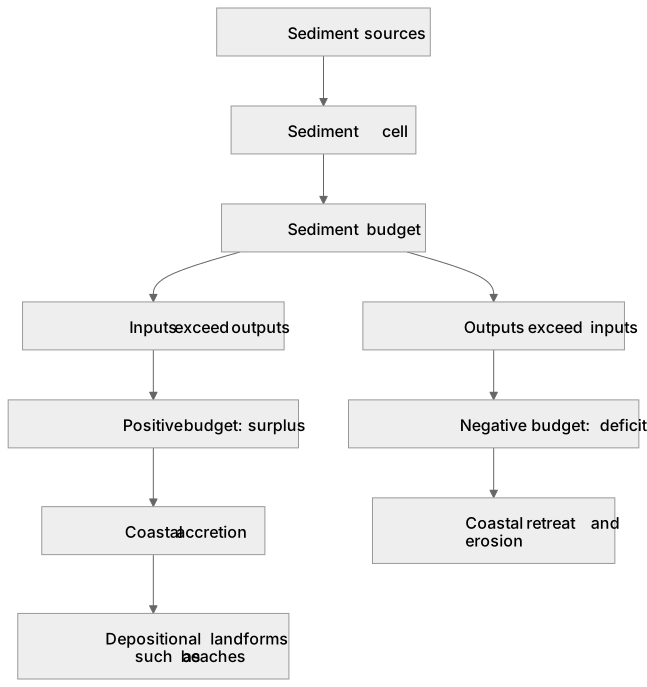
Key words
Say what each word means before you turn the card.
Sediment cell
Try answering aloud or in your head before turning the card.
Sediment budget
Try answering aloud or in your head before turning the card.
Positive budget
Try answering aloud or in your head before turning the card.
Negative budget
Try answering aloud or in your head before turning the card.
See every definition
- Sediment cell
- A largely self-contained stretch of coastline where sediment circulates, with distinct boundaries typically defined by major headlands or estuaries.
- Sediment budget
- The balance between sediment inputs (sources) and outputs (sinks) within a sediment cell.
- Positive budget
- A surplus created when inputs exceed outputs, leading to coastal accretion and the formation of depositional landforms like beaches.
- Negative budget
- A deficit caused when outputs exceed inputs, resulting in coastal retreat and erosion.
Label the diagram
Some boxes have lost their names. Pick the right name for each number.
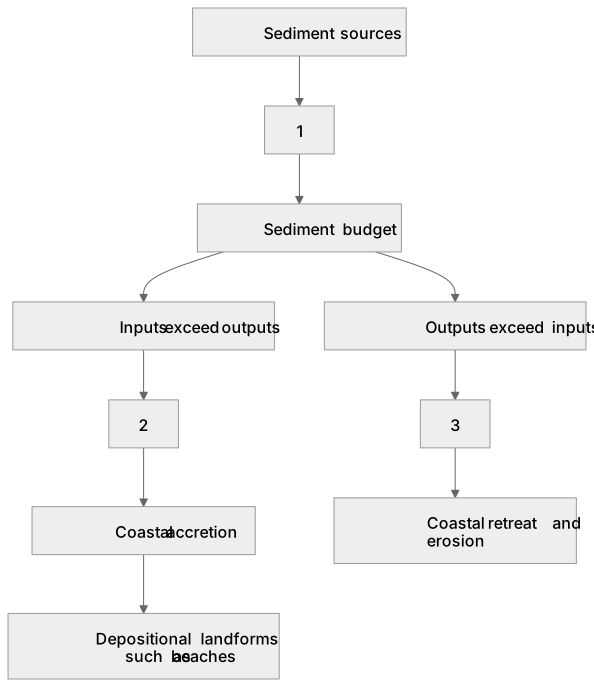
1Box 1
2Box 2
3Box 3
There is more to this lesson
The full lesson goes on to check your understanding and help you earn the marks. Create a free account to carry on, with your progress saved.
A week of Premium from your first lesson · Then the free plan continues · No card, no charge
Test your understanding of Coastal systems and landscapes - 3.1.3.2 Systems and processes: Sediment sources, cells and budgets.
Active recall beats re-reading. Take an instant quiz now to test what you’ve learned and lock it into long-term memory.
A week of Premium from your first lesson · Then the free plan continues · No card, no charge