AQA · A-Level · Geography
Course version: 7037 · Version from Sept 2018
Sources of energy in coastal environments: winds, waves (constructive and…
Full specification wording
Coastal systems and landscapes - 3.1.3.2 Systems and processes: Sources of energy in coastal environments: winds, waves (constructive and destructive), currents and tides. Low energy and high energy coasts.
Coastal systems are driven by multiple energy sources.
Checked against the AQA 7037 specification (opens in a new tab) on .
- Point 1 of 4
- 4 key terms
Study notes
From the checked teaching notes for this specification point.
The idea
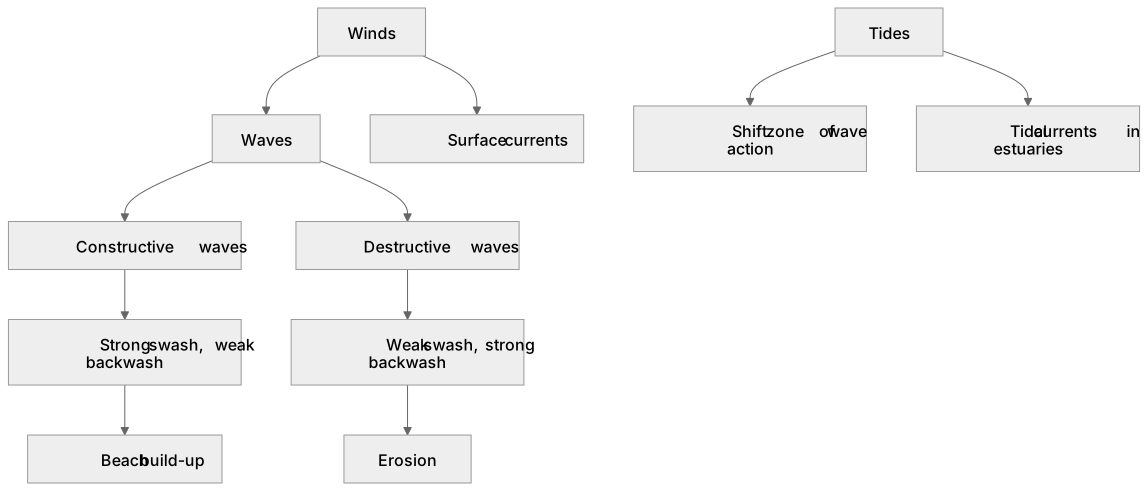
Coastal systems are driven by multiple energy sources. Winds generate waves and drive surface currents, with fetch determining wave energy. Constructive waves have a strong swash and weak backwash, building up beaches, whereas destructive waves possess a weak swash and strong backwash, eroding material. Tides, driven by gravitational pull, dictate the range of wave action and generate tidal currents in estuaries. High energy coasts, like Cornwall, face strong prevailing winds and long fetches, resulting in destructive waves and erosional landforms such as cliffs. Conversely, low energy coasts, like the Baltic Sea, experience limited fetch and gentle winds, dominated by constructive waves and depositional features like spits and mudflats.
What earns the marks
- Identify wind as the primary energy source that generates waves and influences their magnitude through fetch, duration, and velocity.
- Contrast constructive waves (low frequency, strong swash, net deposition) with destructive waves (high frequency, strong backwash, net erosion).
- Explain the role of tides in shifting the zone of wave action and generating tidal currents that transport sediment, particularly in estuaries.
- Characterise high energy coasts by their exposure to strong prevailing winds, long fetches, and dominant erosional processes and landforms.
- Characterise low energy coasts by their sheltered locations, short fetches, and dominant depositional processes and landforms.
Common mistakes and how to put them right
Stating that constructive waves have a strong backwash.
Put it right: Constructive waves have a strong swash and weak backwash, leading to sediment deposition.
Confusing currents and tides.
Put it right: Tides are vertical movements of water driven by gravity, while currents are horizontal movements of water driven by wind, temperature, or tidal flows.
Assuming high energy coasts only experience erosion.
Put it right: While erosion dominates high energy coasts, deposition still occurs in sheltered bays or during calmer seasonal conditions.
Exam tips
- Link wave types directly to beach profiles, explaining how destructive waves create steep, combed-down winter profiles.
- Use specific geographical examples to contrast high energy (e.g., Atlantic coast of Scotland) and low energy (e.g., Lincolnshire coast) environments.
- When discussing energy sources, explicitly mention how wind fetch and duration control the kinetic energy transferred to waves.
Try the lesson
The start of the Coastal systems and landscapes - 3.1.3.2 Systems and processes: Sources of energy in coastal environments: winds, waves (constructive and destructive), currents and tides. Low energy and high energy coasts. lesson, made from checked teaching notes for this specification point.
Have a go first
Which combination of characteristics is typical of destructive waves in a coastal environment?
Listen
Coastal systems are driven by multiple energy sources. Winds generate waves and drive surface currents, with fetch determining wave energy. Constructive waves have a strong swash and weak backwash, building up beaches, whereas destructive waves possess a weak swash and strong backwash, eroding material. Tides, driven by gravitational pull, dictate the range of wave action and generate tidal currents in estuaries. High energy coasts, like Cornwall, face strong prevailing winds and long fetches, resulting in destructive waves and erosional landforms such as cliffs. Conversely, low energy coasts, like the Baltic Sea, experience limited fetch and gentle winds, dominated by constructive waves and depositional features like spits and mudflats. A strong answer earns marks for these points. Identify wind as the primary energy source that generates waves and influences their magnitude through fetch, duration, and velocity. Contrast constructive waves (low frequency, strong swash, net deposition) with destructive waves (high frequency, strong backwash, net erosion). Explain the role of tides in shifting the zone of wave action and generating tidal currents that transport sediment, particularly in estuaries. Characterise high energy coasts by their exposure to strong prevailing winds, long fetches, and dominant erosional processes and landforms. A common slip: Stating that constructive waves have a strong backwash. Instead, constructive waves have a strong swash and weak backwash, leading to sediment deposition. Exam tip: Link wave types directly to beach profiles, explaining how destructive waves create steep, combed-down winter profiles.
See it
Key words
Say what each word means before you turn the card.
Constructive waves
Try answering aloud or in your head before turning the card.
Destructive waves
Try answering aloud or in your head before turning the card.
Tides
Try answering aloud or in your head before turning the card.
Fetch
Try answering aloud or in your head before turning the card.
See every definition
- Constructive waves
- Waves with a strong swash and weak backwash, building up beaches.
- Destructive waves
- Waves with a weak swash and strong backwash, eroding material.
- Tides
- Movements driven by gravitational pull that dictate the range of wave action and generate tidal currents in estuaries.
- Fetch
- A factor determining wave energy, alongside duration and velocity, in generating waves from wind.
Label the diagram
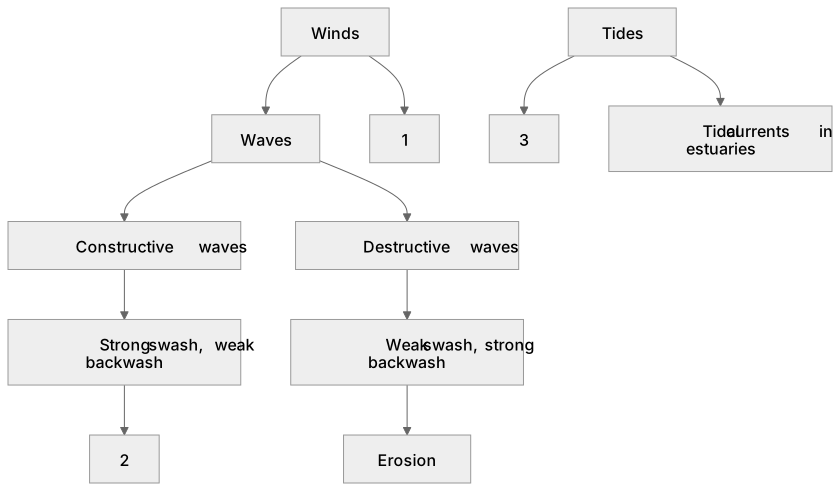
Some boxes have lost their names. Pick the right name for each number.
1Box 1
2Box 2
3Box 3
There is more to this lesson
The full lesson goes on to check your understanding and help you earn the marks. Create a free account to carry on, with your progress saved.
A week of Premium from your first lesson · Then the free plan continues · No card, no charge
Test your understanding of Coastal systems and landscapes - 3.1.3.2 Systems and processes: Sources of energy in coastal environments: winds, waves (constructive and destructive), currents and tides. Low energy and high energy coasts.
Active recall beats re-reading. Take an instant quiz now to test what you’ve learned and lock it into long-term memory.
A week of Premium from your first lesson · Then the free plan continues · No card, no charge