AQA · A-Level · Geography
Course version: 7037 · Version from Sept 2018
Core skills: Questionnaire and interview techniques.
Questionnaires and interviews are primary data collection techniques used to investigate human geography topics, such as perceptions of place.
Checked against the AQA 7037 specification (opens in a new tab) on .
- Point 4 of 4
- 4 key terms
Study notes
From the checked teaching notes for this specification point.
The idea
Questionnaires and interviews are primary data collection techniques used to investigate human geography topics, such as perceptions of place. Questionnaires typically use closed questions with Likert scales to generate quantitative data that can be easily graphed and statistically analysed. In contrast, interviews employ open-ended questions in a structured or semi-structured format to gather rich, qualitative insights into personal experiences. Effective technique requires careful sampling design to avoid bias, ensuring participants represent the target population.
What earns the marks
- Design effective questionnaires using a mix of open and closed questions to gather both qualitative and quantitative primary data.
- Select appropriate interview techniques, such as structured, semi-structured, or unstructured, based on the research aims and required depth of qualitative data.
- Apply appropriate sampling strategies, such as random, systematic, or stratified, to select participants and minimise researcher bias.
- Evaluate the limitations of self-reported data, including subjectivity, low response rates, and the potential for leading questions.
Common mistakes and how to put them right
Confusing questionnaires with interviews.
Put it right: Questionnaires are typically written surveys completed by respondents, whereas interviews involve direct verbal questioning by the researcher.
Using leading questions that bias the results.
Put it right: Ensure questions are phrased neutrally rather than suggesting a preferred answer.
Failing to justify the sampling method.
Put it right: Explain why a specific sampling strategy was chosen to ensure a representative sample of the population.
Exam tips
- When evaluating your own fieldwork, explicitly mention how you addressed ethical considerations such as informed consent and data confidentiality.
- Critique the design of provided questionnaires by identifying double-barrelled questions or overlapping age categories in tick boxes.
- Link the choice of interview technique directly to the geographical enquiry question, explaining why qualitative depth was necessary.
Try the lesson
The start of the Core skills: Questionnaire and interview techniques. lesson, made from checked teaching notes for this specification point.
Have a go first
What is the primary methodological advantage of using closed questions rather than open questions in a geographical questionnaire?
Listen
Questionnaires and interviews are primary data collection techniques used to investigate human geography topics, such as perceptions of place. Questionnaires typically use closed questions with Likert scales to generate quantitative data that can be easily graphed and statistically analysed. In contrast, interviews employ open-ended questions in a structured or semi-structured format to gather rich, qualitative insights into personal experiences. Effective technique requires careful sampling design to avoid bias, ensuring participants represent the target population. A strong answer earns marks for these points. Design effective questionnaires using a mix of open and closed questions to gather both qualitative and quantitative primary data. Select appropriate interview techniques, such as structured, semi-structured, or unstructured, based on the research aims and required depth of qualitative data. Apply appropriate sampling strategies, such as random, systematic, or stratified, to select participants and minimise researcher bias. Evaluate the limitations of self-reported data, including subjectivity, low response rates, and the potential for leading questions. Exam tip: When evaluating your own fieldwork, explicitly mention how you addressed ethical considerations such as informed consent and data confidentiality.
See it
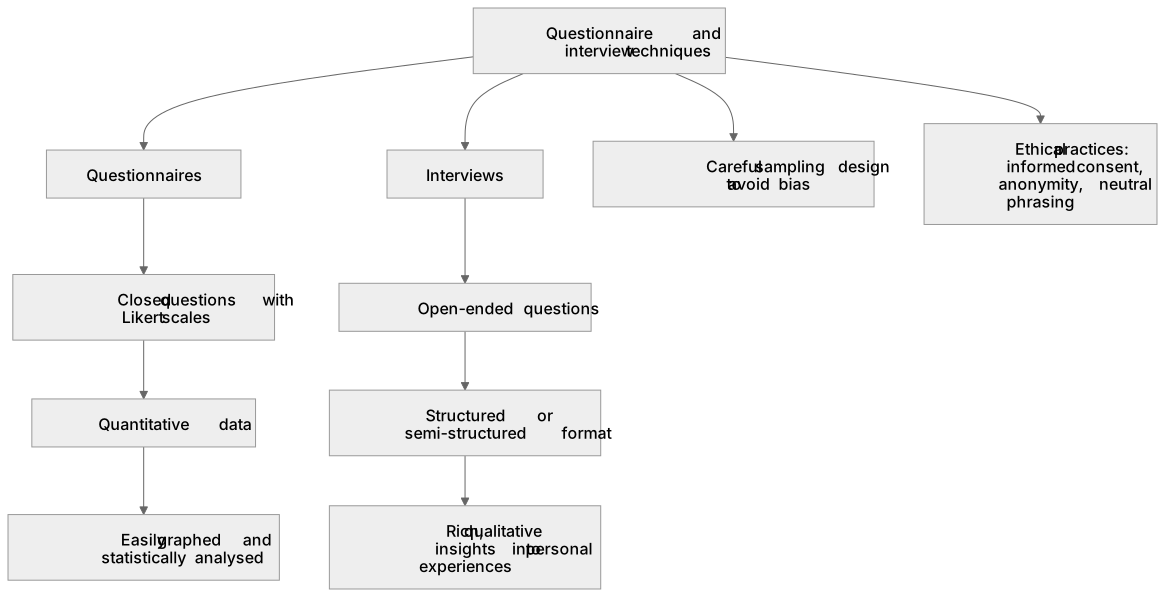
Key words
Say what each word means before you turn the card.
Primary data collection
Try answering aloud or in your head before turning the card.
Qualitative methods
Try answering aloud or in your head before turning the card.
Sampling strategies
Try answering aloud or in your head before turning the card.
Fieldwork ethics
Try answering aloud or in your head before turning the card.
See every definition
- Primary data collection
- Techniques such as questionnaires and interviews used to investigate human geography topics, such as perceptions of place.
- Qualitative methods
- Interviews employ open-ended questions in a structured or semi-structured format to gather rich insights into personal experiences.
- Sampling strategies
- Careful sampling design is required to avoid bias, ensuring participants represent the target population.
- Fieldwork ethics
- Ethical practices include obtaining informed consent, ensuring anonymity, and phrasing questions neutrally to avoid leading the respondent.
Label the diagram
Some boxes have lost their names. Pick the right name for each number.
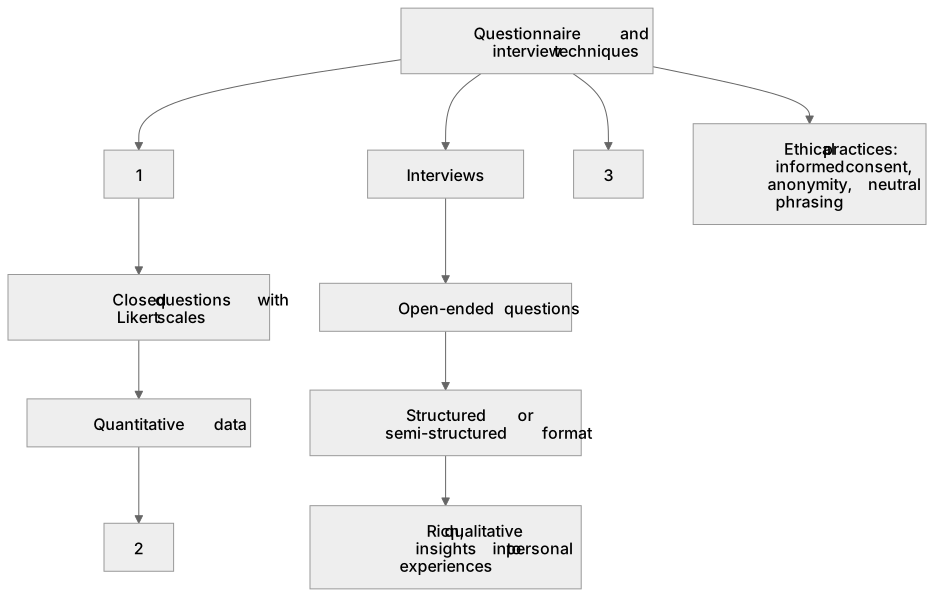
1Box 1
2Box 2
3Box 3
There is more to this lesson
The full lesson goes on to check your understanding and help you earn the marks. Create a free account to carry on, with your progress saved.
A week of Premium from your first lesson · Then the free plan continues · No card, no charge
Test your understanding of Core skills: Questionnaire and interview techniques.
Active recall beats re-reading. Take an instant quiz now to test what you’ve learned and lock it into long-term memory.
A week of Premium from your first lesson · Then the free plan continues · No card, no charge