AQA · A-Level · Geography
Course version: 7037 · Version from Sept 2018
Core skills: Numeracy – use of number, measure and measurement.
Numeracy in geography requires the accurate application of numbers, measures, and measurement techniques to quantify spatial and temporal patterns.
Checked against the AQA 7037 specification (opens in a new tab) on .
- Point 3 of 4
- 3 key terms
Study notes
From the checked teaching notes for this specification point.
The idea
Numeracy in geography requires the accurate application of numbers, measures, and measurement techniques to quantify spatial and temporal patterns. Using numbers involves calculating statistics, percentages, and rates of change, such as determining the percentage increase in urban populations. Measure and measurement require selecting appropriate units and tools to collect or interpret data.
For example: Calculating river discharge requires measuring width and depth in metres to find the cross-sectional area in square metres (m²), then multiplying by velocity to yield discharge in cubic metres per second (m³ s⁻¹).
What earns the marks
- Accurately calculate percentages, fractions, and rates of change from geographical data sets.
- Select and use appropriate units of measurement for physical and human variables, such as m³ s⁻¹ for discharge or people per km² for population density.
- Convert accurately between different units of measurement, such as scaling distances from maps or converting mm to m.
- Express calculated results to an appropriate number of significant figures or decimal places, matching the precision of the raw data.
Common mistakes and how to put them right
Failing to convert units before performing calculations.
Put it right: Ensure all measurements are in the same unit, such as converting cm to m, before calculating area or volume.
Providing answers to too many decimal places.
Put it right: Round final answers to the same number of significant figures as the least precise piece of raw data provided.
Miscalculating percentage change by dividing by the new value.
Put it right: Divide the absolute change by the original value and multiply by 100.
Exam tips
- Always write down the formula and show your working out, as method marks are often awarded even if the final answer is incorrect.
- Check that the units in your final answer match the units requested in the question prompt.
- When measuring distances on a map, carefully check the scale and convert your ruler measurement accurately into real-world kilometres.
Try the lesson
The start of the Core skills: Numeracy – use of number, measure and measurement. lesson, made from checked teaching notes for this specification point.
Have a go first
A geography student measures the cross-sectional area of a river as 2.5 m² and the mean velocity as 0.4 m/s. What is the river's discharge?
Listen
Numeracy in geography requires the accurate application of numbers, measures, and measurement techniques to quantify spatial and temporal patterns. Using numbers involves calculating statistics, percentages, and rates of change, such as determining the percentage increase in urban populations. Measure and measurement require selecting appropriate units and tools to collect or interpret data. For example, calculating river discharge requires measuring width and depth in metres to find the cross-sectional area in square metres (m²), then multiplying by velocity to yield discharge in cubic metres per second (m³ s⁻¹). A strong answer earns marks for these points. Accurately calculate percentages, fractions, and rates of change from geographical data sets. Select and use appropriate units of measurement for physical and human variables, such as m³ s⁻¹ for discharge or people per km² for population density. Convert accurately between different units of measurement, such as scaling distances from maps or converting mm to m. Express calculated results to an appropriate number of significant figures or decimal places, matching the precision of the raw data. Exam tip: Always write down the formula and show your working out, as method marks are often awarded even if the final answer is incorrect.
See it
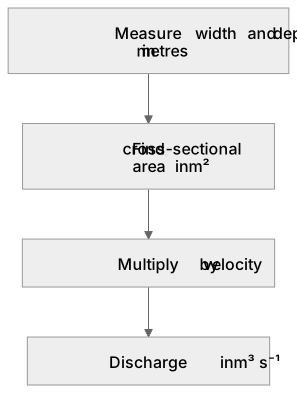
Put it in order
Put these steps in the order they happen.
- 1. Multiply by velocity
- 2. Discharge in m³ s⁻¹
- 3. Find cross-sectional area in m²
- 4. Measure width and depth in metres
Key words
Say what each word means before you turn the card.
Numeracy
Try answering aloud or in your head before turning the card.
Measure and measurement
Try answering aloud or in your head before turning the card.
Significant figures
Try answering aloud or in your head before turning the card.
See every definition
- Numeracy
- The use of number, measure and measurement.
- Measure and measurement
- Selecting appropriate units and tools to collect or interpret data.
- Significant figures
- A way of presenting final calculated values, applied appropriately alongside conversion between units.
Label the diagram
Some boxes have lost their names. Pick the right name for each number.
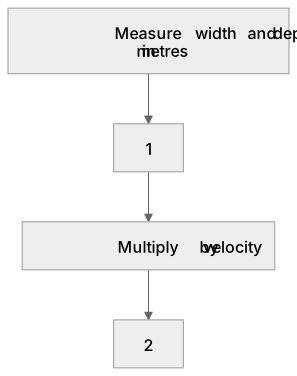
1Box 1
2Box 2
There is more to this lesson
The full lesson goes on to check your understanding and help you earn the marks. Create a free account to carry on, with your progress saved.
A week of Premium from your first lesson · Then the free plan continues · No card, no charge
Test your understanding of Core skills: Numeracy – use of number, measure and measurement.
Active recall beats re-reading. Take an instant quiz now to test what you’ve learned and lock it into long-term memory.
A week of Premium from your first lesson · Then the free plan continues · No card, no charge