AQA · A-Level · Geography
Course version: 7037 · Version from Sept 2018
Characteristics of hot desert environments and their margins: climate,…
Full specification wording
Deserts as natural systems: Characteristics of hot desert environments and their margins: climate, soils and vegetation (and their interaction). Water balance and aridity index.
Hot deserts feature extreme climates with high diurnal temperature ranges and annual precipitation below 250 mm.
Checked against the AQA 7037 specification (opens in a new tab) on .
- Point 3 of 4
- 4 key terms
Study notes
From the checked teaching notes for this specification point.
The idea
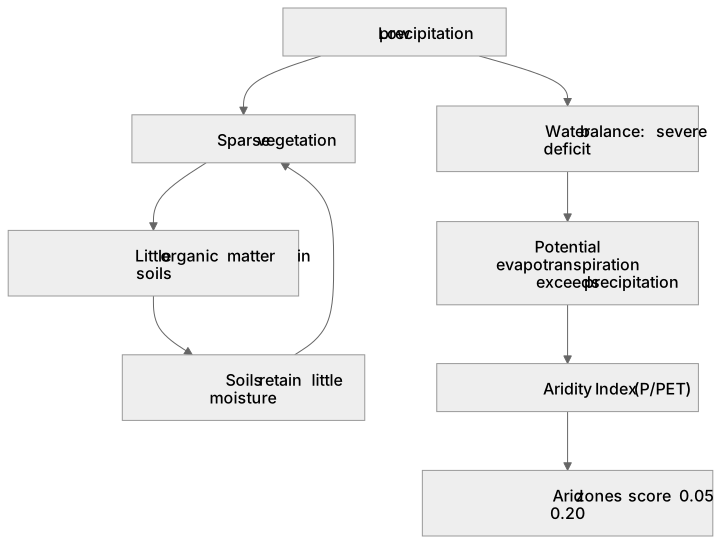
Hot deserts feature extreme climates with high diurnal temperature ranges and annual precipitation below 250 mm. Their margins experience slightly higher, yet variable, rainfall. Soils (aridisols) are typically saline, alkaline, and lack organic matter due to sparse vegetation. Vegetation adapts through xerophytic or ephemeral traits, like the deep taproots of the mesquite tree. These elements interact closely: sparse vegetation provides little organic matter to soils, which then retain little moisture, further limiting plant growth. The water balance shows a severe deficit, as potential evapotranspiration vastly exceeds precipitation. The Aridity Index (P/PET) quantifies this, with arid zones scoring between 0.05 and 0.20.
What earns the marks
- Describe the climate of hot deserts, focusing on low precipitation (under 250 mm per year) and high diurnal temperature ranges.
- Explain the characteristics of desert soils (aridisols), including high salinity, alkalinity, and low humus content.
- Detail vegetation adaptations (xerophytes, phreatophytes, ephemerals) and how they interact with soil and climate.
- Calculate or interpret the Aridity Index (Precipitation divided by Potential Evapotranspiration) to classify arid and semi-arid environments.
- Analyse the water balance in hot deserts, highlighting the continuous soil moisture deficit where potential evapotranspiration exceeds precipitation.
Common mistakes and how to put them right
Treating climate, soils, and vegetation as isolated factors.
Put it right: Explicitly discuss their interactions, such as how low rainfall leads to low biomass, resulting in nutrient-poor soils.
Confusing the Aridity Index formula.
Put it right: The Aridity Index is Precipitation (P) divided by Potential Evapotranspiration (PET), not the other way around.
Stating that desert soils are completely infertile.
Put it right: Desert soils often contain abundant mineral nutrients but lack the moisture and organic matter required to support dense plant life.
Exam tips
- Use the Aridity Index formula (P/PET) to quantitatively distinguish between hyper-arid, arid, and semi-arid margins in data response questions.
- When discussing interactions, use a systems approach to show how a change in climate (e.g., prolonged drought) impacts both soil salinity and vegetation survival.
- Memorise specific plant adaptations, such as the waxy cuticles of succulents or the extensive root systems of phreatophytes, to illustrate vegetation-climate interactions.
Try the lesson
The start of the Deserts as natural systems: Characteristics of hot desert environments and their margins: climate, soils and vegetation (and their interaction). Water balance and aridity index. lesson, made from checked teaching notes for this specification point.
Have a go first
How is the Aridity Index (AI) of a desert environment calculated?
Listen
Hot deserts feature extreme climates with high diurnal temperature ranges and annual precipitation below 250 mm. Their margins experience slightly higher, yet variable, rainfall. Soils (aridisols) are typically saline, alkaline, and lack organic matter due to sparse vegetation. Vegetation adapts through xerophytic or ephemeral traits, like the deep taproots of the mesquite tree. These elements interact closely: sparse vegetation provides little organic matter to soils, which then retain little moisture, further limiting plant growth. The water balance shows a severe deficit, as potential evapotranspiration vastly exceeds precipitation. The Aridity Index (P/PET) quantifies this, with arid zones scoring between 0.05 and 0.20. A strong answer earns marks for these points. Describe the climate of hot deserts, focusing on low precipitation (under 250 mm per year) and high diurnal temperature ranges. Explain the characteristics of desert soils (aridisols), including high salinity, alkalinity, and low humus content. Detail vegetation adaptations (xerophytes, phreatophytes, ephemerals) and how they interact with soil and climate. Calculate or interpret the Aridity Index (Precipitation divided by Potential Evapotranspiration) to classify arid and semi-arid environments. A common slip: Treating climate, soils, and vegetation as isolated factors. Instead, Explicitly discuss their interactions, such as how low rainfall leads to low biomass, resulting in nutrient-poor soils. Exam tip: Use the Aridity Index formula (P/PET) to quantitatively distinguish between hyper-arid, arid, and semi-arid margins in data response questions.
See it
Key words
Say what each word means before you turn the card.
Water balance
Try answering aloud or in your head before turning the card.
Aridity Index
Try answering aloud or in your head before turning the card.
Adaptation
Try answering aloud or in your head before turning the card.
Ecosystem interactions
Try answering aloud or in your head before turning the card.
See every definition
- Water balance
- A severe deficit occurs because potential evapotranspiration vastly exceeds precipitation.
- Aridity Index
- Precipitation divided by potential evapotranspiration, quantifying aridity, with arid zones scoring between 0.05 and 0.20.
- Adaptation
- Vegetation adapts through xerophytic or ephemeral traits, like the deep taproots of the mesquite tree.
- Ecosystem interactions
- Sparse vegetation provides little organic matter to soils, which then retain little moisture, further limiting plant growth.
Label the diagram
Some boxes have lost their names. Pick the right name for each number.
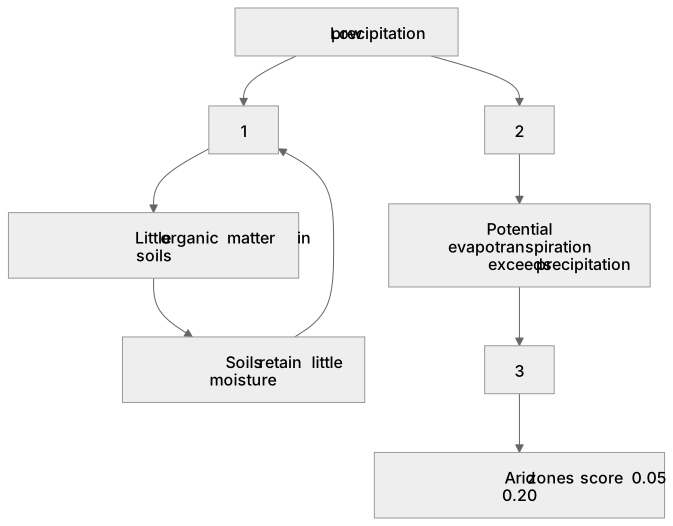
1Box 1
2Box 2
3Box 3
There is more to this lesson
The full lesson goes on to check your understanding and help you earn the marks. Create a free account to carry on, with your progress saved.
A week of Premium from your first lesson · Then the free plan continues · No card, no charge
Test your understanding of Deserts as natural systems: Characteristics of hot desert environments and their margins: climate, soils and vegetation (and their interaction). Water balance and aridity index.
Active recall beats re-reading. Take an instant quiz now to test what you’ve learned and lock it into long-term memory.
A week of Premium from your first lesson · Then the free plan continues · No card, no charge